
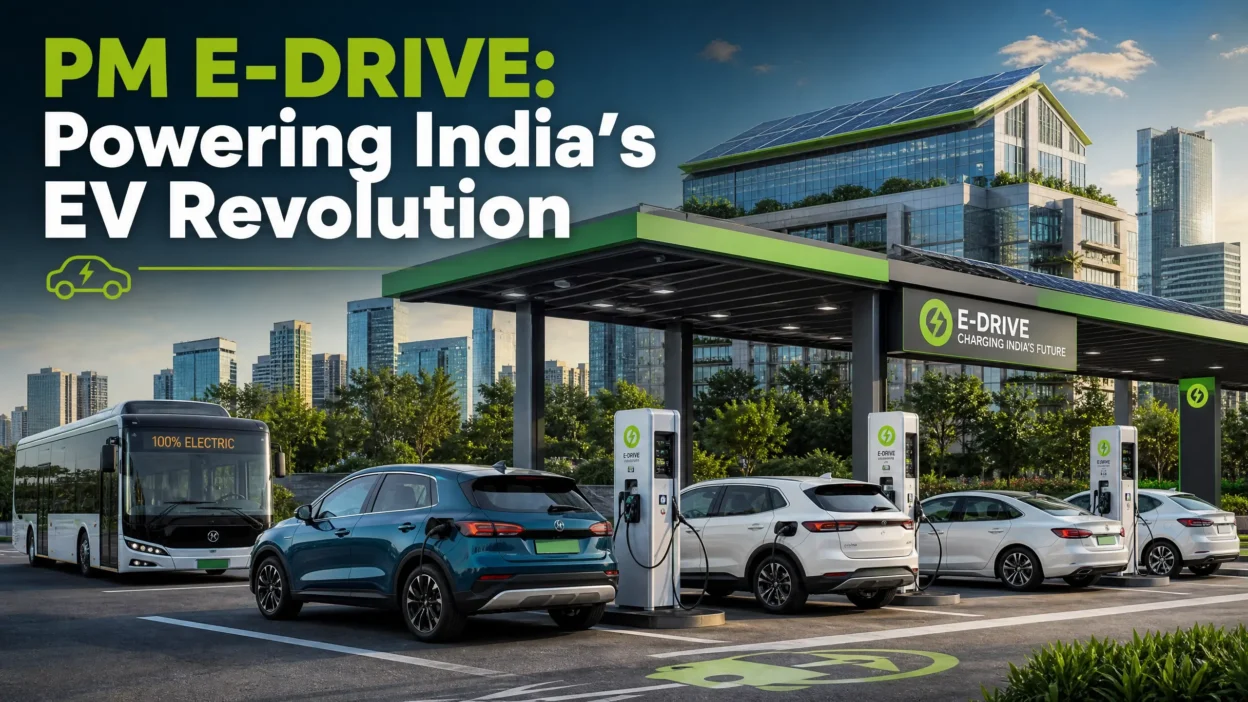
The transition to clean mobility in India is no longer a distant goal—it is unfolding on our roads right now. As electric vehicles (EVs) shift from a niche preference to a mainstream choice, the demand for accessible, high-speed charging infrastructure has reached an all-time high. Recognizing that a robust network of chargers is the backbone of sustainable transportation, the Government of India launched a transformative initiative: the PM Electric Drive Revolution in Innovative Vehicle Enhancement (PM E-DRIVE) Scheme.
For entrepreneurs, landowners, fleet operators, and public sector undertakings (PSUs), this policy shift represents one of the most lucrative green business opportunities of the decade. Backed by a massive budgetary allocation, the PM E-Drive subsidy for public charging station installations is specifically designed to eliminate the steep upfront costs traditionally associated with setting up Electric Vehicle Supply Equipment (EVSE).
Whether you are a private landowner looking to monetize a vacant plot through public-private partnerships, a startup eager to establish a foothold as a Charge Point Operator (CPO), or a government agency tasked with upgrading public amenities, this comprehensive guide will break down everything you need to know. From navigating the intricate under-the-meter infrastructure funding to understanding power ratings, location tiers, and step-by-step application rules, here is your definitive blueprint for tapping into the PM E-DRIVE ecosystem.
PM E-DRIVE Scheme
Announced by the Ministry of Heavy Industries (MHI), the PM E-DRIVE scheme formally replaced the earlier FAME II framework, bringing a renewed, hyper-focused strategy to India’s electric mobility landscape.While the scheme heavily incentivizes the adoption of electric two-wheelers, three-wheelers, e-buses, and commercial heavy vehicles, the government understands that consumers will not switch to electric unless they see visible, reliable charging stations along their daily commutes and travel corridors.
Budgetary Outlay and Scope
The PM E-DRIVE scheme operates with a total financial footprint of ₹10,900 crore. To ensure that infrastructure keeps pace with vehicle manufacturing, a dedicated slice of ₹2,000 crore has been explicitly carved out for setting up public EV charging infrastructure.This targeted fund covers not only standard public charging stations (EV PCS) but also extends support to innovative systems like Battery Swapping Stations (BSS) and specialized Battery Charging Stations (BCS).
Timeline and Scale
- Effective Duration: The core implementation window kicked off on October 1, 2024, and runs through March 31, 2026.
- Extensions: To accommodate long-term infrastructure deployments and ensure a sustained rollout, specific components of the charging infrastructure support have been extended until March 31, 2028.
- National Deployment Target: The overarching goal of the scheme is to deploy a massive network of 72,300 public charging stations across the length and breadth of the country. This target includes roughly 22,100 fast chargers dedicated to four-wheelers, 48,400 rapid charging points tailored for agile two- and three-wheelers, and 1,800 ultra-high-power fast chargers built specifically to sustain electric public transit buses.
What the PM E-DRIVE Scheme Offers for Charging Infrastructure
Historically, the biggest barrier for anyone looking to set up an EV charging station was the prohibitive cost of electrical backend upgrades. Connecting a high-capacity commercial fast charger to the local grid isn’t as simple as plugging in a home appliance; it requires dedicated transformers, heavy-duty distribution cables, and extensive civil works.
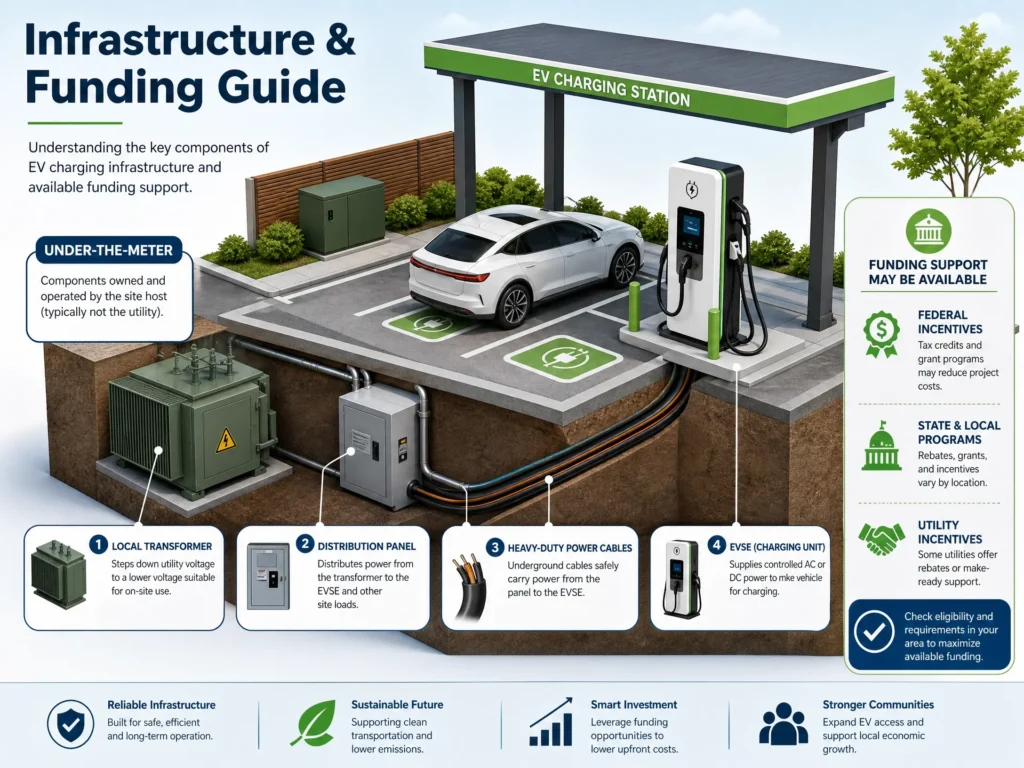
The PM E-DRIVE scheme directly addresses this financial headache by restructuring how public subsidies are awarded.
┌────────────────────────────────────────────────────────┐
│               TOTAL PUBLIC EVSE PROJECT COST           │
└───────────────────────────┬────────────────────────────┘
                            │
              ┌─────────────┴─────────────┐
              ▼                           ▼
 ┌─────────────────────────┐ ┌─────────────────────────┐
 │       EVSE COSTS        │ │ UNDER-THE-METER INFRA   │
 │   (Charging Hardware,   │ │ (Transformers, Cables,  │
 │    Connectors, Screen)  │ │ Grid Connections, Panel)│
 └─────────────────────────┘ └─────────────────────────┘
Under-the-Meter Infrastructure Funding
One of the most revolutionary aspects of the PM E-DRIVE model is its explicit financial backing for under-the-meter (upstream) infrastructure.Depending on the classification of the location, the scheme offers capital grants that cover up to 100% of the cost required to establish the grid connection.This includes:
- Procuring and setting up localized distribution transformers.
- High-tension (HT) and low-tension (LT) cabling works.
- Installing AC distribution boxes, circuit breakers, isolators, and comprehensive surge protection gear.
- Dedicated civil works, security fencing, and heavy-duty tubular or PCC mounting structures.
Geographical Reach
Rather than clustering chargers exclusively in high-income urban zones, PM E-DRIVE maps out a strategic, nation-wide network topology:
- Within City Limits: Deep penetration into residential zones, commercial complexes, and municipal parking zones.
- Inter-City Corridors: Strategic spacing along heavy-traffic roads connecting major commercial hubs.
- Inter-State Highways: Establishing ultra-fast charging ribbons across national highways to eliminate “range anxiety” for long-distance commuters and commercial logistics fleets.
Embracing Next-Gen Innovation
PM E-DRIVE does not just fund legacy hardware; it actively incentivizes technology that future-proofs the grid:
- High-Power Charging: Support for advanced pantograph charging and ultra-fast flash charging networks designed specifically for electric heavy trucks and municipal transit buses.
- Green Energy Integration: Direct encouragement for CPOs who deploy “Solar + Charging” models, utilizing localized rooftop solar arrays and battery energy storage systems (BESS) to lower operational costs and draw less strain from the conventional thermal grid.
- Smart Grid Interactions: Integration of intelligent load management systems, preparing the network for dynamic vehicle-to-everything (V2X) interactions where parked vehicles can strategically feedback power to the grid during peak loads.
Eligibility Criteria for the PM E-DRIVE Subsidy
To ensure the efficient deployment of public funds, the Ministry of Heavy Industries routes the primary subsidy allocations through verified, highly accountable organizations. However, the framework is intentionally designed to foster public-private partnerships (PPP), opening a major doorway for private enterprise and individuals.
Primary Eligible Entities
The baseline organizations authorized to directly aggregate demand and formally submit EV public charging station (EVPCS) proposals to the government include:
- Central Government Ministries and Departments.
- Central Public Sector Enterprises (CPSEs) such as NTPC, REIL, EESL, and BHEL.
- State and Union Territory (UT) Governments along with their respective state-level PSUs (e.g., State Transport Undertakings or DISCOMs).
The Private Sector Opportunity
If you are a private entrepreneur, startup founder, or independent business owner, you can fully leverage the PM E-DRIVE subsidy by operating as a designated Charge Point Operator (CPO) in alignment or collaboration with the primary state nodal agencies or CPSEs. High-potential avenues for private participation include:
- Petrol Bunk Owners: Transitioning traditional retail outlets of state-run Oil Marketing Companies (OMCs like IOCL, BPCL, HPCL) into hybrid energy hubs.
- Parking Facility & Fleet Operators: Upgrading commercial parking yards, private logistic parks, and corporate delivery hubs into semi-public or public charging points.
- Real Estate Developers & Startups: Integrating fast-charging bays into commercial spaces, technology parks, and high-density markets.
How Common Individuals Can Participate
You do not need to own a massive corporation to benefit from this clean energy boom. Common citizens who own strategically located, clear-titled real estate—such as land plots along busy state highways, vacant commercial spaces near active markets, or properties adjacent to transit hubs—can step forward.
By proactively partnering with a state nodal agency or an active CPSE, individual landowners can lease out their space or enter into a long-term revenue-sharing model. The PSU steps in as the official applicant to draw down the PM E-DRIVE capital subsidy, while the individual gains a reliable, long-term rental income stream or a percentage of the charging revenue, completely bypassing the massive capital expenditures typically required to upgrade local transformers.
Financial Support, Subsidy Levels, and Location Categories
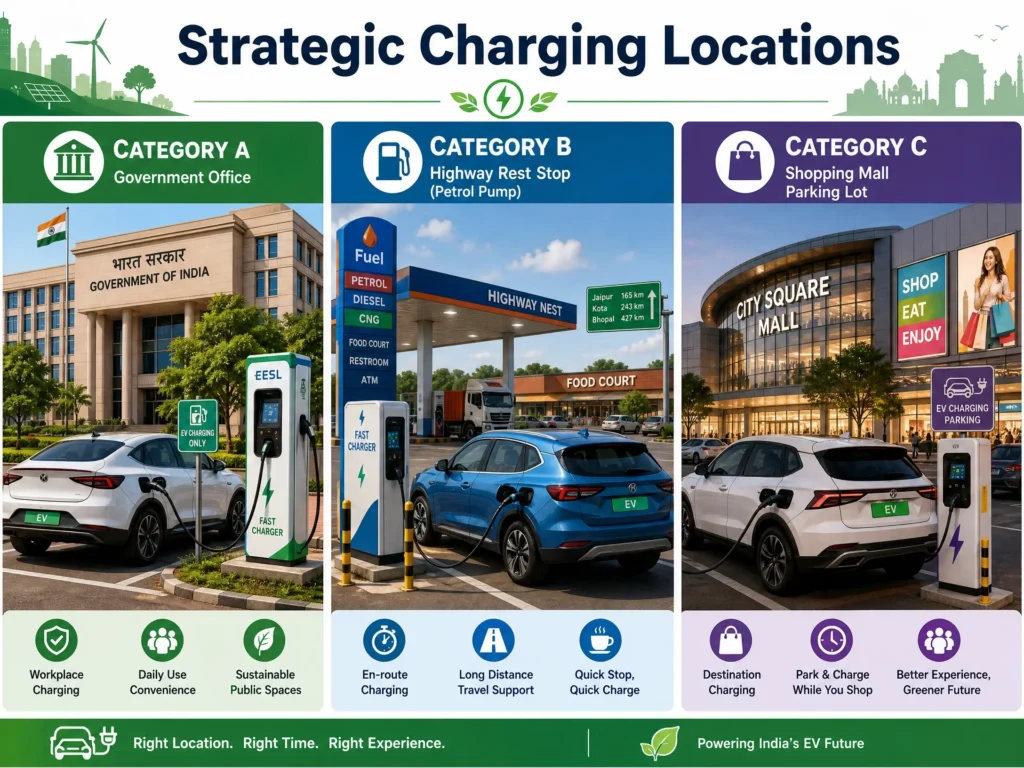
The PM E-DRIVE scheme leverages a highly strategic, tiered funding model. Rather than offering a flat, blanket grant across the country, it matches financial support directly with the location’s specific accessibility profile and the exact power rating of the deployed hardware.
Location Classification Matrix
To direct capital where it yields the maximum public utility, the government categorizes installation sites into four distinct tiers:
| Category | Typical Locations Covered | Subsidy on Upstream Infrastructure | Subsidy on EVSE Hardware |
| Category A | State/Central Govt. offices, public residential complexes, government hospitals, IITs/NITs/State Universities, CPSE townships. | 100% Cover | 100% Cover (Must feature completely open, unrestricted public access) |
| Category B | Semi-public municipal parking spaces, AAI airports, public sector OMC petrol pumps, STU bus stations, metro stations, NHAI toll plazas/rest stops. | 80% Cover | 70% Cover |
| Category C | Privately owned public hubs: shopping malls, private market complexes, open city streets, private highway sites. | 80% Cover | 0% Cover (Hardware funded entirely by the developer/CPO) |
| Category D | Battery Swapping Stations (BSS) and specialized Battery Charging Stations (BCS) deployed at any location. | 80% Cover | 0% Cover |
Power Ratings and Bureau of Energy Efficiency (BEE) Benchmark Costs
The actual monetary payout of the subsidy is tightly capped based on standardized benchmark costs defined and regularly revised by the Bureau of Energy Efficiency (BEE).The benchmark costs (inclusive of GST) for core EV supply equipment serve as the baseline for calculating the percentage caps:
- Light EV DC & LECCS (12 kW): Benchmark cost capped at ₹1.60 Lakh. (Ideal for rapid charging fleets of 2-wheelers and 3-wheelers).
- CCS-II Mid-Power Fast Charger (60 kW): Benchmark cost capped at ₹3.40 Lakh. (The sweet spot for city public parking and passenger e-cars).
- CCS-II High-Power Fast Charger (120 kW): Benchmark cost capped at ₹5.00 Lakh. (Optimized for busy highway corridors and commercial fleets).
- Ultra-High-Power Systems (240 kW to 360 kW+): Benchmark costs scale from ₹8.00 Lakh to ₹12.50 Lakh respectively. (Reserved for heavy commercial e-trucks and high-capacity e-bus depots).
Important Subsidy Calculation Note: Upstream infrastructure costs are calculated directly via the formal demand notes issued by the local State DISCOM. If a DISCOM issues a demand note for ₹10 Lakh to set up a transformer for a Category B site, the PM E-DRIVE scheme will directly step in to reimburse ₹8 Lakh (80%) of that cost. Refundable safety deposits made to the DISCOM, however, are excluded from the subsidy calculations.
The Two-Tranche Cash Flow Model
To protect public funds while maintaining a healthy cash flow for project implementation agencies, the financial disbursement is broken into a strict two-stage process:
- Tranche 1 (70% Allocation): Released immediately upon verification of procurement orders, signing of structural agreements, or initial civil deployment milestones.
- Tranche 2 (30% Balance Allocation): Disbursed only after the physical station is completely energized, operational, and officially onboarded onto the central government’s National Unified Hub.
Conditions and Requirements for PM E-DRIVE Projects
Securing government funding comes with an absolute mandate to maintain quality, safety, and uninterrupted public accessibility. The Ministry of Heavy Industries enforces a strict operational framework that every applicant must strictly comply with.
1. The Open-Access Rule
The charging station must be unconditionally open to the general public. You cannot claim a PM E-DRIVE capital subsidy to build a walled-off charging station meant exclusively for a private corporate fleet or restricted residents within a gated society, unless it falls under specific open-access guidelines under Category A. The location must be easily discoverable and physically accessible without artificial entry barriers.
2. Siting and Spatial Preferences
The project implementation boards prioritize approvals for stations mapped inside high-traffic, high-demand node areas:
- Core commercial zones, high-density retail markets, and prominent shopping malls.
- Mega-cities boasting a million-plus population, designated Smart Cities, and rapidly growing urban satellite towns.
- Heavy freight highways connecting key industrial zones, coastal ports, and state capitals.
3. Absolute Technical Standards Compliance
Every piece of equipment installed must comply with the central Ministry of Power (MoP) 2024 Guidelines and guidelines set forth by the Central Electricity Authority (CEA). Hardware must carry authentic Bureau of Indian Standards (BIS) certifications, featuring specific connector protocols:
- Light EVs: Standardized LEVDC protocols (IS-17017-2-6).
- Passenger Cars & Commercial Fleets: Combined Charging System (CCS-II) connectors capable of scaling seamlessly from 50 kW up to 500 kW for heavy transport vehicles.
- Interoperability: Hardware must support open backend communication protocols (OCPP and OCPI). This ensures “EV Roaming”—meaning a driver using any mainstream EV app can naturally discover, plug into, and pay at your station without being forced to download a proprietary app.
4. Mandatory Data Integration
Every station funded by the subsidy must feature active smart meters linked via cellular or internet backhauls to share real-time operational metrics (uptime, energy consumption, charger availability status) with the central National Unified Hub (known online as Unified Bharat E-Charge).
Step-by-Step Application Process for PM E-DRIVE
Setting up your station requires clear coordination between land preparation, corporate/PSU structuring, and technological validation. The administrative workflow is managed under the strict oversight of BHEL (acting as the primary Project Implementation Agency) and IFCI Ltd. (operating as the official Project Management Agency).
1.Document Aggregation & Site Verification: Compliance.
Gather clear corporate identity proof, detailed land ownership deeds, or a legally registered long-term lease agreement (minimum 10-15 years). Compile exact GPS coordinates, sitewide high-resolution photos, and an initial electrical load assessment report.
2.Establish Strategic Institutional Partnerships: Alignment.
Since individual private entities cannot apply directly to the MHI portal, private developers must approach an authorized State Nodal Agency (such as the state’s renewable energy development authority), a regional DISCOM, or an active CPSE (like NTPC or REIL) to include their project location into a consolidated institutional regional proposal.
3.Formal Proposal Submission via the PM E-DRIVE Portal: Digital Application.
The designated nodal agency uploads the project blueprint to the unified portal. The filing must clearly specify the chosen location category (A, B, or C), the targeted charger types, exact BEE power ratings, estimated DISCOM upstream grid connection costs, and the chosen CPO operating model.
4.Technical Review and Subsidy Sanctioning: Evaluation.
The Project Management Agency (IFCI) and the Project Implementation Sanctioning Committee (PISC) run a rigorous evaluation against the assessment matrix. Once verified, a formal Subsidy Sanction Letter is generated, detailing the exact financial quantum approved, allowing you to safely draw down Tranche 1 funding.
5.Civil Installation, Grid Connection, and Commissioning: Go-Live.
Procure BIS-certified, OCPP-compliant hardware. Execute the structural civil foundation works and have the DISCOM install the dedicated transformer and commercial meter. Complete safety testing, link the station APIs live to the Unified Bharat E-Charge platform, and submit the final commissioning report to claim the remaining 30% balance subsidy.
Why PM E-DRIVE is a Generational Business Opportunity
For decades, the fuel retail market in India was heavily locked behind massive corporate entry barriers. A regular individual or small mid-tier enterprise could rarely dream of establishing a conventional petrol pump due to intense regulatory layering, supply chain complexities, and high land capitalization costs.
The electrification of transit completely tears down that monopoly. The PM E-DRIVE scheme acts as an incredible equalizer:
- Drastic Capital De-risking: By subsidizing up to 80% to 100% of the expensive under-the-meter infrastructure costs (transformers and distribution grids), the government effectively absorbs the riskiest portion of your initial capital expenditure. You enter the high-growth energy market at a fraction of the historical cost.
- Concessional Commercial Overhead: Most Indian states have introduced highly attractive, dedicated concessional electricity tariffs specifically for commercial EV public charging stations (often ranging between ₹4.5 to ₹6.0 per kWh, heavily decoupled from standard high-tier commercial electricity slabs). This massive regulatory pricing gap ensures highly attractive margins for charge point operators.
- Compounding Traffic Capture: A public charging station is an incredible footfall magnet. Unlike a petrol pump where drivers spend barely three minutes, an EV fast-charging bay holds a captive consumer for 30 to 60 minutes. This creates massive secondary monetization avenues—allowing operators to successfully bundle high-margin amenities like boutique coffee shops, quick-service restaurants, retail convenience kiosks, or co-working lounges directly alongside their charging bays.
Conclusion
The transition toward electric mobility in India is no longer an experimental wave—it is an absolute structural reality. With the central government explicitly committing ₹2,000 crore to fund over 72,000 public chargers through the PM E-DRIVE scheme, the economic runway for early movers is incredibly clear.
If you possess clear-titled land, run a commercial facility, or operate a startup looking to ride the renewable energy wave, the current window of overlapping central subsidies and state-level tax exemptions represents the perfect time to act.By bridging the financial gap for heavy under-the-meter infrastructure, the PM E-DRIVE initiative effectively pays you to build the fueling network of tomorrow. Reach out to your local State Nodal Agency or partner with an authorized CPSE today, and position your business at the very center of India’s green transport revolution.