
Delhi’s battle with seasonal smog and rising air pollution is a narrative every resident knows all too well. For years, the conversation has centered around compressed natural gas (CNG) conversions, odd-even road rationing, and emission norms. However, the most significant shift is happening right now under the hood of our vehicles. The transition from internal combustion engines (ICE) to electric mobility has transformed from a voluntary environmental choice into a heavily incentivized economic masterstroke.
Enter the newly notified Delhi Electric Vehicles Policy 2026. Formally cleared by the Delhi Cabinet led by Chief Minister Rekha Gupta and approved by Lieutenant Governor Taranjit Singh Sandhu, this framework came into official effect on July 1, 2026, and will remain active until March 31, 2030. With a massive total projected investment of around ₹15,000 crore over the next four years, this is one of the most aggressive and highly funded green mobility roadmaps in the world.
For prospective car, scooter, and commercial vehicle buyers in the National Capital Territory (NCT), the most crucial takeaway from this policy is the Delhi EV policy 2026 registration road tax waiver.By eliminating the traditional financial hurdles of buying a premium vehicle, the Delhi government is making electric vehicles (EVs) cheaper upfront than their fossil-fuel alternatives.
This comprehensive guide breaks down exactly how the new policy works, how it stacks up with central government benefits like the PM E-DRIVE scheme, and how you can combine these programs to maximize your savings.
Understanding the Long-Term Vision of Delhi’s EV Policy 2026
The primary objective of the Delhi EV Policy 2026 is clear: to accelerate the adoption of clean energy vehicles, radically improve urban air quality, and establish a bulletproof charging network across the capital.Rather than merely handing out temporary, minor cash rebates, the government has instituted structural mandates that will reshape Delhi’s traffic permanently.
The framework introduces rigid timelines to phase out the registration of traditional fossil-fuel vehicles in specific consumer and commercial segments:
- Electric Auto-Rickshaws & N1 Commercial Trucks: From January 1, 2027, only zero-emission electric three-wheelers and N1-category light goods carriers will be allowed new registrations within the capital.
- Two-Wheelers: New registrations of conventional petrol-powered and CNG-powered motorcycles and scooters will be systematically phased out. Starting April 1, 2028, the transport department will grant new two-wheeler registrations exclusively to electric models.
Crucial Note on Existing Vehicles: These deadlines apply strictly to the registration of new vehicles. If you already own a registered petrol scooter or a CNG auto-rickshaw before these cut-off dates, you can continue to drive it legally as per prevailing regional regulations. The rule stops the inflow of new fossil-fuel vehicles to ensure that the city’s vehicular growth is entirely green.
The Zero Road Tax and Registration Waiver Explained
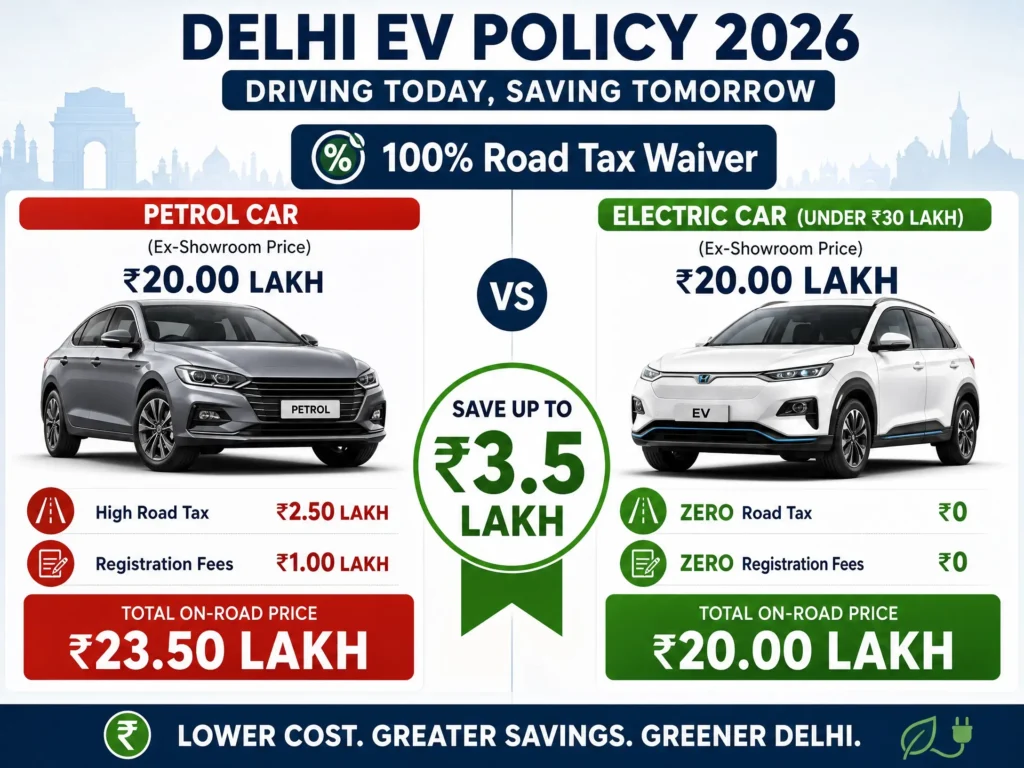
When purchasing a traditional internal combustion engine vehicle in Delhi, the “on-road” price is inflated by hefty state levies, primarily composed of road taxes and permanent registration fees. Depending on the vehicle’s price and engine capacity, road taxes in Delhi can easily add 10% to 15% to your base bill.
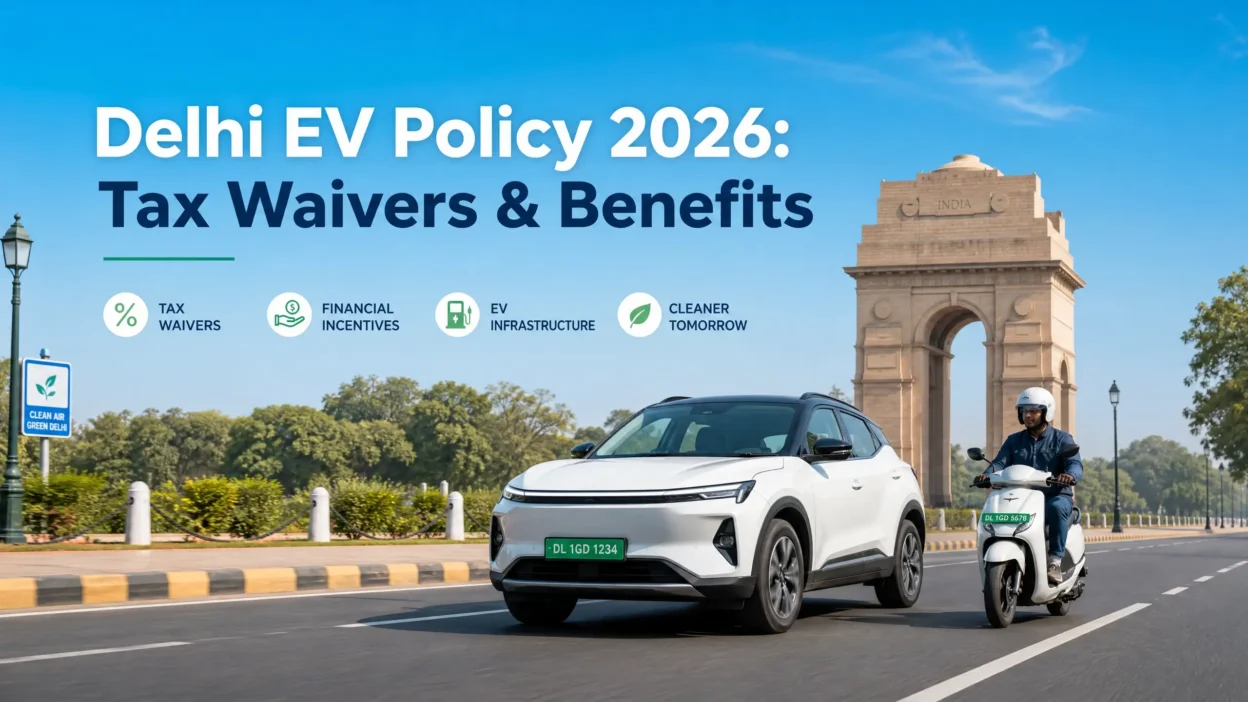
Under the Delhi EV Policy 2026, the state has completely slashed these financial bottlenecks. All electric cars with an ex-showroom price of ₹30 lakh or less registered in the National Capital are granted a 100% waiver on road tax and registration charges.
Financial Breakdown of the Cap
The ₹30 lakh ceiling is positioned to capture the most popular, mass-market passenger EVs, ensuring that standard middle-class and working professionals reap the absolute maximum benefit.
- Vehicles Under ₹30 Lakh: Enjoy a full 100% waiver on both road tax and registration fees. This immediately slashes between ₹1.5 lakh and ₹3.5 lakh off the total on-road price relative to an identically priced petrol or diesel car.
- Vehicles Above ₹30 Lakh: Do not qualify for the tax waiver. Premium luxury electric cars exceeding this price bracket will attract standard state road taxes and registration fees.
- Strong Hybrid Vehicles: While they are not fully electric, the policy recognizes their role as a bridge technology. Strong hybrids receive a 50% exemption on road taxes and registration fees.
By targeting the high-volume consumer segment, this waiver brings parity to the initial transaction costs. It effectively neutralizes the historic “EV premium” that often discouraged buyers during their showroom visits.
Turning Junk into Gold: The ₹1 Lakh Scrappage Benefit
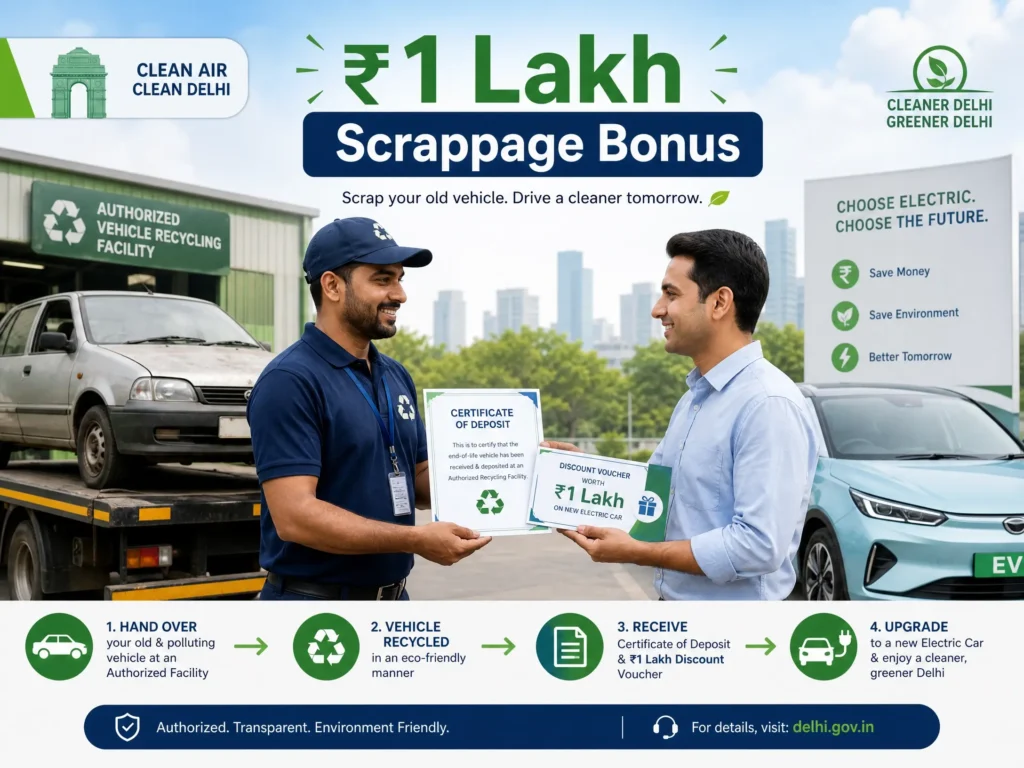
One of the boldest pillars of the 2026 framework is its dedication to removing older, high-emission vehicles from Delhi’s choked corridors rather than just adding new vehicles to the mix. To achieve this, the government has allocated a dedicated ₹1,500 crore fund specifically for consumer scrappage incentives.
If you own an old, polluting vehicle registered in Delhi, you can trade it in for a massive direct cash incentive toward your new EV purchase. The benefits vary strictly by vehicle category:
| Scrapped Vehicle Type | Replacement EV Target Category | Maximum Cash Incentive |
| BS-IV or Older Petrol/Diesel Car | Electric Passenger Car (Under ₹30 Lakh) | ₹1,00,000 |
| N1 Commercial ICE Truck | Electric Goods Carrier (N1) | ₹50,000 |
| Three-Wheeler (Auto/Cargo) | Electric Three-Wheeler | ₹25,000 |
| Two-Wheeler (Scooter/Bike) | Electric Two-Wheeler | ₹10,000 |
Crucial Fine Print for the ₹1 Lakh Car Scrappage Bonus
To claim the premier ₹1,00,000 incentive, buyers must strictly adhere to the following regulatory parameters:
- The vehicle being scrapped must be a Delhi-registered, end-of-life vehicle or a BS-IV (or older) petrol or diesel car.
- Upon scrapping the vehicle at an authorized recycling facility, you will receive a official Certificate of Deposit (CoD).
- The new electric vehicle must be purchased within six months of the date listed on that Certificate of Deposit.
- This specific ₹1 lakh car scrappage pool is strictly limited to the first 1,00,000 eligible applicants. Early adopters are guaranteed priority.
State Purchase Subsidies for Two-Wheelers and Three-Wheelers
While cars enjoy a massive tax waiver, two-wheelers and three-wheelers receive direct purchase subsidies from the Delhi government to help lower their upfront cost. Recognizing that different vehicle segments require unique paths to mature, the policy introduces the following direct-to-consumer cash incentives:
1. Electric Two-Wheelers (Scooters & Motorcycles)
To make the transition smooth ahead of the strict 2028 electric-only mandate, the direct state purchase subsidy operates on a sliding scale over the first three years of the policy:
- Year 1 (Active Now): A direct state subsidy of ₹30,000 per vehicle.
- Year 2: The incentive drops down to ₹20,000 per vehicle.
- Year 3: The incentive tapers off to a final ₹10,000 per vehicle.
This step-down design is highly intentional. It rewards consumers who embrace electric mobility early while signaling that as manufacturing scales and prices drop, the market must become self-sustaining.
2. Electric Three-Wheelers & Commercial Fleets
For those operating commercial three-wheelers (including e-rickshaws, e-carts, and high-speed cargo models), the policy offers direct support to preserve small business margins:
- Electric Auto-Rickshaws: Eligible for a flat subsidy of up to ₹50,000 to fast-track fleet conversions ahead of the 2027 fossil-fuel ban.
- N1-Category Electric Goods Carriers: Small commercial trucks used for last-mile logistics qualify for a massive direct purchase subsidy of up to ₹1,00,000.
Stacking Benefits: Combining Delhi State Subsidies with Central Schemes
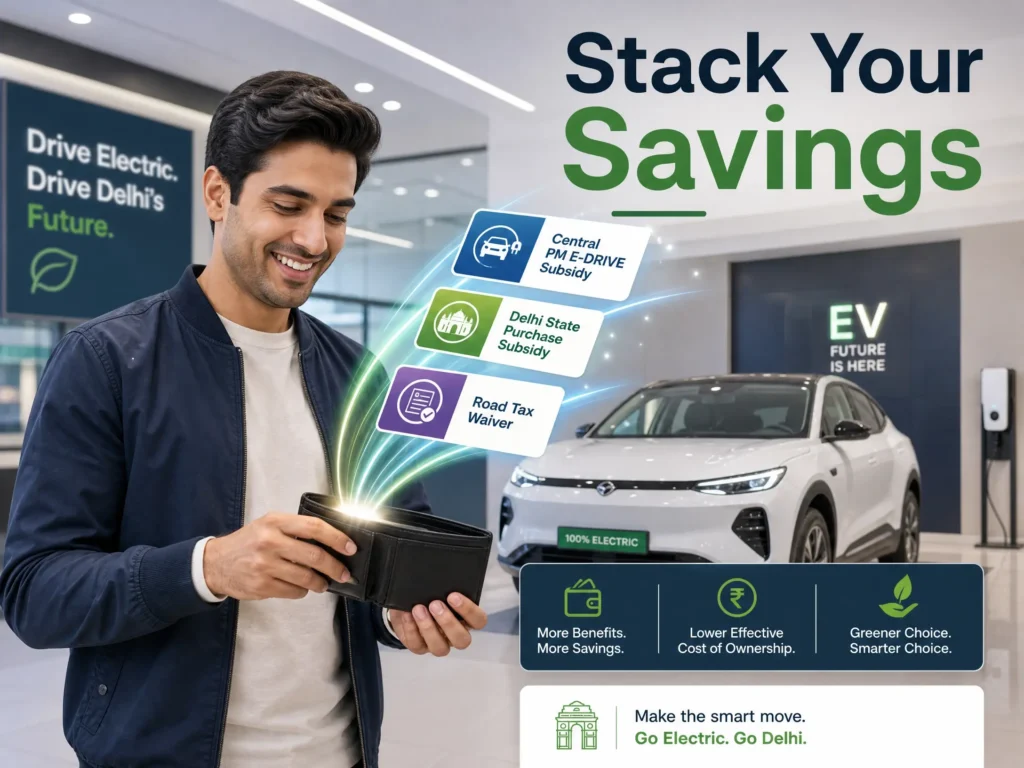
The most financially rewarding element of buying an EV in Delhi is the legal ability to stack benefits. This means you do not have to choose between Delhi’s regional policy and the central government’s national programs—you can leverage both simultaneously.
The central government’s cornerstone electric mobility policy is the PM E-DRIVE (Prime Minister Electric Drive Revolution in Innovative Vehicle Enhancement) scheme. Backed by a massive national budget of ₹10,900 crore, the PM E-DRIVE program runs alongside state frameworks.However, the central government has clearly signaled a major shift away from long-term consumer handouts for mature segments, transitioning instead to public infrastructure development.
The Closing Window for Two-Wheeler Central Subsidies
If you are planning to buy an electric scooter or motorcycle, you need to act fast. Under current central mandates, the PM E-DRIVE demand incentives for electric two-wheelers are scheduled to conclude on July 31, 2026.
The central subsidy is highly structured and tracked:
- Subsidy Scale: Calculated at ₹2,500 per kWh of battery capacity.
- Cap: Strictly capped at a maximum of ₹5,000 per vehicle.
- Price Ceiling: Only two-wheelers with a maximum ex-factory price of ₹1.5 lakh or less are eligible.
- Anti-Exploitation Limits: The subsidy is limited to one electric scooter per individual, tracked strictly via Aadhaar card verification to prevent commercial hoarders from consuming public funds.
- Technical Benchmarks: Lead-acid batteries are completely excluded. The vehicle must utilize high-grade, modern, advanced chemistry batteries (like Lithium-Ion) and carry a comprehensive OEM warranty of at least 3 years or 20,000 km.
How the Savings Stack Up in Real Life
Let’s see what happens when you combine the central PM E-DRIVE subsidy and the Delhi state policy for an eligible electric scooter before the July 31, 2026 deadline:
- Ex-Factory Price Discount: Your dealer deducts the central PM E-DRIVE subsidy (up to ₹5,000) directly from the scooter’s starting invoice at the counter.
- State Purchase Subsidy: Delhi adds its Year 1 state incentive of ₹30,000 directly to the transaction.
- Tax Exemptions: Delhi waives the standard road tax and registration fees, saving you an extra ₹6,000 to ₹10,000 depending on the model.
- Scrappage Integration: If you turn in an old petrol moped or scooter, you can claim an additional ₹10,000 scrappage bonus.
By stacking these benefits, you can save well over ₹45,000 on a brand-new electric two-wheeler. However, if you delay your purchase until August 1, 2026, the central PM E-DRIVE portion drops to zero, increasing your upfront cost.
The Infrastructure Pivot
After the consumer subsidies for two-wheelers wrap up, the PM E-DRIVE budget is moving entirely toward infrastructure.The central government is backing the installation of 72,000 public charging points across metropolitan hubs. This fits perfectly with the Delhi government’s own goal of adding 32,000 public charging points and battery-swapping stations across the NCT, creating a highly reliable and accessible charging ecosystem for all EV owners.
Popular Electric Cars Under the ₹30 Lakh Cap
Because the Delhi EV Policy 2026 provides a full 100% road tax and registration waiver exclusively to vehicles priced at or below ₹30 lakh ex-showroom, choosing the right model within this limit can maximize your savings.
Fortunately, India’s EV market has grown rapidly, offering plenty of excellent options that fit comfortably within this tax-exempt threshold:
- Compact Urban Commuters: Models like the MG Comet EV and Tata Tiago EV are perfect for navigating tight city streets. They sit well under the price ceiling and become incredibly affordable once all taxes are waived.
- Micro and Compact SUVs: Highly popular models like the Tata Punch EV, Tata Nexon EV, and Mahindra XUV400 qualify for the full 100% tax waiver, saving buyers a massive chunk of change on their final invoice.
- Premium Crossovers & Mid-Size SUVs: The MG ZS EV and the stylish Tata Curvv EV offer extended range and premium features while staying under the ₹30 lakh mark.
- Upcoming Highly-Anticipated EVs (2026-2027 launches): New and upcoming models like the Tata Sierra EV, Mahindra BE 6, Mahindra XEV 9e, Tata Harrier EV, Maruti Suzuki e Vitara, Toyota Urban Cruiser Ebella, and the Kia Carens Clavis EV are all expected to position key variants under the ₹30 lakh ex-showroom line. This gives future buyers plenty of exciting, tax-free options to look forward to.
Step-by-Step Guide: How to Claim Your EV Benefits in Delhi
Navigating government incentives can sometimes feel overwhelming, but both the state and central frameworks have been streamlined to work digitally right at the dealership. Here is exactly how to secure your savings:
Step 1: Complete Your e-KYC Verification at the Dealership
When you select your EV, provide the dealer with your Aadhaar card. Your mobile number must be linked to your Aadhaar to complete the mandatory e-KYC authentication process.Once authenticated, a secure central e-voucher is generated, which you sign digitally.This applies the central PM E-DRIVE subsidy as a direct reduction on your invoice.
Step 2: Automatic Processing of the Road Tax and Registration Waiver
You do not need to visit the Regional Transport Office (RTO) to claim your tax waiver. The dealership processes your vehicle’s registration through the centralized online Vahan portal. Since the system identifies the vehicle as an eligible EV priced under ₹30 lakh, it automatically sets the road tax and registration fee fields to zero. Review your final itemized bill to confirm these charges have been completely removed.
Step 3: Redeem Your Scrappage Certificate (If Applicable)
If you are replacing an old vehicle, take it to a state-authorized vehicle scrapping facility to receive an official Certificate of Deposit (CoD).Present this certificate to the EV dealer during your purchase. The corresponding scrappage incentive (up to ₹1 lakh for cars) will be integrated directly into your purchase contract.
Why Now is the Time to Go Electric in Delhi
The Delhi EV Policy 2026 is a massive win for the city’s environment and economy. By combining a 100% road tax waiver with strong scrappage incentives and central subsidies, the upfront cost of buying an EV has never been lower.
However, the clock is ticking on some of the best deals. With the central two-wheeler subsidy wrapping up soon and car scrappage benefits limited to early applicants, taking action now ensures you maximize your savings.Making the switch to an EV is no longer just a great way to help clean up Delhi’s air—it’s also the smartest financial move you can make for your wallet.