
India is undergoing a quiet but massive transportation overhaul. Green license plates are no longer a rare sight on urban roads or national highways; they represent one of the fastest-growing automotive transitions in the country’s history. Driven by the government’s massive ₹10,900-crore PM E-DRIVE scheme and an aggressive push toward sustainable energy, the electric vehicle (EV) market is expanding rapidly.
However, this rapid growth has exposed a significant bottleneck: infrastructure. While thousands of new EVs roll off production lines every month, India will require an estimated 1.3 million public charging stations by 2030 to keep pace.Currently, fewer than 30,000 exist.
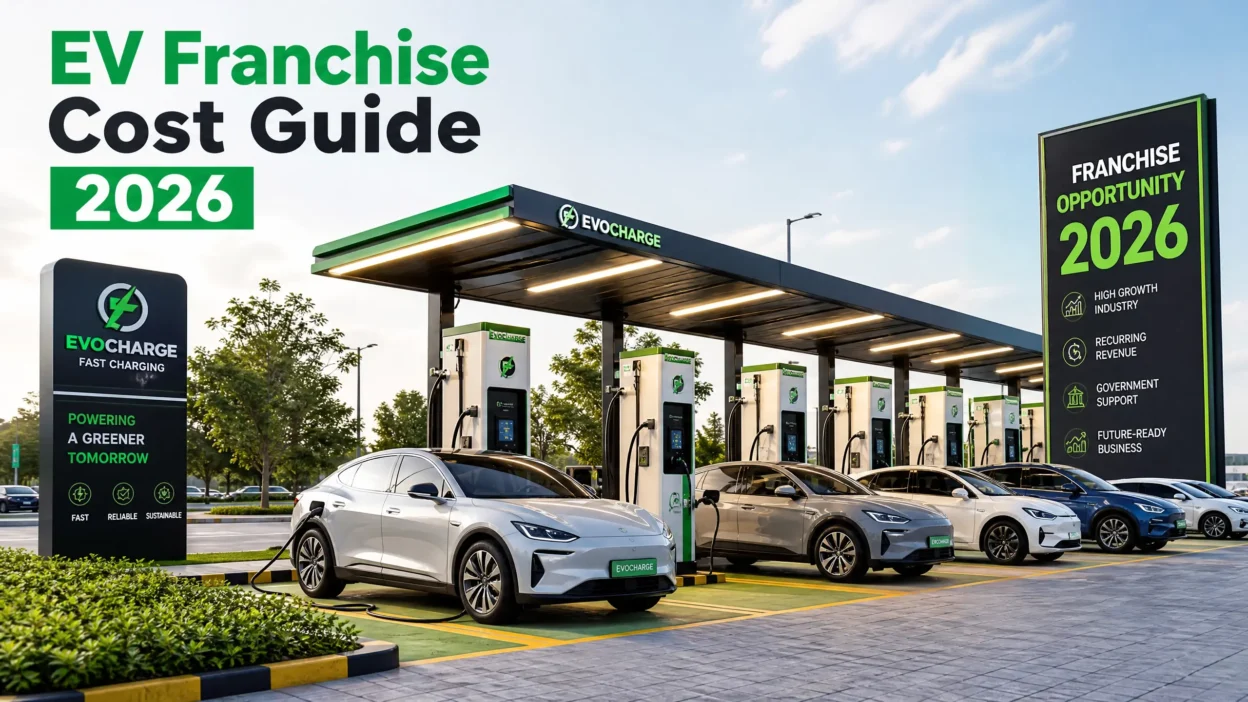
For forward-thinking entrepreneurs and investors, this infrastructure deficit represents a massive opportunity.Venturing into the EV charging station franchise business in 2026 allows you to build a highly scalable, future-proof source of passive or active income.
This comprehensive guide breaks down the true EV charging station franchise cost in India, explores the leading brand collaborations, details the regulatory frameworks, and provides a realistic blueprint for your Return on Investment (ROI).
The Financial Blueprint: Upfront Capital Investment Breakdown
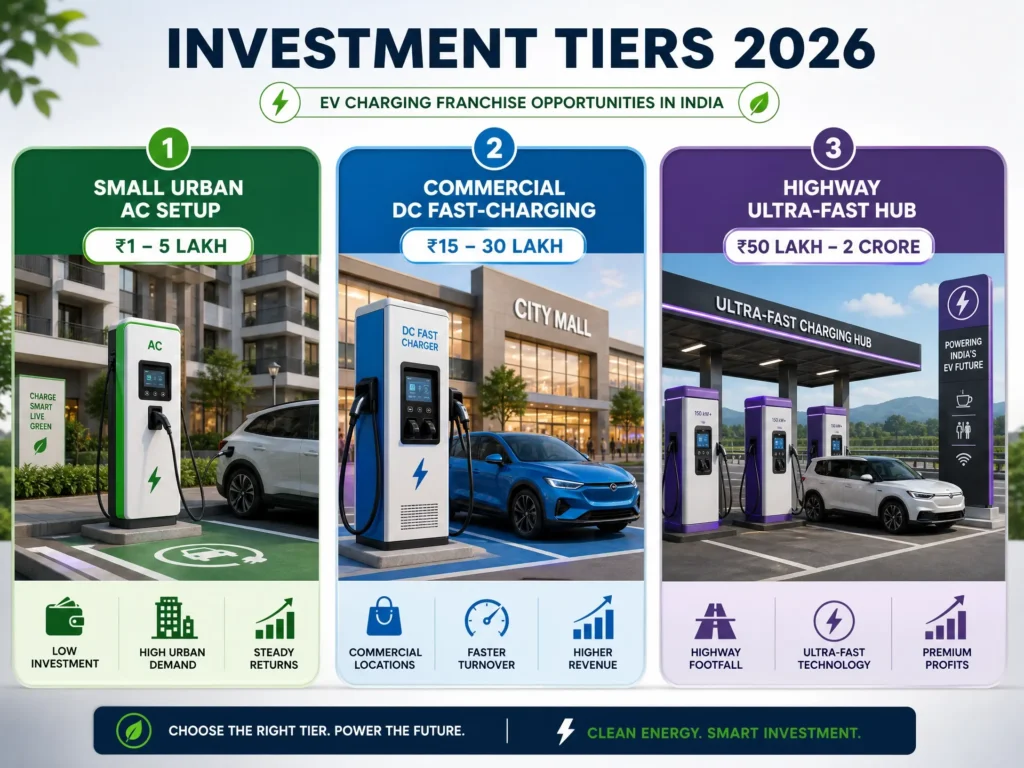
The capital expenditure (CAPEX) required to open an EV charging franchise varies significantly based on location (urban versus highway), charger type (slow AC versus ultra-fast DC), and power capacity.
To provide a clear financial picture, we have categorized the initial setups into three major investment tiers reflecting the 2026 market real estate and equipment costs.
Tier 1: Small-Scale Urban AC Setup (Low CAPEX)
- Ideal Locations: Apartment complexes, corporate tech parks, gym parking lots, boutique cafes, and shopping complexes.
- Target Audience: Commuters who leave their vehicles parked for 3 to 8 hours.
- Estimated Investment: ₹1 Lakh to ₹5 Lakh
| Expense Component | Estimated Cost (INR) |
| 7.2 kW to 22 kW AC Dual-Gun Chargers | ₹35,000 – ₹1,500,000 |
| Heavy-duty Wiring & Electrical Safety Infrastructure | ₹10,000 – ₹25,000 |
| Civil Work, Concrete Pads & Basic Painted Bays | ₹5,000 – ₹15,000 |
| DISCOM Security Deposit & Load Sanction (Under 20 kW) | ₹15,000 – ₹40,000 |
| Software Management Integration (CMS) & App Listing | ₹10,000 – ₹30,000 |
| Total Estimated Initial Outlay | ₹1 Lakh – ₹5 Lakh |
Tier 2: Commercial DC Fast-Charging Station (Mid CAPEX)
- Ideal Locations: Shopping malls, star hotels, busy city transit hubs, and fleet logistics depots.
- Target Audience: Premium four-wheeler owners, commercial EV cabs, and delivery fleets needing an 80% top-up within 45 to 90 minutes.
- Estimated Investment: ₹15 Lakh to ₹30 Lakh
| Expense Component | Estimated Cost (INR) |
| 30 kW to 60 kW DC Fast Charger (CCS2 Compatible) | ₹7,00,000 – ₹12,00,000 |
| Dedicated Transformer installation & Load Setup (50 kVA+) | ₹2,00,000 – ₹5,00,000 |
| Civil Works (Canopies, protection bollards, drainage) | ₹1,00,000 – ₹2,00,000 |
| Franchise Fees, Security Deposit & Brand Signage | ₹1,50,000 – ₹3,00,000 |
| Government Approvals, CEIG Safety Inspection Certification | ₹25,000 – ₹75,000 |
| Total Estimated Initial Outlay | ₹15 Lakh – ₹30 Lakh |
Tier 3: Highway Ultra-Fast Charging Hub (High CAPEX)
- Ideal Locations: National Highways (NH), major state expressways, inter-city toll plazas, and large food courts.
- Target Audience: Long-distance travelers, electric luxury cars, multi-axle electric trucks, and interstate electric buses.
- Estimated Investment: ₹50 Lakh to ₹2 Crore+
| Expense Component | Estimated Cost (INR) |
| Multiple Multi-Gun 120 kW to 360 kW DC Ultra-Fast Chargers | ₹25,00,000 – ₹80,00,000 |
| High-Voltage Substation, Industrial Transformer & Grid Tie-in | ₹10,00,000 – ₹40,00,000 |
| Extensive Civil Construction (Paving, commercial bays, rest areas) | ₹10,00,000 – ₹30,00,000 |
| Premium Franchise Fee, Hardware Integration, Network Software | ₹3,00,000 – ₹8,00,000 |
| Lighting, 24/7 CCTV, Fire Suppression & Safety Systems | ₹2,00,000 – ₹5,00,000 |
| Total Estimated Initial Outlay | ₹50 Lakh – ₹2 Crore |
Choosing Your Partner: Top EV Franchise Brand Collaborations
Partnering with an established Charge Point Operator (CPO) saves you from developing complex billing software, navigating vendor lines for equipment, and marketing your location from scratch. In India’s 2026 EV ecosystem, four brands dominate the franchise landscape:
1. Tata Power EZ Charge
As the clear market leader holding roughly a 50% market share in the public space, Tata Power offers massive brand recognition.
- The Model: Turnkey franchise solutions ranging from standard commercial setups to highway ultra-fast hubs. They manage site optimization, hardware procurement, and provide 24/7 monitoring through their central Network Operations Center.
- Pros: Deep consumer trust, seamless integration with the highly rated Tata Power EZ Charge App, and massive corporate tie-ups.
2. Statiq
Statiq has aggressively expanded its footprint by offering flexible investment layers, making them highly popular among modern commercial property owners.
- The Model: Primarily features the FOCO model (Franchise Owned, Company Operated). You fund the initial setup, while Statiq manages the tech platform, updates, and customer support.
- Pros: Advanced tech ecosystem, precise software, and automated revenue payouts.
3. ChargeZone
Focused heavily on high-speed corridor charging networks, ChargeZone is the go-to partner for highway entrepreneurs.
- The Model: Fast and Super Charging setups scaling up to megawatt-level structures.
- Pros: Strong partnerships with luxury automakers and bus fleets, offering pre-negotiated, institutional utilization for your station.
- Financing Advantage: ChargeZone offers up to 75% project financing with attractive terms, minimizing your starting personal capital barrier.
4. Jio-bp pulse
A powerhouse joint venture combining Reliance’s vast retail footprint with BP’s international fuel-retailing expertise.
- The Model: Highly integrated commercial models situated near existing commercial epicenters or integrated energy plazas.
- Pros: Premium infrastructure built to global standards and massive footfall spillover from existing Reliance ecosystems.
Operational Models: FOFO vs. FOCO vs. COCO
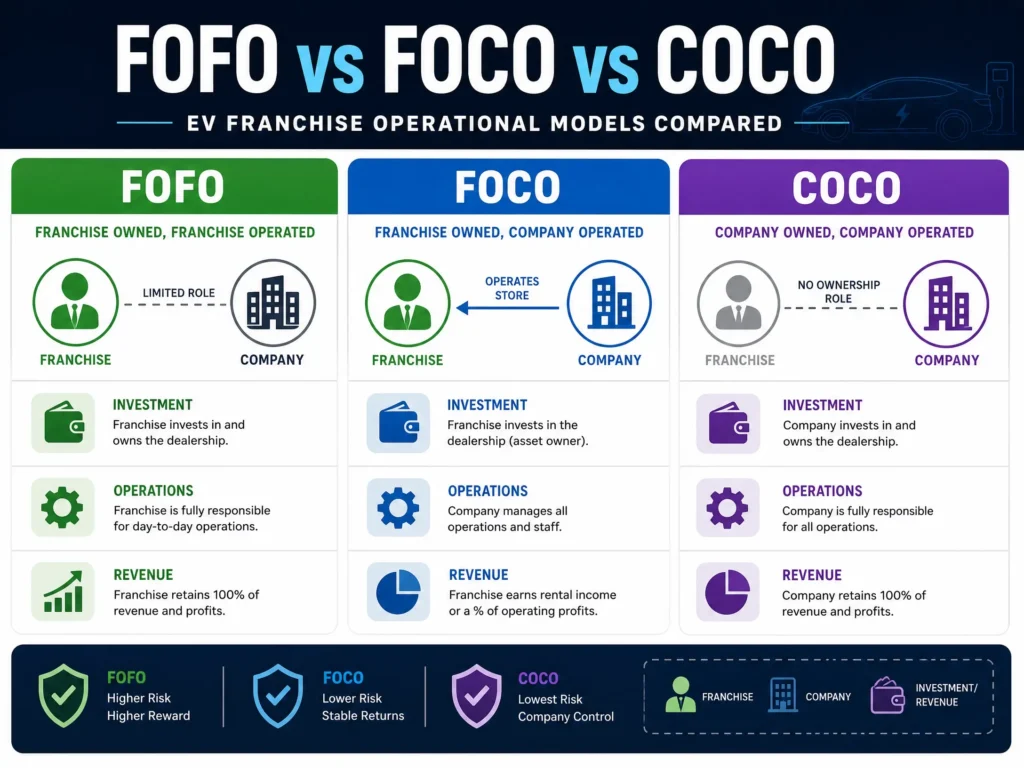
When you choose to collaborate with an EV charging brand, you will generally be presented with three core operational architectures. Your choice dictates how much operational effort you must exert versus how much control over revenue you retain.
┌─────────────────────────────────────────────────────────────────┐
│                    EV OPERATIONAL MODELS                        │
├───────────────────┬───────────────────────┬─────────────────────┤
│   FOFO Model      │      FOCO Model       │     COCO Model      │
│ (Franchise Owned, │   (Franchise Owned,   │   (Company Owned,   │
│Company Operated)  │  Company Operated)    │  Company Operated)  │
├───────────────────┼───────────────────────┼─────────────────────┤
│ • High Control    │ • Hands-off Investment│ • Zero CAPEX        │
│ • Higher Margins  │ • Passive Profit Share│ • Fixed Rent Income │
│ • You run day-to-day│ • Brand manages ops │ •Brand owns hardware│
└───────────────────┴───────────────────────┴─────────────────────┘
- FOFO (Franchise Owned, Franchise Operated): You pay for the infrastructure, purchase the hardware from the brand, and run the daily site operations yourself. You pay a small recurring technology/royalty fee (typically 10% to 15%) to use their application ecosystem and brand name. Best for: Active entrepreneurs seeking maximum revenue control.
- FOCO (Franchise Owned, Company Operated): You cover the initial CAPEX for the equipment and installation. However, the parent company takes total control of daily management, customer service, billing, and upkeep. Net profits are distributed based on a pre-agreed revenue split (e.g., 60% to the investor, 40% to the brand). Best for: Passive investors looking for high-yield, green assets.
- COCO (Company Owned, Company Operated): The brand leases the land directly from you. They bear 100% of the equipment, installation, and power connection costs. You do not own the business; instead, you receive a guaranteed monthly rental yield or a small percentage of overall sales for leasing your real estate. Best for: Strategic landowners who want zero financial risk.
No License Needed: Navigating the Regulatory Landscape
Historically, selling electricity in India required a rigid power distribution license. The Indian government completely deregulated the sector to accelerate infrastructure deployment.
Crucial Policy Fact: As declared by the Ministry of Power, operating a public EV charging station is legally deemed a “Service,” not a resale of electricity. Consequently, no electricity distribution license is required to start this business anywhere in India.
While you don’t need a distribution license, setting up a compliant public charging point involves a straightforward regulatory process:
- DISCOM Power Allocation: You must apply to your local power distribution company (DISCOM) for a dedicated, high-tension or three-phase commercial EV connection. To incentivize the infrastructure, most Indian states offer highly subsidized EV charging power tariffs (averaging ₹5.00 to ₹7.00 per kWh, compared to standard commercial rates that cross ₹10 to ₹12).
- DISCOM Timeline Mandates: Under current guidelines, DISCOMs are legally bound to process and install EV connections under strict priority timelines: within 7 days in metro regions, 15 days across municipal municipal centers, and 30 days in rural areas.
- CEA Safety Compliance: Your electrical installation must comply with Central Electricity Authority (CEA) safety guidelines, featuring dedicated earthing systems, circuit breakers (MCBs), and lightning protection. A final safety clearance from the state’s Chief Electrical Inspector to the Government (CEIG) is mandatory before opening your station to the public.
- CMS Network Openness: The government mandates that public charging networks feature open architecture. Your station software must link up via OCPP (Open Charge Point Protocol) to consumer applications so passing EV drivers can discover your station live on map platforms.
The Math That Matters: Expected Revenue, Utilization & ROI
Let’s evaluate a realistic financial model for a commercial 30 kW DC Fast-Charging Station located in a busy commercial zone or highway junction.
The Core Math of EV Tariffs
The basic formula for profitability rests entirely on your spread—the difference between what you pay the DISCOM for a unit of power versus the service surcharge you levy on the customer.
- Your Procurement Cost (DISCOM EV Tariff): ~₹6.50 per kWh
- Your Retail Price to Consumer: ~₹20.00 per kWh
- Gross Profit Margin per Unit Sold: ₹13.50 per kWh
Utilization Scenarios & Monthly Profitability
An EV station’s success depends completely on utilization—how many hours a day your chargers are actively pumping power into vehicles. Let’s look at a single 50 kW DC Fast Charger under varying traffic densities:
| Metric | Low Traffic (10% Utilization) | Optimal Traffic (25% Utilization) | High Traffic (40% Utilization) |
| Active Charging Hours / Day | 2.4 Hours | 6 Hours | 9.6 Hours |
| Total Energy Dispensed / Day | 120 kWh | 300 kWh | 480 kWh |
| Daily Gross Revenue (@ ₹20/kWh) | ₹2,400 | ₹6,000 | ₹9,600 |
| Daily Electricity Cost (@ ₹6.5/kWh) | ₹780 | ₹1,950 | ₹3,120 |
| Monthly Gross Margin (Before O&M) | ₹48,600 | ₹1,21,500 | ₹1,94,400 |
| Estimated Fixed O&M Expenses | ₹15,000 | ₹20,000 | ₹25,000 |
| Net Monthly Profit to Franchisee | ₹33,600 | ₹1,01,500 | ₹1,69,400 |
O&M costs include monthly software subscriptions, lease land allocations, security, clean-up, and basic preventative maintenance packages.
Payback Timeline
Assuming an initial capital expenditure of ₹12 Lakhs for equipment and setup:
- Under Optimal 25% Traffic conditions, your project breaks even and enters full profitability in roughly 12 to 14 months.
- In realistic, building-phase locations (10% to 15% traffic), expect a clear payback cycle spanning 24 to 30 months.
Location Strategies & The “40% Extra Income” Secret
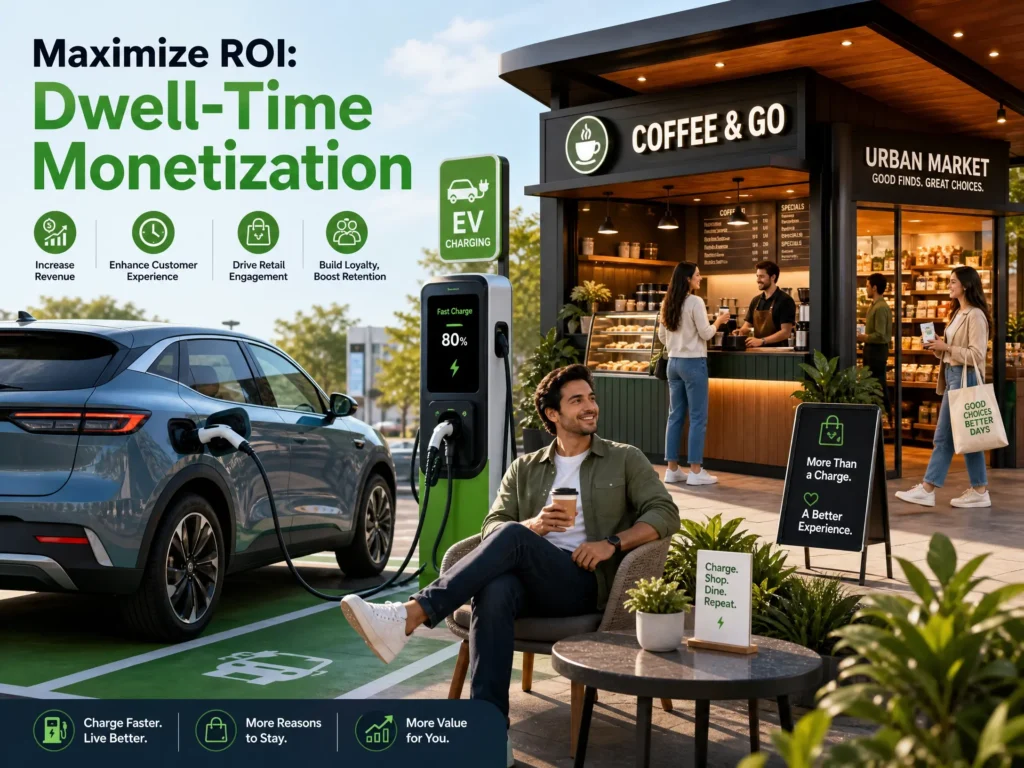
You can buy the most advanced ultra-fast charger on the market, but if it’s placed in a hard-to-reach alley with zero amenities, your utilization rates will plummet. In the EV charging game, location is your primary asset.
Top Location Archetypes
- Highway Food Plazas: Drivers are forced to stop for 30–45 minutes to eat, creating the perfect window for a DC fast-charging top-up.
- Star Hotels & Resorts: Providing EV charging attracts higher-spending clientele who prefer to stay where they can safely charge their vehicles overnight.
- Hyperlocal Delivery Hubs: Partnering locally with quick-commerce delivery services or local EV aggregators guarantees highly predictable, institutional volume during off-peak night hours.
The Secret: The Cross-Sell Dwell-Time Model
When an internal combustion engine vehicle visits a traditional petrol pump, the driver wants to exit within 3 minutes. When an EV owner pulls up to a fast charger, they are anchored to your location for at least 30 to 45 minutes.
This is where smart franchisees unlock The 40% Extra Income Strategy:
      ┌────────────────────────────────────────────────────────┐
      │               THE DWELL-TIME ECOSYSTEM                 │
      ├───────────────────────────┬────────────────────────────┤
      │    Primary Infrastructure │    Monetized Amenities     │
      ├───────────────────────────┼────────────────────────────┤
      │                           │  ➔ QSR / Coffee Shop      │
      │   [ 2x DC Fast Chargers ] │  ➔ Automated Car Wash     │
      │   Captive 45-Min Dwell    │  ➔ Co-Working Wi-Fi Pods  │
      │                           │  ➔ Retail/Snack Kiosks    │
      └───────────────────────────┴────────────────────────────┘
By adding a small coffee kiosk, a quick-service restaurant (QSR), an automated car wash, or a premium snack center right next to the charging bays, you convert passive waiting time into active consumer transactions. Often, the net margins generated from selling premium coffee, snacks, and automated car washes to waiting drivers can match or exceed the immediate profits derived from the power cables.
Is an EV Franchise Right for You?
Investing in an EV charging station franchise in 2026 is an excellent move for investors who own commercial land, hospitality businesses, or highway real estate.With low regulatory friction, long-term state support, and an exploding vehicle population, your infrastructure asset will only appreciate in value over time.
To succeed, focus on a prime location, integrate complementary retail streams to maximize dwell time, and partner with a reliable CPO brand that ensures maximum uptime.The electric transition is no longer a future trend—the infrastructure rollout is happening right now, and the early adapters are securing the best locations.