
Delhi State Electricity Board EV Charging Tariff Slabs: The Complete Guide to Subsidies, Separate Meters, and Off-Peak Savings
The green revolution is no longer a distant blueprint for India’s national capital—it is unfolding rapidly across its arterial roads and neighborhoods. Delhi has positioned itself as the pioneering hub for electric vehicle (EV) adoption in the country, driven by forward-thinking state policies, rising fuel costs, and a collective push toward cleaner urban air.
However, bringing an electric car or two-wheeler home introduces a brand-new economic variable: your monthly electricity bill. While running an EV is significantly cheaper than refueling a petrol or diesel car, mapping out exactly how much you pay to charge depends heavily on navigating the regulatory frameworks of Delhi’s electricity grid.
To optimize your daily commuting economics, you must master the Delhi state electricity board EV charging tariff slabs, understand your choices for billing separation, and unlock the cost-saving benefits of smart, off-peak charging schedules. This comprehensive guide provides a complete blueprint to power your EV in Delhi without overpaying.
The Landscape: Who Supplies Your Power in Delhi?
Before analyzing specific tariff figures, it is crucial to understand how electricity distribution operates in the National Capital Territory (NCT). Today, power distribution is managed by three primary private Power Distribution Companies (DISCOMs), each catering to specific geographical regions:
- BSES Rajdhani Power Limited (BRPL): Supplies power to the southern and western parts of Delhi.
- BSES Yamuna Power Limited (BYPL): Powers the central, eastern, and northeastern pockets of the city.
- Tata Power Delhi Distribution Limited (TPDDL): Manages the distribution infrastructure across North and Northwest Delhi.
Despite the division of service territories, all three DISCOMs implement a uniform tariff structure mandated and approved by the Delhi Electricity Regulatory Commission (DERC). Whether you are a TPDDL consumer in Rohini or a BRPL consumer in Saket, the base cost per unit for your dedicated EV charging infrastructure remains exactly the same.
Delhi State Electricity Board EV Charging Tariff Slabs Explained
To actively promote electric mobility and protect the primary distribution grid from overwhelming domestic load spikes, the DERC has instituted a special category for electric vehicle charging. This separates EV energy usage from standard household consumption slabs.
The Dedicated EV Charging Tariff
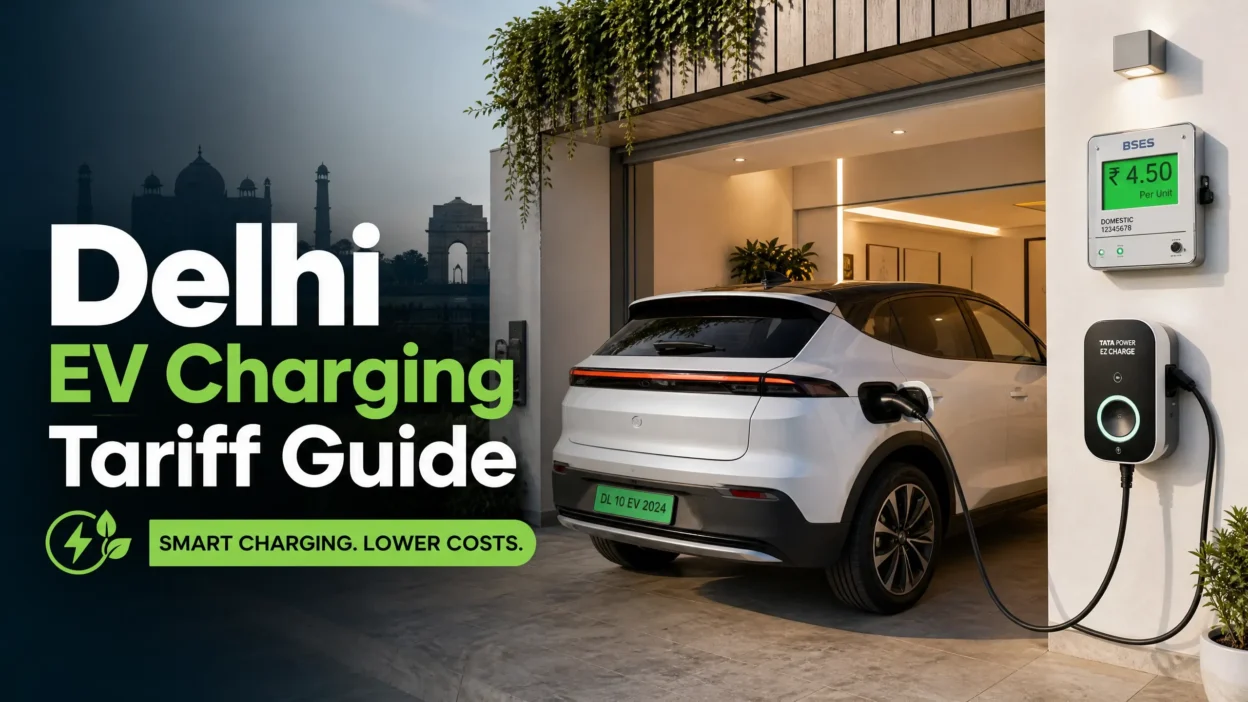
If you opt for a dedicated domestic EV charging connection, your consumption is billed at a flat, concessional rate rather than a progressive, tiered system. The base energy charges fixed by the regulatory commission are highly competitive:
- Low Tension (LT) Connections: For standard home charging setups (typically single-phase or three-phase connections up to 22 kW), the flat tariff is Rs 4.50 per unit (kWh).
- High Tension (HT) Connections: For bulk charging facilities, commercial complexes, or larger fleet yards requiring high-voltage lines, the rate drops to Rs 4.00 per unit (kWh).
Note: These figures represent the base energy charge. Your final billing will include standard state taxes, a regulatory asset surcharge, and minimal fixed monthly charges based on your sanctioned load capacity.
Comparison: Dedicated EV Tariff vs. General Residential Slabs
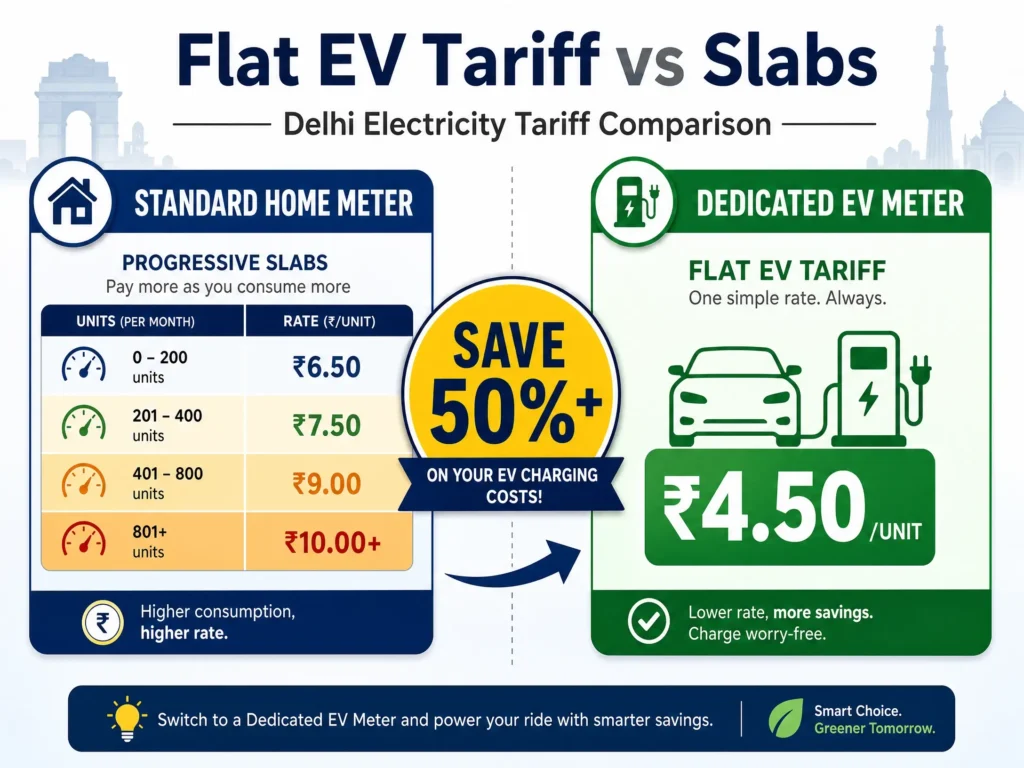
Many new EV owners wonder whether they truly need a separate connection or if they should simply plug their vehicle into a standard 15A garage socket linked to their main home meter. To see why a dedicated connection is highly beneficial, let us compare the progressive domestic slab rates with the flat EV tariff:
- 0 – 200 Units Slab: Free (100% State Subsidy). Adding an EV will immediately push you out of this free tier.
- 201 – 400 Units Slab: Around Rs 4.50 (with 50% state subsidy). Charging your EV here rapidly exhausts your subsidized allocation.
- 401 – 800 Units Slab: Around Rs 6.50 to Rs 7.00 per unit. This is significantly higher than the flat Rs 4.50 EV rate and inflates total home expenses.
- Above 800 Units Slab: Up to Rs 8.00 – Rs 10.00+ per unit. Substantially more expensive than using a dedicated EV meter.
If your household already consumes 350 units a month for lights, fans, and appliances, adding an EV—which consumes roughly 150 to 200 units monthly for moderate daily commuting—will push your entire bill into the highest, unsubsidized domestic slabs. By utilizing a separate EV connection, your normal household consumption remains protected under the low-cost or free subsidy brackets, while your vehicle charging draws cleanly from the flat Rs 4.50 per unit slab.
Commercial & Public Charging Tariffs
When you use a public DC fast charger along the highway or inside a shopping mall in Delhi, you do not pay the residential rate. Public charging stations operate under a commercial tariff profile. These stations typically charge anywhere between Rs 18 and Rs 28 per unit. This markup accounts for the high-speed commercial infrastructure, grid demand surcharges, property rentals, and operator profit margins. Therefore, maximizing your home charging infrastructure is the absolute key to lowering your cost per kilometer.
Billing Separation and Metering Options: Choosing Your Path
When installing home charging infrastructure in Delhi, you can choose between two main billing structures:
Option A: The Independent Dedicated EV Meter (Recommended)
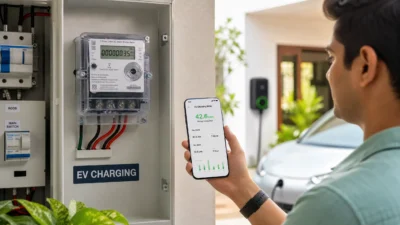
Under this framework, you apply directly to your DISCOM (BRPL, BYPL, or TPDDL) for a secondary, separate electrical connection designated solely for your EV. The DISCOM installs an independent prepaid or smart meter alongside your home’s primary entry point.
- How it bills: All energy consumed by your vehicle bypasses your residential meter completely. You are billed at the flat concessional rate of Rs 4.50 per unit from the very first kilowatt-hour.
- The Big Advantage: It isolates your home appliances from your transport costs, offering absolute transparency and preventing you from entering high-percentage domestic tax brackets.
Option B: Drawing Power from Your Existing Residential Meter
If you live in a rented property or lack the space to mount additional meters, you can simply draw power from your existing household connection via a dedicated 15A line.
- How it bills: The units consumed by your EV are aggregated with your televisions, air conditioners, and water heaters.
- The Downside: If your total monthly consumption crosses 400 units due to vehicle charging, you lose the 50% state subsidy on your domestic electricity bill. This can cause your overall monthly power bill to rise unexpectedly.
Off-Peak Charging Schedules and Time-of-Use (ToU) Mechanics
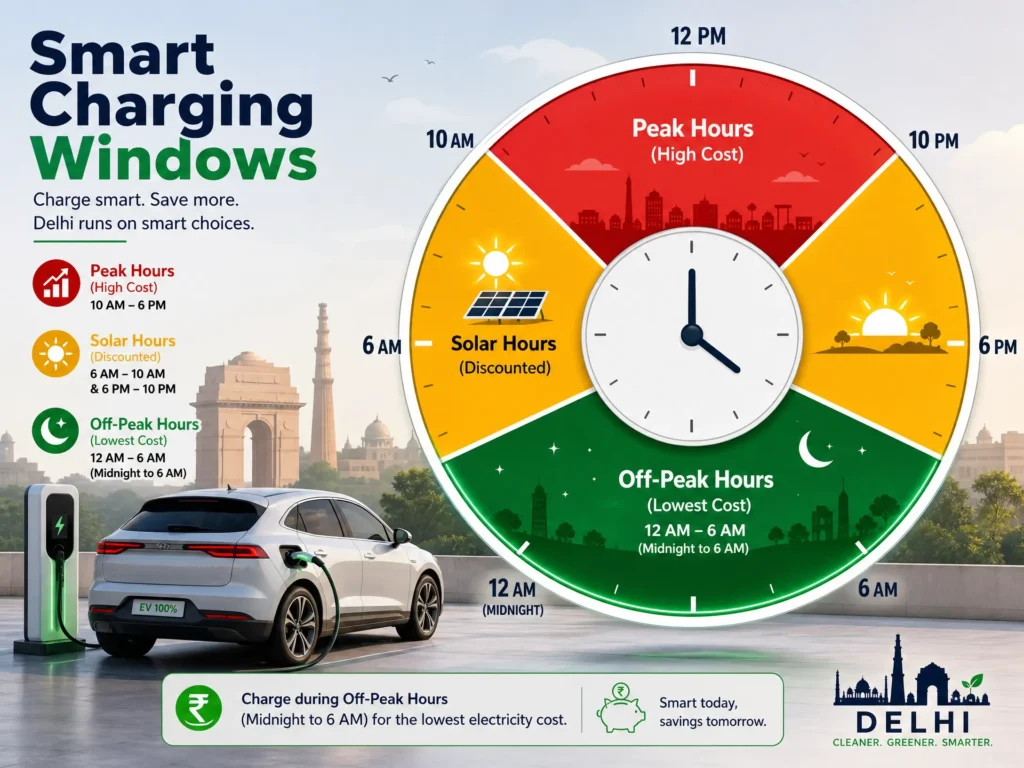
Electricity demand fluctuates across the day. The grid experiences extreme strain during “peak hours”—typically hot summer afternoons and late evenings when millions of households switch on air conditioning units simultaneously. Conversely, during “off-peak hours” (late at night or early morning), grid utilization drops dramatically.
The Mechanics of Time-of-Use (ToU)
To balance grid loads, the Ministry of Power and the DERC are rolling out Time-of-Use (ToU) or Time-of-Day (ToD) tariffs across residential and EV categories. Under a ToU framework, your billing rate dynamically updates depending on the time your vehicle is actively drawing power:
- Peak Hours (6:00 PM – 10:00 PM): High energy charges apply. Avoid plugging in your vehicle right when you return home from work to prevent a premium surcharge.
- Solar Hours (9:00 AM – 5:00 PM): A 10% to 20% discount often applies as clean solar energy floods the regional grid. This is ideal if your vehicle is parked at home or work during the day.
- Off-Peak / Deep Night Hours (Midnight – 6:00 AM): This is the ideal window for residential EV owners. Charging during these hours can reduce your core energy charges significantly.
Note: While a general ToU architecture is actively rolling out under national mandates, exact off-peak discount windows can fluctuate seasonally. It is highly recommended to check the latest monthly tariff order on your respective DISCOM’s mobile application (such as the BRPL Power App or Tata Power-DDL Connect) to verify current rebates.
Unlocking Savings with Smart Chargers
You do not have to wake up at midnight to plug your car in. Modern home setups utilize IoT-enabled smart chargers. These wall-box units link directly to your home Wi-Fi network and allow you to set specific charging schedules via a mobile app. You can plug your car in at 8:00 PM, but program the app to keep the charger idle until 12:05 AM, ensuring you automatically access the lowest possible tariff slab every night.
Delhi Government Subsidies & The Single-Window Solution
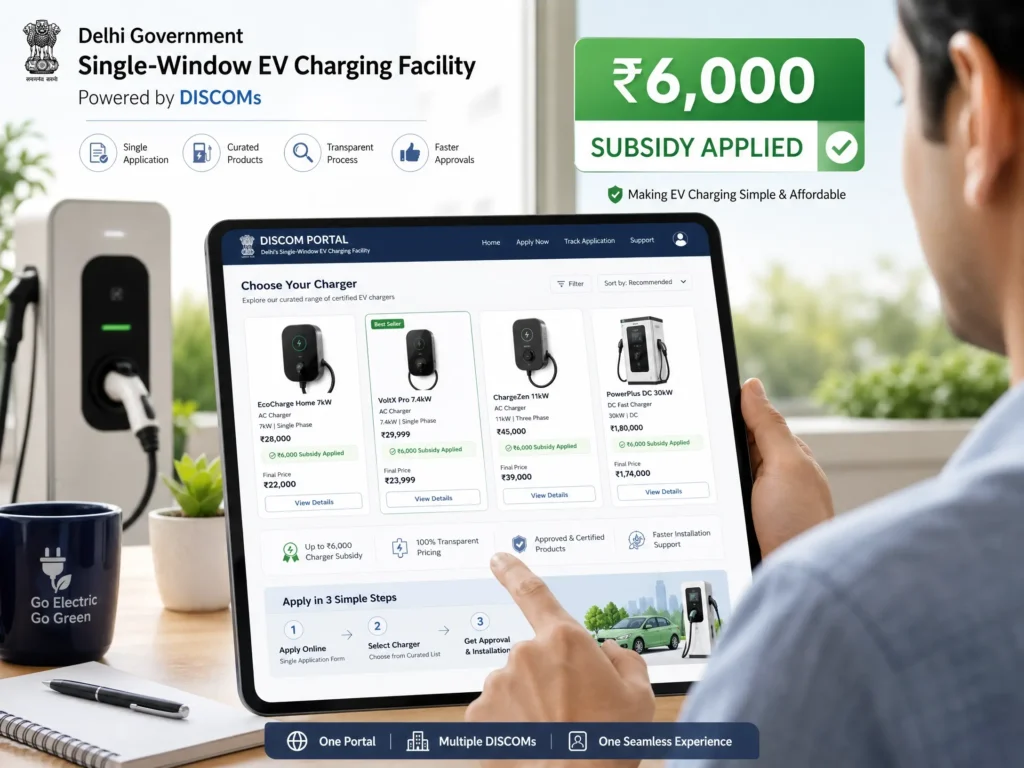
To make private charging setup seamless, the Delhi Government offers excellent incentives under its progressive EV policy frameworks:
The Direct Hardware Subsidy
The Delhi Government provides a direct financial subsidy of up to Rs 6,000 for the first 30,000 applicants installing private EV home chargers. This incentive substantially offsets the upfront purchase price of a standard 3.3 kW or 7.4 kW smart wallbox AC charger, bringing safe, dedicated charging hardware within financial reach for everyday buyers.
The Single-Window Installation Facility
Historically, getting a secondary meter and coordinating with private contractors to install a charger required extensive paperwork. To eliminate this friction, the Delhi Government partnered with BRPL, BYPL, and Tata Power-DDL to create an integrated Single-Window Facility.
The entire process can be completed online through a simple, unified workflow:
1.Visit the DISCOM Portal: Log onto the official website of your regional electricity distributor (BSES or Tata Power-DDL) and navigate to the dedicated Single-Window EV Charging panel.
2.Select an Approved EV Charger: Browse a curated catalog of certified, fire-safe, and smart-scheduled AC chargers provided by empanelled vendors. The Rs 6,000 government subsidy is automatically applied to your checkout cart as a deduction.
3.Schedule the Site Inspection: An authorized DISCOM technician will visit your property to verify your existing sanctioned electrical load and ensure your apartment complex or private garage features safe, code-compliant physical wiring paths.
4.Meter Installation and Activation: The DISCOM team mounts your dedicated EV pre-paid meter, hooks up the physical charger hardware to a secure circuit breaker, and activates the discounted line.
The Math: Calculating Your Real-World EV Charging Costs
Understanding the theory behind tariff slabs is useful, but mapping out the actual math makes the financial benefits clear. Let us calculate the true charging economics using a standard mid-sized electric car featuring a 40 kWh battery pack.
The Core Charging Cost Formula
To determine how much a complete top-up costs from zero to 100 percent, apply this simple format:
- Formula: Total Cost = Battery Capacity (in kWh) x Tariff Rate per Unit x Grid Loss Factor
- Values Used: Battery Capacity = 40 kWh, Concessional EV Tariff Rate = Rs 4.50 per unit, Grid Charging Loss Factor = 1.10 (Accounts for roughly 10 percent energy lost as residual heat during AC-to-DC conversion through the vehicle’s onboard charger).
- Calculation: 40 x 4.50 x 1.10 = Rs 198
A full charge at home on a dedicated EV meter costs under Rs 200.
Calculating the Real Running Cost per Kilometer
If your 40 kWh electric car achieves a realistic, real-world city range of 300 kilometers on a full charge, we can determine your exact per-kilometer operational cost:
- Formula: Cost Per Kilometer = Total Cost of a Full Charge / Real-World Range
- Calculation: 198 / 300 = Rs 0.66 per km
Comparison: EV vs. Petrol SUV Running Economics
To put this into perspective, let’s look at how this compares to a traditional petrol vehicle:
- Standard Electric Vehicle: Around Rs 0.66 per kilometer
- Comparable Petrol Car: A standard petrol car delivering an efficiency of 14 km per liter with fuel priced at around Rs 96 per liter costs roughly Rs 6.85 per kilometer.
Over a standard monthly driving routine of 1,500 kilometers in Delhi, the petrol car requires an expenditure of over Rs 10,200. The electric car operating under Delhi’s dedicated EV tariff requires less than Rs 1,000, saving you over Rs 9,000 every single month.
Practical Action Blueprint for Delhi EV Owners
To maximize your savings, keep this actionable checklist in mind:
- Opt for the Dedicated Connection: Avoid plugging your vehicle into your standard home meter long-term. Apply for a separate EV meter to lock in the flat, low-cost tariff slab.
- Audit Your Sanctioned Load: Before mounting a high-speed 7.4 kW home wallbox, verify that your property’s total sanctioned load can accommodate it. If needed, submit a quick load-enhancement request through your DISCOM app to prevent over-use penalties.
- Configure Automated Night Charging: Open your charger’s smart mobile companion app and restrict active power draw to late-night windows to take advantage of off-peak hours.
- Leverage the Single-Window Subsidy: Don’t purchase non-certified charging hardware online. Use the government’s single-window portal to save Rs 6,000 upfront and ensure a certified, safe installation.
Conclusion
Transitioning to an electric vehicle in Delhi is an excellent financial decision that pays off consistently over time. By capitalizing on the DERC’s Rs 4.50 per unit dedicated EV charging tariff slabs, separating your automotive billing from your household meter, and using smart scheduling to charge during off-peak windows, you can minimize your daily running costs. Take advantage of Delhi’s single-window digital portal, install a certified smart charger, and enjoy clean, highly affordable electric driving across the capital.
To see exactly how the single-window dashboard operates in real-time, take a look at this helpful guide on Applying for a New EV Meter Connection in Delhi which breaks down the application steps, document compliance, and processing timelines for various Delhi DISCOMs.