
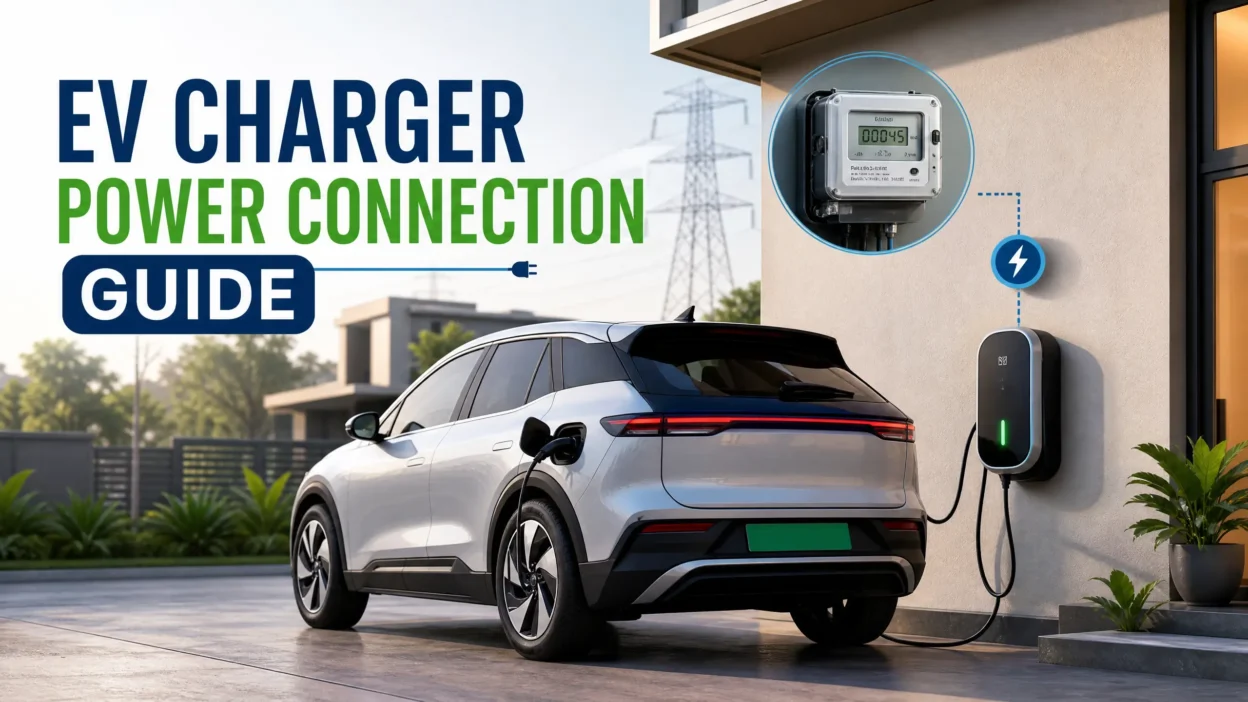
The Indian electric vehicle (EV) market is accelerating at a historic pace. Driven by robust fiscal incentives under central programs like the PM E-DRIVE scheme and progressive state policies, the country’s public and private charging landscape is scaling up dramatically. However, buying an EV is only the first step. The true foundation of a seamless electric mobility experience lies in building a robust, safe, and sanctioned power infrastructure to feed your vehicle’s battery.
Whether you are a homeowner installing a wallbox in your garage, a Resident Welfare Association (RWA) upgrading an apartment complex, or an entrepreneur building a commercial public charging hub, your first operational gateway is the local electricity Distribution Company (DISCOM). Securing an authorized electrical connection is vital. Unsanctioned or improperly wired setups risk electrical hazards, voided hardware warranties, and legal action for power theft or unauthorized load extension.
This guide walks you through the electrical requirements, step-by-step DISCOM application workflows, grid load enhancement procedures, and local municipal power board paperwork required to secure a dedicated EV charging power connection in India.
Powering Your EV: Understanding Electrical Requirements
EV chargers draw continuous high current for extended periods. This requires specific infrastructure adjustments depending on whether the deployment is residential, commercial, or a fast-charging utility station.
Home Installation (Level 2 AC – 7.5kW / 11kW / 22kW)
Most personal four-wheelers come bundled with or support a Level 2 AC smart wallbox.
- Voltage & Phase: 230V single-phase for standard 7.5 kW chargers. Higher-capacity 11 kW and 22 kW wallboxes require a 415V three-phase supply.
- Circuit Breakers: A dedicated Miniature Circuit Breaker (MCB) alongside a Surge Protection Device (SPD) is mandatory to protect against voltage spikes. Use a 40A 2-pole MCB for a single-phase 7.5 kW unit or a 20A/40A 4-pole MCB for three-phase systems.
- Residual Current Protection: A Type B RCCB (Residual Current Circuit Breaker) is highly recommended. It detects both AC and smooth DC leakage currents, which standard household Type A or AC models miss.
- Wire Gauge: Use minimum 6 sq mm copper cabling for short distances. For longer cable runs (e.g., from a utility meter room to a distant basement parking bay), upgrade to 10 sq mm copper or aluminum equivalent to combat voltage drop.
- Earthing: A dedicated, low-resistance chemical earth pit is crucial. The earth-to-neutral voltage must consistently measure below 2V to prevent the charger from throwing safety faults.
- Load Planning: Ensure your home equipment load plus the charger’s peak draw stays within your total sanctioned capacity. As a rule of thumb, your Home Equipment Load + EV Charger Capacity should be less than or equal to your Total Sanctioned Load.
Commercial & Public Installations (Level 2 AC – 7.5kW / 22kW)
Public destinations like malls, corporate offices, and fleet depots often bundle multiple AC units.
- Grid Supply: A 415V three-phase grid supply is essential to distribute load symmetrically across lines.
- Distribution Setup: A dedicated Distribution Board (DB) with isolated MCBs for each charger.
- Connectivity: Modern Ministry of Power (MoP) guidelines dictate that public setups utilize networked smart chargers supporting Wi-Fi, 4G SIM cards, or Ethernet to facilitate automated billing and cloud tracking.
DC Fast Charging Infrastructure (Heavy-Duty Requirements)
DC fast chargers (ranging from 30 kW to 150 kW and above) convert AC power internally to deliver rapid juice directly to the EV battery.
- Power Demands: 415V three-phase supply is mandatory, demanding high currents ranging from 100A to over 300A per unit.
- Substation Infrastructure: High-capacity commercial setups frequently require a dedicated High Tension (HT) or Low Tension (LT) step-down transformer provided or approved by the DISCOM, operating alongside an independent panel yard.
Navigating the Grid: Step-by-Step Guide to DISCOM Approval
Obtaining a connection or enhancing your load involves a clear sequence of steps. Per national regulations, installing or running an EV charging station is an unlicensed activity, meaning you do not need an operating license—only an approved electrical load from your utility provider.
The DISCOM Application Sequence
- Site Survey and Assessment: Prerequisite Phase.
Hire a certified electrical contractor to map your existing electrical layout. Verify your current panel rating, structural distance to the parking bay, earthing effectiveness, and baseline energy use. This reveals whether your existing connection can support the charger or if a formal load adjustment is required. - Submit DISCOM Application: Processing: 7 to 30 Days.
Log onto your local DISCOM portal (e.g., Tata Power, BSES, BESCOM, MSEDCL, UPPCL) or visit a local consumer care center. Submit a request for either a new connection or a grid load enhancement under the designated EV category. - Physical Infrastructure Deployment: Post-Sanction Electrical Work.
Once the DISCOM issues the demand note and sanctions the capacity, mount your hardware. Your team will lay down the dedicated MCB, appropriate protection modules, heavy-duty cabling, and specialized earthing pits. - Network and Charger Configuration: Smart System Setup.
For public or shared installations, link the charger to its cloud-based Central Management System (CMS) via cellular or local networks. Configure user permissions, open standard communication settings, and establish payment processing gateways. - Inspection and Commissioning: System Activation.
Coordinate an inspection by the government’s Electrical Inspector. Once verified safe, the DISCOM completes the meter installation and grid integration, allowing the charging system to go live.
Time and Cost Realities
- Statutory Timelines: The Ministry of Power mandates rapid turnarounds for EV applications. Connection processes generally take up to 7 business days in tier-1 metro markets, 15 days in municipal urban centers, and around 30 days in rural locations.
- Load Enhancement Cost: Varies significantly by state and current tier configurations. Average processing fees and structural security deposits range from ₹500 to ₹5,000 for standard low-tension residential upgrades, escalating for bulk high-voltage systems.
The Paper Trail: Essential Documents for Municipal Power Boards
To secure grid approvals without bureaucratic delays, compile your documentation pack in advance. Municipal power boards and state utility bodies review applications carefully to prevent localized transformer overloads.
General Administrative Paperwork
- Identity Proof: Aadhaar card, PAN card, Voter ID, or corporate registration/incorporation papers for business entities.
- Property Ownership Validation: Recent property tax receipt, registered sales deed, or a formal lease agreement alongside a No-Objection Certificate (NOC) from the landlord.
- Site Layout Plan: A simple geographic map highlighting structural grid availability, proximity to localized distribution transformers, and traffic access points for commercial charging zones.
- Project Feasibility Brief: Outline detailing equipment types, operational ratings, and overall project cost estimates.
Specific Technical Certifications and Approvals
- DISCOM Load Sanction & Metering Pact: Official approval documents demonstrating sanctioned load alongside an executed grid connectivity agreement.
- Electrical Inspector Certificate: A formal safety sign-off issued by a government-authorized Electrical Inspector following a physical assessment of the single-line diagram (SLD) and earthing installations.
- Fire Safety NOC: Required primarily for high-voltage setups, commercial structures, or public locations from the municipal Fire Department.
- Civil & Building Clearances: Structural permits from municipal corporations for any physical modifications, such as building protective structural canopies or designated parking bays.
- Hardware Regulatory Compliance: Certificate proving the EV charger is certified by the Bureau of Indian Standards (BIS).
- Protocol Interoperability Certification: Documentation showing the hardware supports OCPP (Open Charge Point Protocol) and OCPI (Open Charge Point Interface) for seamless cross-network operations, conforming to MoP framework rules.
Boosting Your Capacity: Grid Load Enhancement Explained
When bringing a high-draw device online, you must cross-reference your building’s total consumption window. If your home has a sanctioned load of 5 kW, but you turn on a 7.5 kW EV charger alongside a 1.5 kW air conditioner, you will instantly trip the main circuit breaker and face penalties from your DISCOM for exceeding your authorized limits.
[Assess Existing Load] ➔ [Submit Expansion Request] ➔ [DISCOM Field Audit] ➔ [Pay Demand Note] ➔ [Grid Upgrade & Commissioning]The Grid Infrastructure Impact
A cluster of unmanaged high-power fast chargers can distort voltage balances and strain localized distribution transformers during peak hours. DISCOMs manage this by calculating local grid capacity before issuing load extensions, sometimes reinforcing localized hardware using funds from central programs like the Revamped Distribution Sector Scheme (RDSS).
Smart Tariff Structures: Dedicated EV Tariffs and Time-of-Day (ToD) Schemes
Many forward-looking states introduce specific financial models to incentivize EV adoption while protecting the power grid:
- Dedicated EV Tariffs: Utilities like BESCOM in Karnataka, MSEDCL in Maharashtra, and Delhi DISCOMs provide dedicated low-tension EV billing infrastructure. These bypass your standard progressive domestic slabs, offering a lower, flat rate—typically ranging from ₹4.50 to ₹7.00 per unit.
- Time-of-Day (ToD) Pricing: Rather than charging flat fees, modern smart meters apply variable pricing depending on grid load windows:
| Billing Window | Time Block | Pricing Multiplier Impact | Strategy |
|---|---|---|---|
| Solar / Mid-Day Hours | 9:00 AM – 4:00 PM | 10% to 20% Rebate (Utilizing excess solar generation) | Perfect for daytime office environments or weekend charging. |
| Peak Evening Hours | 6:00 PM – 10:00 PM | 10% to 20% Premium (High grid strain) | Avoid high-draw vehicle charging during this window. |
| Off-Peak Night Hours | 10:00 PM – 6:00 AM | Baseline / Reduced Rates (Low grid strain) | Ideal window to set automated overnight charging routines. |
Beyond the Basics: Special Scenarios and Common Pitfalls
Strategy for Apartments and Housing Societies
Installing a personal vehicle charger in a shared apartment complex can sometimes involve navigating permissions with Resident Welfare Associations (RWAs). Under India’s Model Building Bye-Laws, multi-dwelling complexes are encouraged to allocate specific power provisions for EV systems.
Individual flat owners have the right to request dedicated EV lines pulled from their personal electricity meters rather than tapping into the society’s common area power panel. For long-term scalability, progressive RWAs are deploying shared smart charging stations featuring integrated cloud billing platforms to manage load across the community without straining the building’s central transformer.
Critical Implementation Pitfalls to Avoid
Undersized Electrical Cabling: Using thin 4 sq mm or general-purpose wiring leads to overheating, voltage drops, and potential fire hazards under prolonged high-current draw.
Skipping Specialized Earthing: Relying on regular household earthing loops without validating that the earth-to-neutral voltage drop stays below 2V.
Bypassing Load Enhancement: Attempting to run a 7.5 kW wallbox on an existing 3 kW domestic sanction, causing frequent breaker trips and safety risks.
Poor Waterproofing Measures: Installing exterior wallboxes without an appropriate IP-rated protective weatherproof enclosure, risking water ingress during monsoon seasons.
Conclusion
Securing an authorized, properly calculated power connection from your local DISCOM is the single most important step in setting up an EV charger. By conducting a thorough site survey, applying for the correct load enhancement, and verifying that your paperwork complies with municipal guidelines, you protect your vehicle investment and contribute to a stable power grid. Keep safety as your top priority, use certified components, and take advantage of off-peak Time-of-Day tariffs to make your switch to electric mobility clean, lawful, and highly cost-effective.