
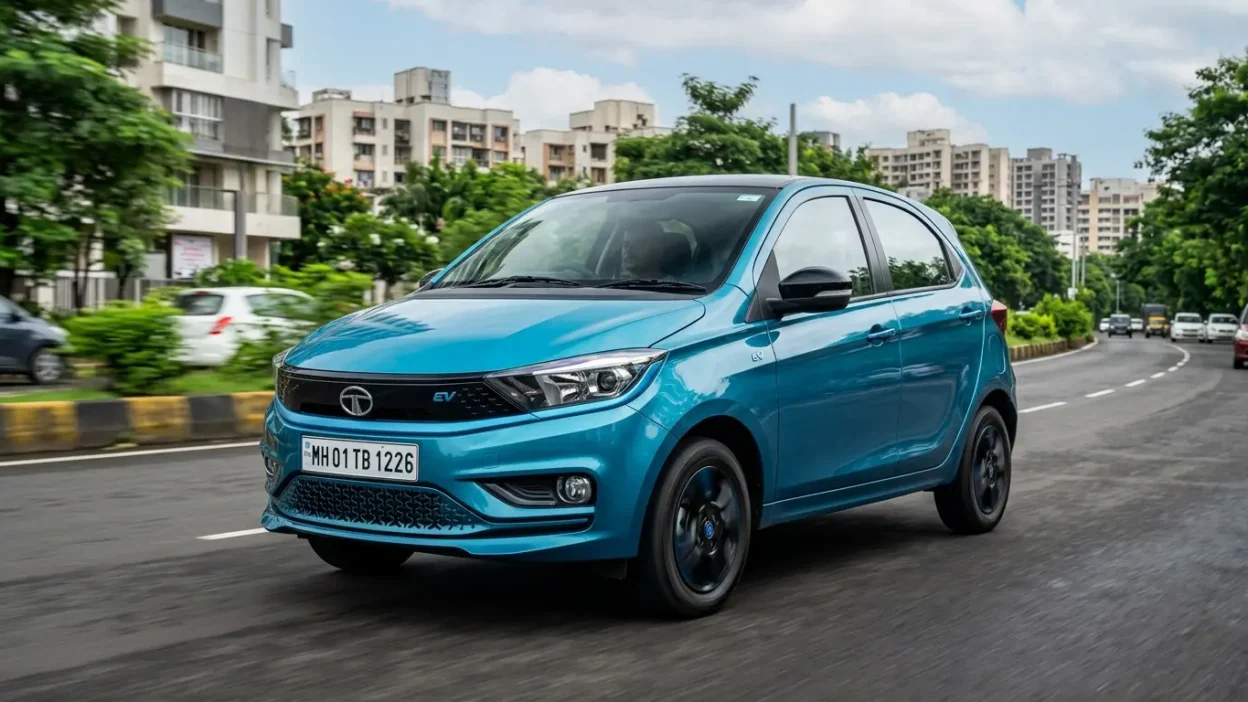
Every EV conversation in India eventually lands on the same question: “But what’s the cheapest one that actually makes sense?” For a long time, that answer has been the Tata Tiago EV, and the freshly updated 2026 model makes an even stronger case for itself. This Tata Tiago EV review looks at what’s changed, what it actually costs to run, and whether “cheapest” also means “compromised” — or not.
Tata Tiago EV Price in India 2026
The 2026 Tiago EV facelift is priced between ₹6.99 lakh and ₹9.99 lakh (ex-showroom) for outright purchase. Under the Battery-as-a-Service (BaaS) scheme, the starting price drops further to ₹4.69 lakh, with a battery EMI of around ₹2.6 per km — worth noting this isn’t a rental subscription; you still own the battery outright, it’s simply structured as a lower-upfront-cost financing option.
For context, the pre-facelift model started at ₹7.99 lakh, so this update has actually made the entry point ₹1 lakh cheaper, while adding meaningful upgrades — a rare combination in the current EV market.
The lineup is spread across three trims:
- Smart (19.2 kWh only)
- Pure+ (19.2 kWh or 24 kWh)
- Creative+ (19.2 kWh or 24 kWh)
For most first-time EV buyers, the Pure+ with the 24 kWh battery is the sweet spot — enough range for daily use plus the updated feature list, without paying for the top Creative+ trim’s extras.
Comparing this against Tata’s slightly bigger EV? Read our Tata Punch EV Review 2026 in Hindi.
Design — A Meaningful Facelift, Not Just a Badge Update
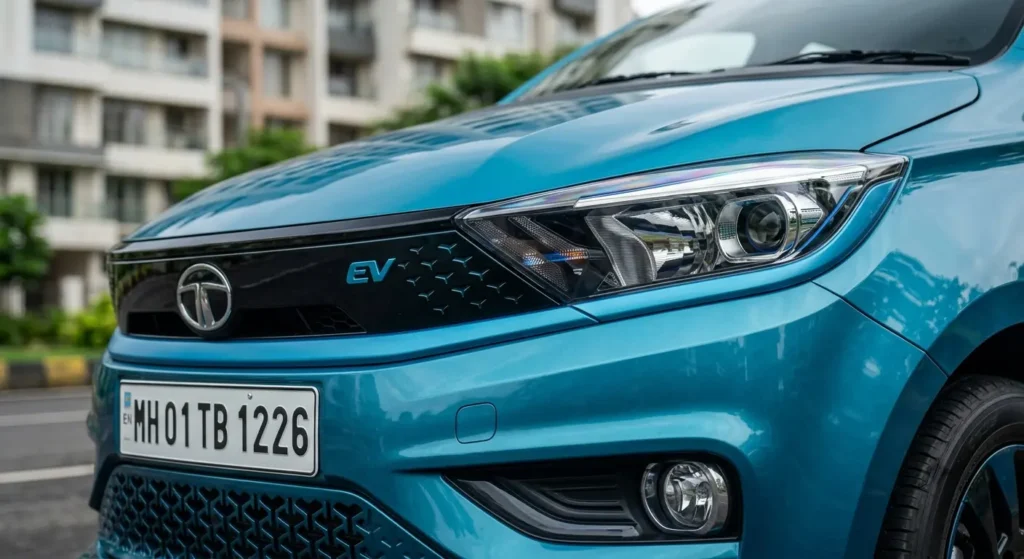
The 2026 Tiago EV facelift brings sharper headlamps, revised bumpers, fresh alloy wheel designs, and a closed-off grille section — a small but telling detail, since EVs don’t need the grille airflow that petrol engines do, and Tata has finally reflected that in the design. Six colour options are available, including Pristine White, Daytona Grey, and the more distinctive Pangong Pulse and Sobo Surge shades.
Dimensions stay compact and city-friendly at 3,825mm length, 1,684mm width, and a 2,400mm wheelbase — easy to park, easy to thread through narrow lanes, which is really the point of a car like this.
Range & Battery — What You Actually Get Day to Day
The Tiago EV continues with two battery options, badged MR (Medium Range) and LR (Long Range):
| Battery | Power / Torque | Claimed Range (MIDC) | Real-World Range |
|---|---|---|---|
| 19.2 kWh (MR) | 60–61 bhp / 110 Nm | 226 km | ~160–180 km |
| 24 kWh (LR) | 74–75 bhp / 114 Nm | 285 km | ~190–210 km |
That real-world gap is worth being upfront about — a claimed 285 km typically translates to something closer to 190-210 km once you factor in AC use, traffic, and typical city driving conditions. For someone commuting daily within city limits with occasional weekend errands, that’s genuinely sufficient. If your daily driving regularly pushes past 150 km, the 24 kWh LR variant is the one to go for — the 19.2 kWh MR will feel tighter on longer days.
Tata also claims a 0-60 km/h time of 5.7 seconds for the 24 kWh version — genuinely quick off the line for a car in this price bracket, which is one of the pleasant surprises of driving an entry-level EV versus its petrol equivalent.
Wondering how this compares to a bigger, pricier Tata EV? Check our Tata Nexon EV Long Term Review.
Charging Time & Cost
This is where the 2026 update genuinely shines. Tata says the Tiago EV now charges 40% faster, adding 100 km of range in just 18 minutes. Both battery packs can go from 10% to 80% in 35 minutes using a 30 kW DC fast charger, and standard AC charging options include 3.3 kW and 7.2 kW setups for home use.
Running costs are where the Tiago EV’s core appeal really lives — several owners report a per-km cost of under ₹1 when charging at home, which is a genuinely dramatic saving compared to even the most fuel-efficient petrol hatchback.
Interior, Features & Tech
The interior gets a proper overhaul for 2026 — a revamped dashboard layout, updated steering wheel, a new centre console, a standalone digital driver’s display, and a rotary gear selector that makes the cabin feel noticeably more modern than the outgoing model.
Feature highlights include a 10.25-inch infotainment touchscreen with wireless Android Auto and Apple CarPlay, automatic climate control, a 4-speaker sound system, rear AC vents, cruise control, a height-adjustable driver’s seat, and four levels of regenerative braking with City, Sport, and Drive modes to choose from.
Boot space comes in at 240 litres — reasonable for a car this size, though it’s worth noting there’s no frunk (front trunk), unlike some rivals.
Curious about a slightly bigger hatchback alternative? Compare it in our Best Electric Car Under 10 Lakh India 2026 roundup.
Safety
This is a genuinely significant upgrade for 2026 — the Tiago EV now gets 6 airbags as standard, up from the previous dual-airbag setup. It also adds a 360-degree camera with multiple viewing modes, a blind-spot monitor, ESP with traction control, hill-hold assist, tyre-pressure monitoring, torque vectoring by braking, and ABS with EBD. Tata has also strengthened the car’s structural rigidity for improved crash protection.
The pre-facelift Tiago EV carried a 4-star Global NCAP rating, and since the structure remains largely the same, the updated model is expected to retain a similar rating — worth double-checking for an official confirmation closer to your purchase date, since crash-test ratings can shift with updated testing protocols.
Warranty — A Genuine Standout
Tata is offering a lifetime, unlimited-kilometre warranty on the high-voltage battery pack for the 24 kWh version, extended to the first registered owner — a genuinely rare commitment in this price segment. The 19.2 kWh version continues with an 8-year/1.6 lakh km battery warranty, which is still solid but noticeably shorter than its bigger sibling’s coverage.
Tata Tiago EV: Pros and Cons
Pros:
- Genuinely the most affordable way into EV ownership in India
- Lifetime battery warranty on the 24 kWh variant
- Meaningfully faster charging after the 2026 update (100 km in 18 minutes)
- 6 airbags now standard — a big safety upgrade
- Very low running cost, often under ₹1 per km on home charging
Cons:
- Real-world range noticeably lower than claimed figures
- No frunk, and boot space is modest at 240 litres
- 4-speaker sound system feels basic on lower trims
- Entry Smart trim misses several features available on Pure+ and Creative+
- Not ideal if your daily driving regularly exceeds 150-180 km
Tata Tiago EV vs Competitors
The Tiago EV’s main rival is the MG Comet EV, though the two take fairly different approaches — the Comet EV leans into a compact city-car format, while the Tiago EV offers a more conventional hatchback layout with a bigger usable cabin. Against Tata’s own lineup, the Tiago EV remains the clear entry point, with the Punch EV as the natural step-up if you want a taller, SUV-styled body for a bit more money.
Deciding between the two? Our Tata Punch EV vs Tata Tiago EV Comparison breaks down which makes more sense for your budget.
For official pricing and the latest variant details, check Tata Motors’ official Tiago EV page.
Verdict: Should You Buy the Tata Tiago EV in 2026?
If your primary goal is the lowest possible cost of entry into EV ownership — without sacrificing on modern safety features or charging speed — the 2026 Tiago EV facelift makes a genuinely strong case for itself. Go for the Pure+ trim with the 24 kWh battery for the best balance of range, features, and that all-important lifetime battery warranty. It’s not a car built to impress with numbers on paper, but as a practical, low-running-cost first EV, it’s hard to beat at this price.
Want to see the full range of budget EV options? Check our Best Electric Car Under 10 Lakh India 2026 guide.
Frequently Asked Questions
What is the real-world range of the Tata Tiago EV? The 24 kWh (LR) variant typically delivers around 190–210 km in real-world driving, against a claimed MIDC range of 285 km.
What is the on-road price of the Tata Tiago EV? Ex-showroom prices range from ₹6.99 lakh to ₹9.99 lakh, with a BaaS option available from ₹4.69 lakh.
How fast does the Tata Tiago EV charge? With the 2026 update, both batteries can charge from 10% to 80% in 35 minutes using a 30 kW DC fast charger, adding 100 km of range in just 18 minutes.
Does the Tata Tiago EV have 6 airbags? Yes, as of the 2026 facelift, 6 airbags are now standard across the range, up from the earlier dual-airbag setup.
Is the Tata Tiago EV good for daily commuting? Yes — for daily city commutes under 150 km, the Tiago EV is a genuinely practical and low-cost option, especially on the 24 kWh variant.