
Maruti Suzuki has spent decades building its reputation on reliability and an unmatched service network, while largely sitting out the EV race in favour of hybrids and CNG. The e Vitara changes that — it’s the brand’s first proper, ground-up electric SUV, built on a dedicated EV platform rather than a converted petrol car. This Maruti Suzuki e Vitara review looks at whether that legendary Maruti trust actually translates into a genuinely competitive EV.
Maruti Suzuki e Vitara Price in India 2026
The e Vitara is priced between ₹15.99 lakh and ₹20.21 lakh (ex-showroom), spread across three variants. Under the Battery-as-a-Service (BaaS) scheme, prices drop significantly — to ₹10.99 lakh for the base Delta 49 kWh, ₹11.99 lakh for the mid-spec Zeta, and ₹14.29 lakh for the fully loaded Alpha 61 kWh — with an additional battery rental fee of ₹3.99–4.39 per km.
The three variants break down as:
- Delta (49 kWh only)
- Zeta (61 kWh)
- Alpha (61 kWh)
For most buyers, the Zeta 61 kWh is the genuine sweet spot — it offers the maximum range, a more powerful motor, Level 2 ADAS, and all the essential features, without paying the premium the top Alpha trim commands for largely cosmetic and convenience extras.
Weighing this against Tata’s premium SUV option? Read our Tata Harrier EV Review.
Design — A Deliberate Departure From the Brezza and Grand Vitara
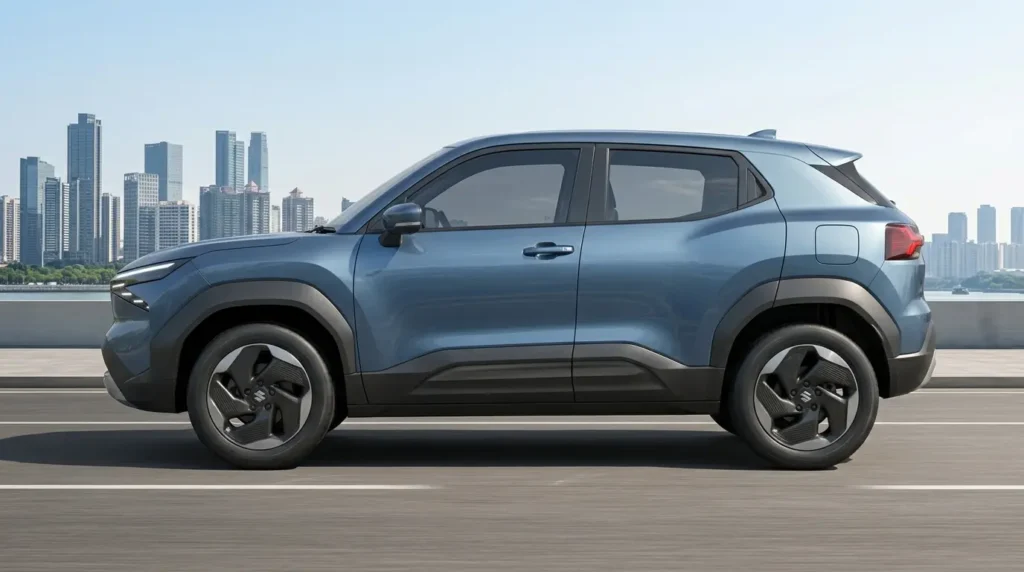
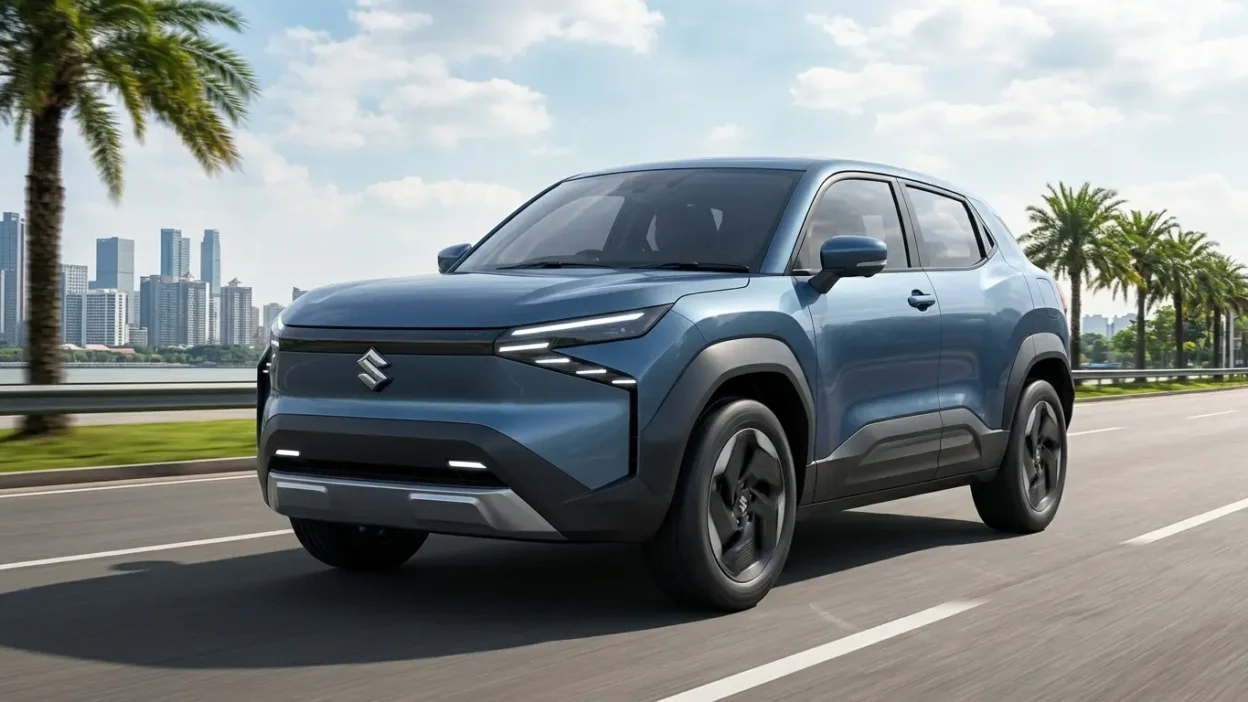
Maruti has clearly decided the e Vitara needed its own identity rather than looking like an electrified version of an existing model. It gets a much more muscular stance, flared wheel arches, a high bonnet line, a closed-off front grille, and tri-arrow LED light signatures that give it a genuinely futuristic look — a deliberate move away from the softer styling Maruti is usually known for.
The 2,700mm wheelbase is a standout figure too, translating directly into cabin space that most rivals in this price bracket can’t quite match.
Range & Battery — A Genuine Segment Highlight
The e Vitara comes with two battery options:
| Battery | Power | Claimed Range (ARAI) | Efficiency |
|---|---|---|---|
| 49 kWh | 144 bhp | 440–543 km* | 8.98 km/kWh |
| 61 kWh | 174 bhp | 428–517 km | 8.90 km/kWh |
*Range figures vary slightly across sources depending on testing cycle; Maruti’s own certified figures place the 49 kWh variant at up to 543 km and the 61 kWh at around 517 km under Indian testing standards.
Real-world testing paints a more grounded picture — most reviewers report a comfortable 420–450 km on a single charge with mixed city and highway driving, and city-only driving with AC running typically returns around 7.5-8.0 km/kWh. That real-world figure is still genuinely competitive, and for most Indian buyers, it’s more than enough to eliminate range anxiety on all but the longest road trips.
Notably, the e Vitara is offered only in front-wheel-drive (FWD) configuration in India, even though an AWD variant exists in overseas markets — worth knowing if all-wheel-drive capability is on your checklist.
Want a Tata alternative with AWD availability? Check our Tata Sierra EV First Look Review.
Charging Time & Cost
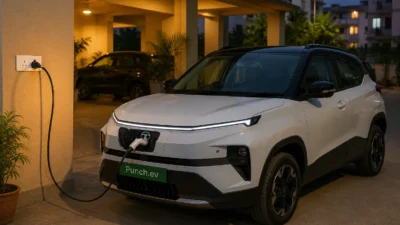
Every e Vitara purchase includes a complimentary 7.4 kW AC home charger with standard installation — a genuinely valuable inclusion that saves buyers a meaningful chunk of setup cost most rivals don’t cover. Maruti also offered early buyers (purchases till March 31, 2026) one year of free charging up to 1,000 kWh at Maruti dealerships through the ‘e for me’ app, which helps with finding chargers and reduces range anxiety on longer trips.
Under the BaaS scheme, the battery rental fee sits between ₹3.99 and ₹4.39 per km — worth running the numbers on for your expected annual mileage before deciding between outright purchase and BaaS.
Interior, Features & Tech
The cabin feels genuinely premium for a Maruti product, with a 10.25-inch digital driver’s display, a 10.1-inch infotainment touchscreen, an Infinity sound system, a wireless phone charger, a fixed glass sunroof, ventilated front seats, and a powered driver’s seat on higher trims. The spacious wheelbase translates into noticeably good rear legroom, which is a genuine practical advantage for family buyers.
Level 2 ADAS is included, which is a meaningful safety and convenience feature to have standard on the mid and top variants rather than locked away entirely.
Internal link: Curious how this compares to another premium electric SUV cabin? Read our MG Windsor EV Review.
Driving Experience
Reviewers consistently point out that the e Vitara drives with a genuinely smooth, silent surge of power typical of a well-tuned EV, with light steering that makes it easy to manage in city traffic and tight parking situations. On the highway, the 174 bhp motor on the 61 kWh variant feels punchy enough for comfortable overtaking and cruising, without tipping into performance-car territory.
It’s not a car built to thrill — it’s built to make the transition from a petrol Maruti to an EV feel as familiar and unintimidating as possible, and on that front, it largely succeeds.
Safety
The e Vitara carries a genuinely strong safety record: a 5-star Bharat NCAP rating and a 4-star Euro NCAP rating, backed by 7 airbags, a 360-degree camera, ADAS, and a tyre pressure monitoring system (TPMS) as standard equipment. For a brand buyers already associate with dependable, no-drama ownership, this safety consistency reinforces exactly the reputation Maruti is leaning on with this launch.
Service Network — Maruti’s Biggest Advantage
This is genuinely where the e Vitara pulls ahead of nearly every rival on this list. Maruti backs the e Vitara with its 1,500+ EV-ready service network — by far the largest of any EV brand in India. For buyers in smaller towns and cities where other EV brands’ service reach is thinner, this is a significant, practical advantage that shouldn’t be underestimated when comparing on-paper specs alone.
Maruti is also offering an assured buyback of up to 60% value return for three years/45,000km and 50% for four years/60,000km — a genuinely reassuring safety net for buyers still nervous about EV resale value.
Maruti Suzuki e Vitara: Pros and Cons
Pros:
- Genuinely strong real-world range (420-450 km) reduces range anxiety
- Backed by India’s largest EV-ready service network (1,500+ centres)
- 5-star Bharat NCAP and 4-star Euro NCAP safety ratings
- Complimentary home charger included with purchase
- Assured buyback scheme adds resale confidence
- Spacious cabin thanks to the 2,700mm wheelbase
Cons:
- No AWD option in the Indian market, unlike some international markets
- Fixed (non-opening) glass sunroof, unlike full panoramic options on rivals
- Base Delta trim misses several features available on Zeta and Alpha
- Pricing sits at a premium compared to some segment rivals
- BaaS battery rental fee adds up over high annual mileage
Maruti Suzuki e Vitara vs Competitors
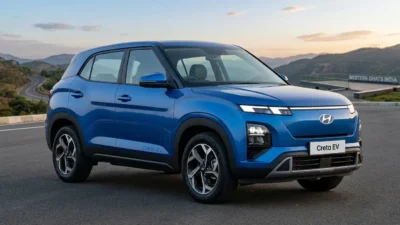
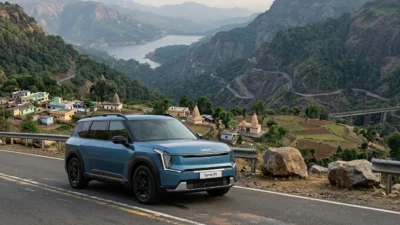
The e Vitara competes directly with the Tata Curvv EV, Hyundai Creta Electric, and Tata Sierra EV. Against most of these, the e Vitara’s biggest differentiator isn’t outright specs — it’s the combination of real-world range consistency and Maruti’s unmatched after-sales network, which matters enormously for buyers outside major metros.
See how it stacks up against Tata’s newer premium SUV in our Tata Sierra EV First Look Review.
Weighing budget options too? Our Best Electric Car Under 15 Lakh India guide covers the full shortlist.
For official specifications and the latest offers, check Maruti Suzuki’s official e Vitara page.
Verdict: Should You Buy the Maruti Suzuki e Vitara in 2026?
If you want an EV that feels genuinely trustworthy — backed by real-world range you can rely on and a service network that won’t leave you stranded — the e Vitara makes a strong case, especially for first-time EV buyers making the switch from a petrol Maruti. Go for the Zeta 61 kWh for the best overall value, and reserve the top Alpha trim only if the extra convenience features genuinely matter to you.
Frequently Asked Questions
What is the real-world range of the Maruti Suzuki e Vitara? Most reviewers report a real-world range of 420–450 km with mixed city and highway driving, against a claimed range of up to 543 km.
What is the on-road price of the Maruti Suzuki e Vitara? Ex-showroom prices range from ₹15.99 lakh to ₹20.21 lakh, with a BaaS option available from ₹10.99 lakh plus a battery rental fee.
Does the Maruti Suzuki e Vitara have all-wheel drive? No, the Indian-market e Vitara is offered only in front-wheel-drive configuration, though an AWD variant exists in some overseas markets.
What is the safety rating of the Maruti Suzuki e Vitara? It has a 5-star Bharat NCAP rating and a 4-star Euro NCAP rating, with 7 airbags standard.
Does the Maruti Suzuki e Vitara come with a free home charger? Yes, every purchase includes a complimentary 7.4 kW AC home charger with standard installation.
Considering the Maruti Suzuki e Vitara as your first electric car? Share your questions in the comments below.