
The electric vehicle (EV) revolution in India is moving at an incredible pace. Thanks to rising fuel costs, proactive government subsidies, and an influx of cutting-edge EV models, thousands of car and scooter buyers are making the switch to clean mobility. However, for a vast majority of urban EV owners living in multi-story apartments and group housing societies, the excitement of purchasing an electric car is often met with an unexpected roadblock: the Resident Welfare Association (RWA) or Cooperative Housing Society (CHS) management committee.
While charging an EV at home is the most convenient way to keep your vehicle powered, installing a private EV charger in a designated apartment parking spot requires navigating an intricate maze of community regulations. Many flat owners face flat-out rejections or unreasonable delays when requesting permission, usually driven by an RWA’s concerns over fire safety, grid overloading, or common-area modifications.
If you are a flat owner facing resistance, it is vital to know that the law is heavily on your side. This comprehensive guide breaks down the latest RWA rules, your explicit legal rights, the step-by-step process to secure a No Objection Certificate (NOC) using our optimized template, and how to logically address every management concern.
The Indian Legal Framework: Your “Right to Charge”
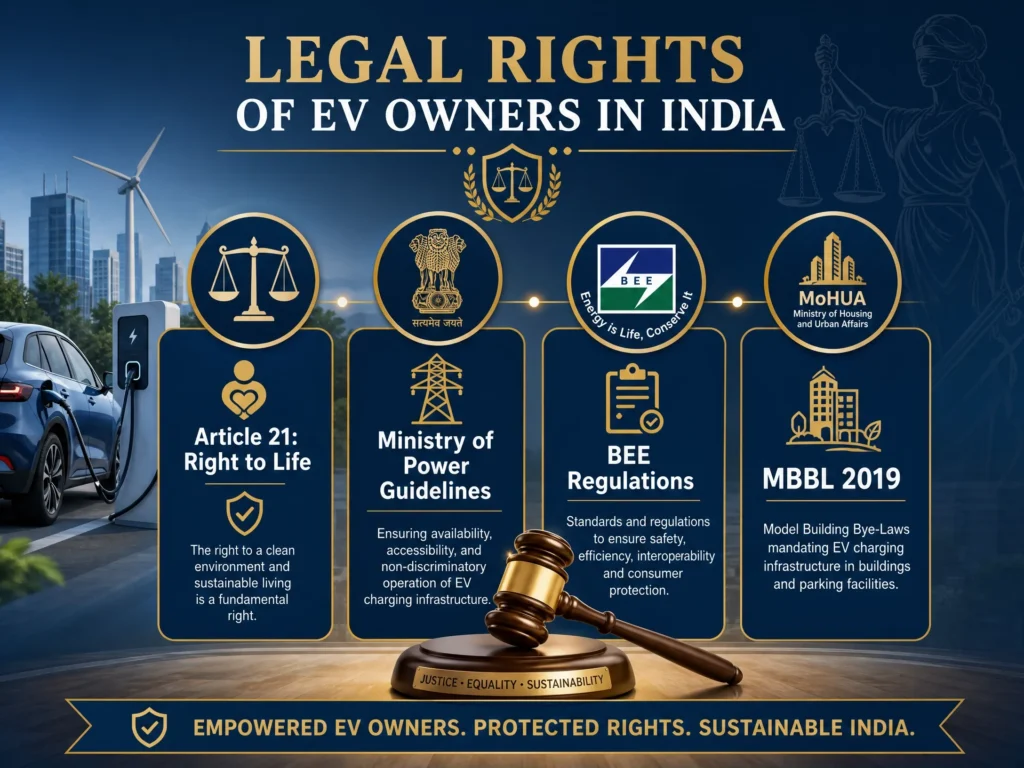
Many RWA committees act under the false impression that they hold absolute veto power over what structural or electrical additions are made to residential properties. However, both the Central Government and the Indian Judiciary have laid down clear, progressive directives that treat EV charging infrastructure not as a luxury, but as an essential utility akin to electricity or water connections.
Ministry of Power (MoP) Guidelines
The Ministry of Power (MoP) updated its Guidelines for Installation and Operation of Electric Vehicle Charging Infrastructure. The cornerstone of this policy framework is that setting up an EV charging station (EVCS) is a completely unlicensed activity.
Any individual, private entity, or housing society is completely free to establish a charger provided they adhere to technical and safety standards issued by the Central Electricity Authority (CEA).Furthermore, the guidelines explicitly mandate local power distribution companies (DISCOMs) to prioritize and fast-track electricity connections for EV charging setups.
Bureau of Energy Efficiency (BEE) Regulations
As the central nodal agency for EV infrastructure rollout, the Bureau of Energy Efficiency (BEE) has explicitly included Group Housing Societies and RWAs as primary target areas for residential charging ecosystem development. The BEE’s framework underscores that individual residents have an inherent right to install individual chargers in their legally allotted or leased stilt/basement parking spaces, provided the technical infrastructure is certified safe.
Ministry of Housing & Urban Affairs (MoHUA) & MBBL 2019
The Model Building Bye-Laws (MBBL) 2019 amended by MoHUA state that all new residential and commercial buildings must allocate at least 20% of their total parking capacity as “EV-ready”. This means the internal wiring, conduits, and transformer load capacities must be pre-engineered to support EV charging points. For older building retrofits, state governments have adjusted these bylaws to favor easy structural alterations for cable layouts.
State-Level EV Policies
Various states have gone a step further to remove bureaucratic friction for flat owners:
- Delhi: The Delhi EV Policy provides structural subsidies for private charging equipment and forces a single-window clearance mechanism to bypass long-winded society approvals.
- Maharashtra: Under the Maharashtra Cooperative Societies Act, arbitrary denial of EV space allocation can be challenged directly with the Registrar.
- Karnataka & Tamil Nadu: Both states have introduced dedicated EV tariffs for residential buildings and high-tension consumers, enabling cheaper, dedicated billing lines for EV owners.
Landmark Judicial Precedents: The Game Changers
If your RWA claims “there is no official society policy to allow this,” the Indian courts have already set a binding answer.
In the landmark case Amit Dholakia v. State of Maharashtra & Ors. (January 2025), the Bombay High Court ruled heavily in favor of a resident who was denied EV charging installation by his housing society. The Division Bench held that:
“The aspect of having a clean, non-polluted environment is an integral part of fundamental rights guaranteed under Article 21 (Right to Life) of the Constitution of India… [This] ought to weigh on the mind of the authorities in taking prospective measures in the mass adoption of technological advancements.”
The court explicitly directed the Registrar of Cooperative Societies to mandate and finalize rules forcing housing societies to allow EV installations.Similarly, various Assistant Registrars across Indian metros have consistently penalized RWAs that pass discriminatory resolutions blocking EV charger setups in allotted car parks.
Understanding the RWA’s Role and Legitimate Concerns
To handle your RWA effectively, you must understand why they require an NOC in the first place. The management committee holds a fiduciary duty to protect the property and its inhabitants. Their hesitations usually stem from real, solvable operational challenges rather than malice:
- Electrical Load and Grid Capacity: If 20 residents plug in 7.4 kW fast chargers simultaneously, will the society’s main transformer trip? This structural anxiety is valid. Legacy buildings were not designed with high-draw EV infrastructure in mind.
- Fire Safety Concerns: Litigations and media coverage surrounding battery fires make committees incredibly nervous about high-voltage lines running through basement parking lots.
- Aesthetics and Common Area Modification: Routing heavy-duty armored cables through common corridors, shafts, and stairwells can lead to messy, unauthorized drilling or messy wiring bundles if unchecked.
- Billing and Power Theft: How can the society guarantee that an individual’s car charger isn’t pulling power from the common area grid (which is paid for by all residents through maintenance fees)?
Overcoming Typical RWA Objections
| Common RWA Objection | Legally and Technically Sound Counter-Response |
| “Our existing building transformer cannot handle the extra load.” | State that you are applying for an independent electrical load enhancement directly from the DISCOM to your personal meter, or utilizing smart load management so charging occurs during off-peak night hours. |
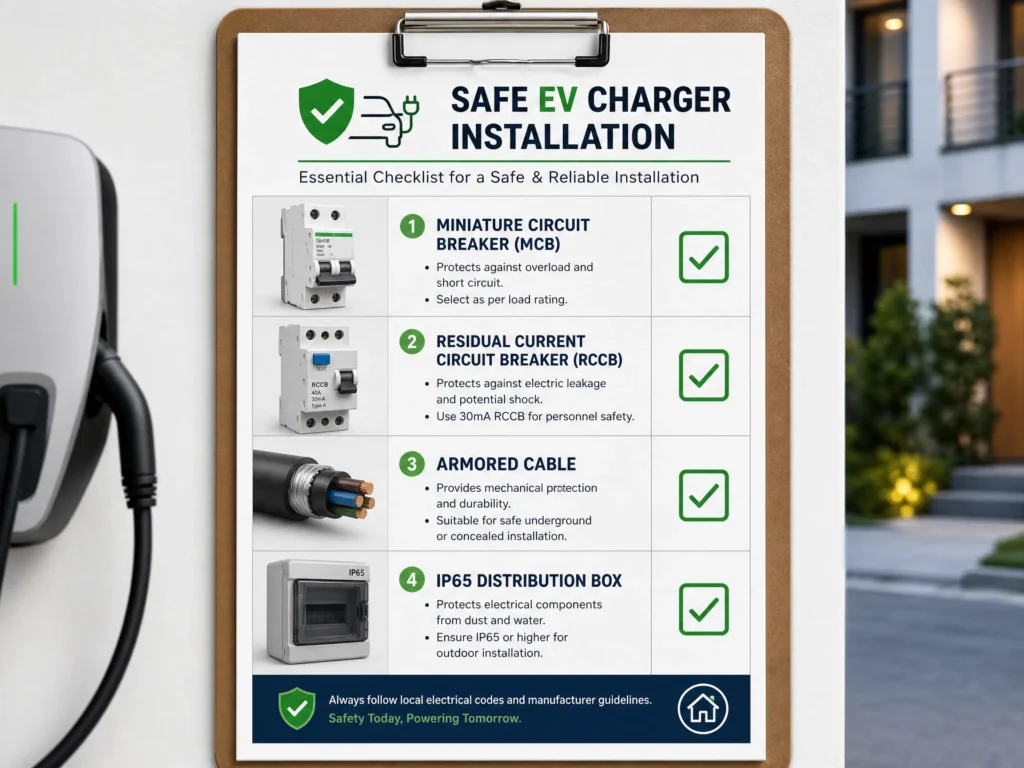
| “EV chargers pose a severe fire hazard to the basement.” | Highlight that your installation will feature dedicated protection devices: a Miniature Circuit Breaker (MCB), a Residual Current Circuit Breaker (RCCB) to prevent shocks, and a Surge Protection Device (SPD). All cables used will be fire-retardant and armored. |
| “You cannot cut or drill through common walls to lay your cables.” | Clarify that the cable routing will follow established common utility shafts (where internet, water, and intercom wires already run) using protective PVC/metal conduits, completely restoring any drilled area to its original state. |
| “Other residents will complain about space and unauthorized power use.” | Emphasize that the charger will be physically locked (via key or RFID tap cards) and linked strictly to your unit’s meter, preventing any third-party energy theft. |
Step-by-Step Guide to Requesting and Obtaining your NOC
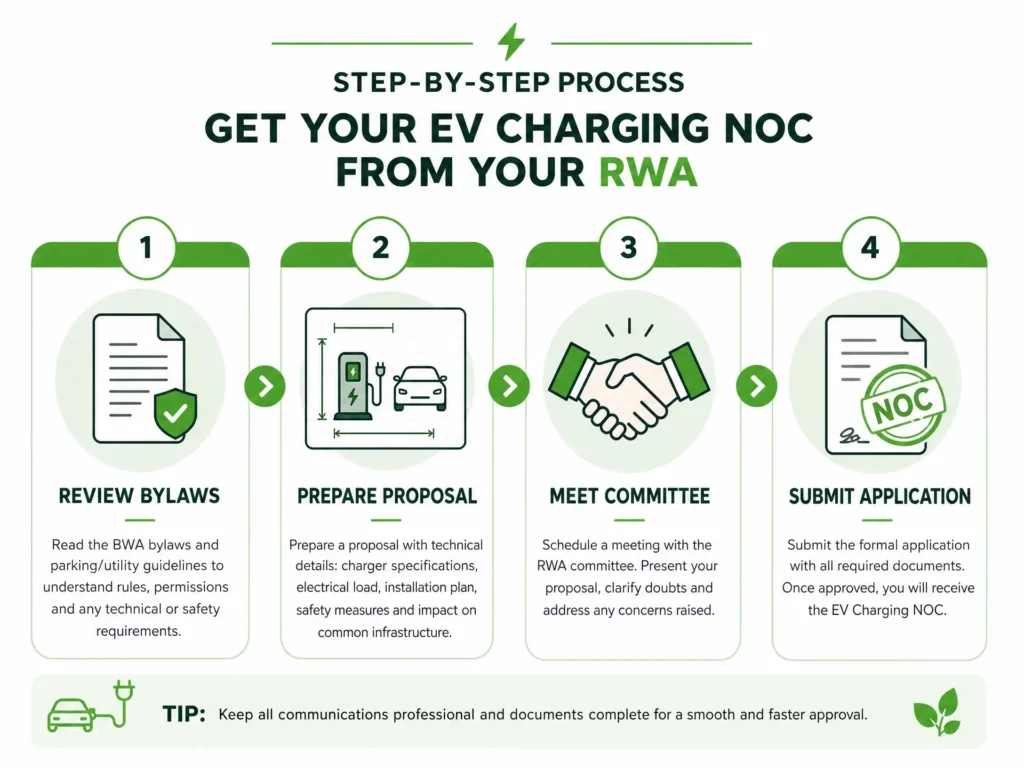
Securing permission is all about presentation. Follow this structured roadmap to eliminate any grounds for rejection:
Step 1: Review the Society Bylaws
Obtain a copy of your society’s registered bylaws or memorandum of association. Check if there are any existing clauses regarding electrical retrofitting, parking area allocations, or specific EV clauses added during recent Annual General Meetings (AGMs).
Step 2: Prepare a Professional Installation Proposal
Do not just write a casual letter. Put together a thorough technical dossier. Your proposal must feature:
- Charger Specifications: Copy of the manufacturer datasheet (e.g., Exicom, Kazam, Tata Power) proving it has ARAI/CE safety certifications and built-in earth leakage protections.
- Electrical Diagram: A simple layout drawn up by a licensed electrical engineer or your EV dealer showing the line path from your meter down to your parking slot.
- Safety Integration Plan: List your defensive gear: an outdoor-rated IP65 distribution box containing an MCB and an RCCB (Type B is highly recommended for EVs to catch DC leakages).
Step 3: Meet the Management Committee In-Person
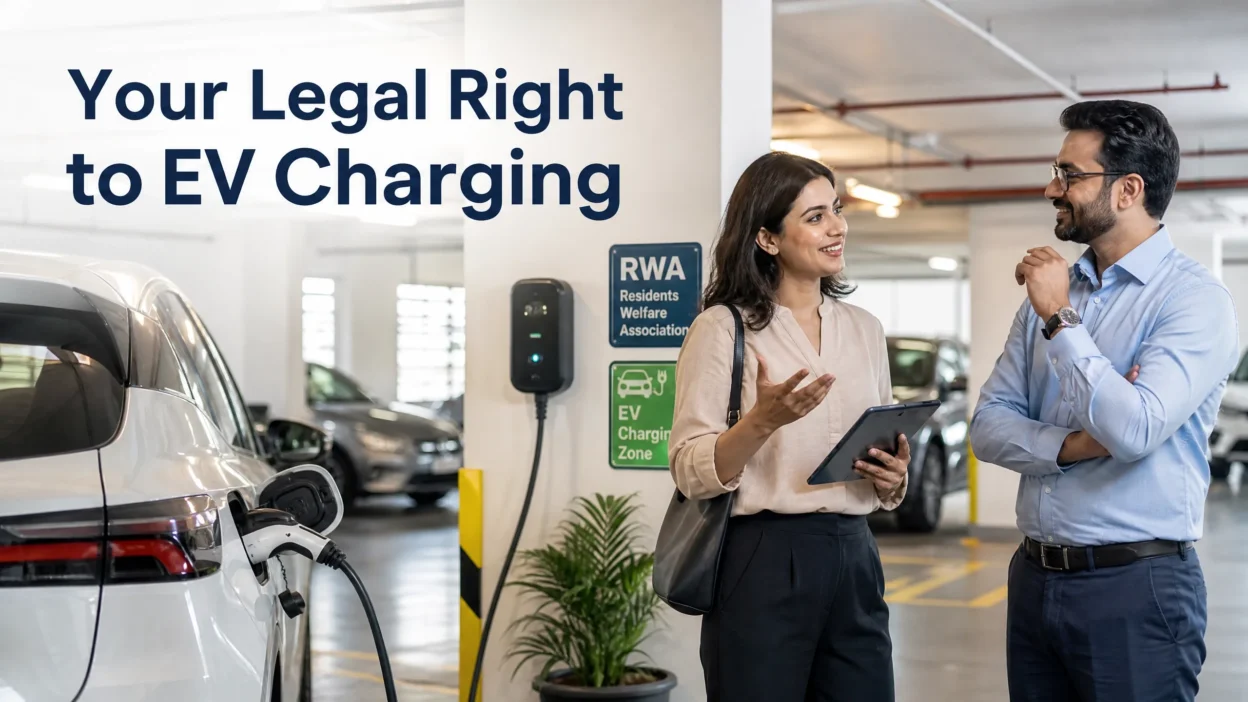
Schedule a brief face-to-face talk with the RWA President or Secretary. Walk them through your plan gently, showing them that you are prioritizing the safety of the entire building. Presenting your project as a standard, professional engineering upgrade dramatically reduces their anxiety.
Step 4: Submit the Formal Application and Get it in Writing
Hand over your comprehensive file alongside a formal request letter. Ensure you get an official “Received” stamp with a date on a duplicate copy for your personal records.
The Standard NOC Request Template
You can adapt the professional template below to submit your official application to your RWA or CHS management committee.
To,
The Management Committee / Resident Welfare Association (RWA),
[Name of the Housing Society/Apartment Complex]
[Full Address of the Society]

Subject: Request for Issuance of No Objection Certificate (NOC) for Installation of Private EV Charging Point at Allotted Parking Slot

Respected Committee Members,

I am [Your Full Name], the registered owner of Flat/Apartment No. [____] in Block/Tower [____] of our society. I am writing to formally request your permission and the issuance of a No Objection Certificate (NOC) to install a private Electric Vehicle (EV) charging point at my legally allotted/designated parking space No. [____], located in the [Basement / Stilt / Open Parking Area].

As part of my commitment to sustainable living, I am transitioning to an electric vehicle. To facilitate safe home charging, I plan to install an AC slow/home charger with a power rating of [e.g., 3.3 kW / 7.4 kW].

To address any safety, operational, or infrastructure requirements, I would like to bring the following points to the committee's attention:

1. Source of Power & Billing: The electrical line for this EV charger will be drawn directly from my personal residential electricity meter / a dedicated new EV connection provided by the DISCOM [Name of Power Company, e.g., BSES, MSEDCL, BESCOM]. The consumption will be billed entirely to my personal account. No common area electricity will be utilized.
2. Safety Compliance: The installation will be carried out by a certified technician/licensed electrical contractor in strict compliance with Central Electricity Authority (CEA) safety guidelines. The setup will include dedicated safety mechanisms housed in an IP65-rated distribution box:
   - A properly rated Miniature Circuit Breaker (MCB) for overcurrent protection.
   - A Residual Current Circuit Breaker (RCCB/RCBO) to prevent any earth-leakage or shock hazards.
   - Fire-retardant, low-smoke (FRLS) armored cables running through protective conduits along common utility pathways.
3. Access Control: The charging unit features [RFID card access / physical key lock / mobile app authentication], ensuring that no unauthorized personnel can access or use the charger.
4. Maintenance and Liability: All upfront installation costs, future maintenance, and technical upkeep of this charging setup will be borne entirely by me. I assure the committee that any common areas utilized for cable routing will be restored neatly to their original condition.

I have enclosed the manufacturer’s technical data sheet, safety certifications, and a tentative line-routing diagram for your reference.

Given that the Ministry of Power guidelines and recent judicial rulings (including the Bombay High Court's directive under Article 21) explicitly protect a resident's right to install residential EV infrastructure, I kindly request you to process this application and issue the written NOC within [e.g., 7 or 14] days so that I may coordinate with the DISCOM for the necessary meter upgrades.

Thank you for your proactive support toward making our community EV-friendly.

Yours Sincerely,

(Signature)
[Your Full Name]
Flat No: [____], Tower: [____]
Mobile Number: [__________]
Date: [DD/MM/YYYY]

Enclosures:
1. Copy of Allotment Letter / Property Deed proving parking slot ownership.
2. Manufacturer Charger Brochure & Safety Certificates (CE/IS).
3. Proposed Cable Route Layout Plan.
What If the RWA Rejects Your Request? Your Legal Recourse
If your management committee flatly denies your request or sits on your application indefinitely without a valid reason, do not panic. You have clear paths of escalation:
- Demand the Rejection in Writing: An RWA cannot simply tell you “No” verbally. Force them to issue a formal letter stating the exact technical or statutory reasons for the rejection. Most committees hesitate to put an arbitrary rejection in writing because they know it holds no legal weight.
- Initiate Formal Mediation: Arrange an extraordinary meeting. Present the Amit Dholakia v. State of Maharashtra case details and the BEE guidelines. Remind them gently that obstructing an infrastructure upgrade backed by the Central Government opens the committee members up to personal legal liabilities for acting ultra vires (beyond their legal power).
- File an Appeal with the Registrar of Cooperative Societies: If the deadlock continues, file a formal complaint with the local Deputy Registrar of Cooperative Societies. The Registrar has explicit powers to overrule arbitrary society resolutions that infringe on your basic property rights and environmental choices.
- Serve a Legal Notice: If all internal options fail, have a lawyer draft and send a formal legal notice to the RWA Management Committee. Cite your rights under Article 21 of the Indian Constitution alongside regional DISCOM rules. This step almost always coaxes the committee into an out-of-court settlement or rapid issuance of the NOC.
Technical Setup Options: Choosing What Works
When planning your setup, you must choose between deploying an independent line or opting for an ecosystem that integrates with the broader community.
Private (Individual) Charger Setup
This is the standard approach where an armored cable runs directly from your personal home electricity meter down to your parking bay. It gives you absolute control over your charging times and means you pay your standard domestic energy rates. It is perfectly suited for a building where only a few early adopters own an EV.
Community (Shared) Smart Charging Networks
If your apartment building has dozens of EV owners, a shared approach becomes far more efficient. The RWA can partner with a Charge Point Operator (CPO) to install a bank of shared AC smart chargers in a common visitor parking zone.
These devices connect to a central software cloud via the internet. Residents scan a QR code, charge their vehicle, and the backend software handles the billing automatically—depositing the energy costs directly into the society’s bank account while utilizing dynamic load balancing to prevent grid trips.
Cost, Upgrades, and Subsidies: The Financials
Setting up home charging involves specific hardware, installation, and recurring electricity costs.
Charger & Installation Breakdown
- Hardware Cost: A standard 3.3 kW or 7.4 kW AC home charger usually costs between ₹15,000 and ₹50,000, and is frequently bundled for free with the purchase of your electric car or premium scooter.
- Installation & Cabling: Depending on how far your personal electricity meter is from your basement parking spot, cabling costs (utilizing high-grade, fire-retardant 3-core copper wires) typically range from ₹15,000 to ₹35,000.
- Infrastructure Upgrades: If your apartment block is an older build, a recent 2026 study by the Alliance for an Energy Efficient Economy (AEEE) and Kazam highlighted that nearly 45% of Indian homes require minor electrical upgrades (such as panel retrofitting or main distribution line reinforcement) to handle sustained EV charging loads safely.
Electricity Tariffs & Smart Metering
Charging your vehicle on your domestic line means the electricity consumed will simply add to your regular progressive billing cycles. However, multiple state governments now provide a dedicated EV Tariff line.
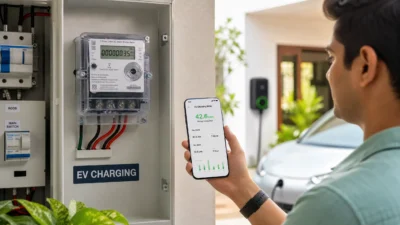
By paying a nominal fee to your DISCOM, they will install a second, separate meter specifically for your EV charger. This line completely bypasses your home’s consumption slabs and offers fixed, significantly cheaper per-unit rates (often ranging between ₹4.50 to ₹6.50 per kWh, depending on the state).
Essential Caveats for a Hassle-Free Safe Setup
To keep your relationship with your RWA smooth and ensure absolute safety, avoid taking shortcuts:
- Avoid Local, Non-Certified Electricians: Do not hire uncertified handymen to lay loose, unarmored wires. Always use an authorized, licensed electrical contractor who can hand over an official Work Completion Certificate.
- Do Not Use Standard 15A Raw Plugs Long-Term: While a portable trickle charger can plug into a standard 3-pin 15-Amp household socket, these outlets are not built to deliver sustained high-current loads over 8 to 10 consecutive hours. They can warm up, warp, and trigger a localized short circuit. Always route power through an industrial-grade IEC 60309 socket enclosed in a weatherproof distribution box.
- Insist on Smart Chargers: Opt for a charger that lets you schedule your charging sessions via a smartphone app. By setting your vehicle to pull power between 2:00 AM and 6:00 AM, you charge during the building’s lowest overall power draw, keeping the RWA completely happy and protecting the local transformer.
Summary Checklist for EV Owners
To make the process straightforward, follow this quick summary checklist to track your progress:
- Get your vehicle’s detailed charging specifications from the dealer.
- Download and fill out the NOC template with your specific flat and parking details.
- Hire a licensed electrician to sketch a quick cable-routing layout.
- Submit the complete dossier to your RWA and get a dated acknowledgement stamp.
- Once approved, apply to your local DISCOM if a separate EV meter or load enhancement is required.
Conclusion
Securing an NOC from your RWA for an EV charger does not have to be a combative process. Armed with the right documentation, an emphasis on certified safety hardware, and backing from robust legal precedents like the Bombay High Court’s directives, you can easily guide your management committee toward a rapid, stress-free approval.
By taking a proactive, highly transparent approach today, you are not just setting up a convenient charging spot for your own vehicle—you are helping lay down the foundational green infrastructure your entire housing society will rely on for years to come.