
The landscape of electric mobility in India is moving at an unprecedented pace. For anyone looking to purchase an electric two-wheeler or for current EV owners tracking the market, understanding government incentives is crucial to maximizing savings. The cornerstone of India’s current consumer-facing EV framework is the PM Electric Drive Revolution in Innovative Vehicle Enhancement (PM E-DRIVE) scheme.
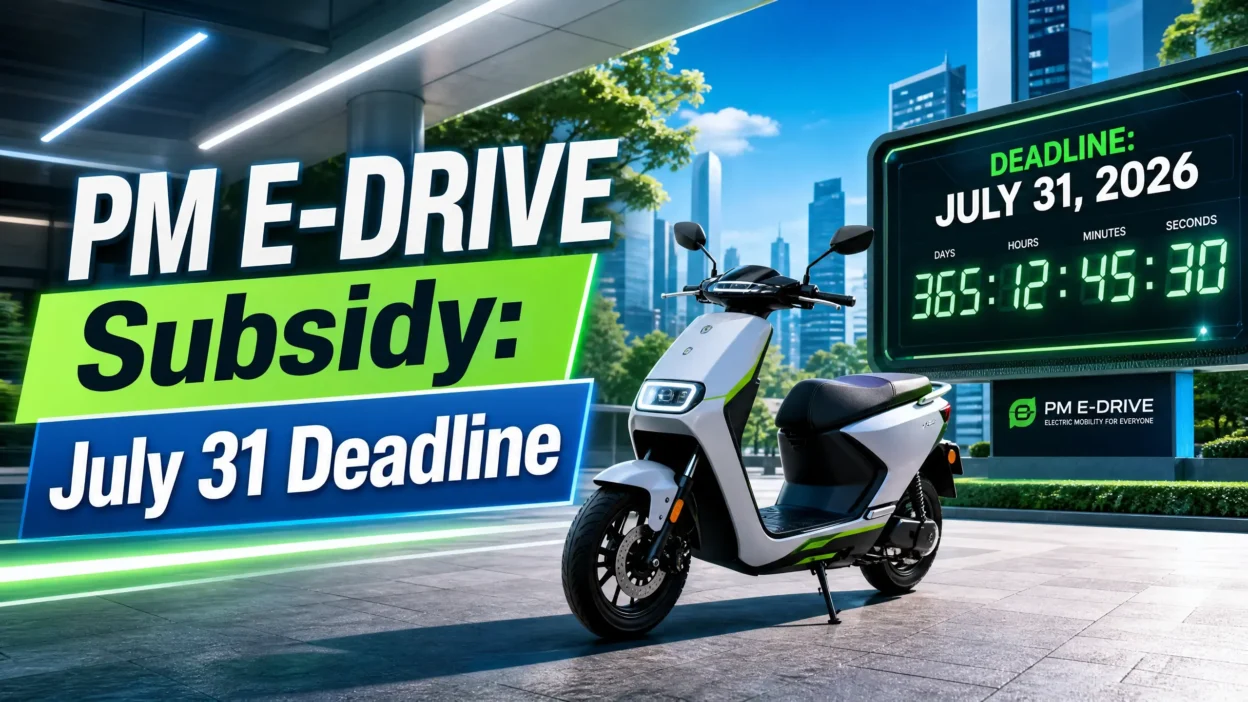
Initially scheduled to transition its primary demand incentives by March 31, 2026, a critical policy amendment from the Ministry of Heavy Industries (MHI) has officially extended the deadline for electric two-wheelers to July 31, 2026. This extension offers a vital four-month window for prospective buyers to secure central subsidies before direct financial incentives are phased out.
This comprehensive guide breaks down everything you need to know about the PM E-Drive subsidy electric scooter 2026 deadline, detailing the structural rules, modified subsidy brackets, strict eligibility conditions, a step-by-step voucher generation walkthrough, and the updated list of compliant manufacturers and models.
Overview of the PM E-DRIVE Scheme
Launched on October 1, 2024, by the Ministry of Heavy Industries, Government of India, the PM E-DRIVE scheme was introduced as a successor mechanism to accelerate the mass deployment of sustainable transport solutions across the country. Backed by an extensive overall financial outlay of ₹10,900 crore, the scheme serves a dual purpose: drastically reducing the upfront capital required by consumers to purchase electric vehicles (EVs) and establishing a robust nationwide charging infrastructure ecosystem.
Unlike generic manufacturing incentives, PM E-DRIVE is structured heavily around direct demand incentives. It provides a clean fiscal bridge, allowing electric vehicles to achieve price parity with traditional internal combustion engine (ICE) vehicles faster. Out of the total ₹10,900 crore budget, the central government allocated ₹1,772 crore specifically to subsidize approximately 24.79 lakh electric two-wheelers. This massive target reflects the government’s strategy to prioritize the highest-volume, highest-impact automotive segment on Indian roads: the daily commuter motorcycle and scooter market.
The July 31, 2026 Extended Deadline: Why Urgency Matters
When PM E-DRIVE was codified in late 2024, the operational guidelines set a firm expiration date of March 31, 2026, for consumer-facing electric two-wheeler demand incentives. The overarching narrative from the government signaled that the electric scooter ecosystem was reaching a state of organic market maturity, meaning direct buyer subsidies would be eliminated to focus funds on charging networks and heavy public transit infrastructure.
However, realizing the need to provide a stable cushion for price-sensitive buyers and ensure full allocation of the designated unit targets, the Centre announced an official amendment extending the subsidy program for electric two-wheelers by an additional four months.
Key Deadline Parameters to Keep in Mind:
- The New Terminal Date: The absolute final date for registered electric two-wheelers to claim the demand subsidy under this block is July 31, 2026.
- The “Fund-Limited” Trap: This is the most crucial caveat for buyers. While July 31, 2026, is the calendar deadline, the PM E-DRIVE scheme is strictly fund-limited and quota-bound.
- The Quota Status: The program is capped at a maximum of 24,79,120 electric two-wheelers. Data from early 2026 reveals that well over 19 lakh electric two-wheelers have already claimed the subsidy. With daily registration rates across India averaging thousands of units, the remaining quota is depleting rapidly.
Crucial Buying Rule: To successfully lock in the subsidy, your chosen electric scooter must be fully delivered and registered on the government’s Vahan portal on or before July 31, 2026. Simply booking the scooter or paying a token amount before the deadline does not qualify you for the discount if the dealership completes registration after the cutoff date. If the allocated budget or unit cap is reached before July 31, the portal will close automatically, and the subsidy will disappear prematurely.
Strict Eligibility Criteria for Electric Scooters
The Ministry of Heavy Industries enforces rigorous operational requirements to ensure that public funds are directed only toward high-quality, high-performance, and safe electric vehicles. A vehicle cannot qualify for the PM E-DRIVE cash-back ecosystem merely by being electric. It must strictly align with the following statutory guidelines:
Vehicle Segment and Ownership Rules
The scheme covers electric two-wheelers (e-2Ws) falling under the definitions of the Central Motor Vehicles Rules (CMVR). Both privately owned individual vehicles and corporate-owned commercial fleets are completely eligible for the registration benefits, providing a massive boost to delivery networks alongside regular family commuters. However, there is a strict one subsidy per individual restriction. The government tracks purchases through Aadhaar linkages, preventing single buyers from claiming multiple discounted personal vehicles.
Battery Technology Mandates
To elevate the safety standards of personal mobility in India, PM E-DRIVE strictly excludes low-grade or legacy battery systems.
- Advanced Batteries Only: The vehicle must be fitted with advanced chemistry batteries, such as Lithium-Ion (Li-ion), Lithium Iron Phosphate (LFP), or newer solid-state equivalents that clear stringent thermal and mechanical stress evaluations.
- Exclusion of Lead-Acid: Traditional lead-acid electric scooters—often found in ultra-low-cost, un-registered slow vehicles—are entirely disqualified from receiving any financial incentives under this program.
Ex-Factory Price Cap
To guarantee that the financial support benefits mainstream buyers rather than subsidizing premium luxury products, the Centre has implemented a strict price ceiling. The maximum permissible ex-factory price for an eligible electric two-wheeler is capped at ₹1.5 lakh. If a manufacturer’s base price before GST and local registration fees exceeds ₹1,500,00, the vehicle is barred from the program, and the consumer must pay the full market price.
Subsidy Amount and Calculation: The Tapering Structure
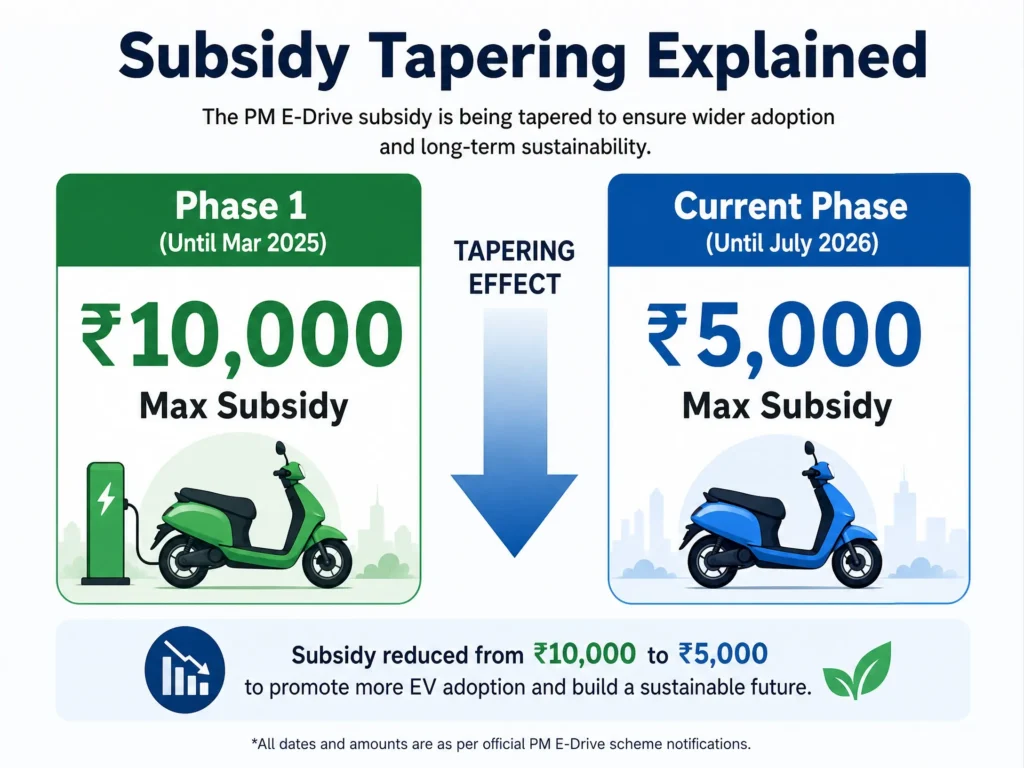
A core pillar of the PM E-DRIVE philosophy is the gradual reduction of direct financial dependence. To prevent a sudden economic shock to the automotive industry, the government designed a step-down tier system where the subsidy amount reduces as the industry matures.
The Fiscal Phase Shift
The incentive calculation moved through a notable structural shift as the calendar flipped past the initial phase of the deployment:
| Implementation Timeline | Incentive Rate per kWh | Maximum Subsidy Cap Per Vehicle |
|---|---|---|
| Launch Phase (Oct 1, 2024 – Mar 31, 2025) | ₹5,000 per kWh | ₹10,000 max per vehicle |
| Current Extension Phase (Apr 1, 2025 – Jul 31, 2026) | ₹2,500 per kWh | ₹5,000 max per vehicle |
The 15% Ex-Factory Protection Rule
Beyond the basic battery capacity calculation, the government maintains a secondary financial guardrail: the total demand incentive applied to the vehicle is limited to either the calculated per-kWh amount or 15% of the total ex-factory price, whichever value is lower.
Practical Calculation Examples
To clarify how this works when you walk into an authorized automobile dealership, consider these two practical scenarios under the current 2026 framework:
- Scenario A (Standard Commuter Scooter): You choose an electric scooter equipped with a 2.2 kWh advanced lithium-ion battery pack. Based on the active rate of ₹2,500 per kWh, the mathematical calculation yields $2.2 \times 2500 = 5500$. However, because the absolute subsidy cap for this current phase is strictly frozen at ₹5,000, the total discount applied to your vehicle invoice will be capped at exactly ₹5,000.
- Scenario B (Compact / Low-Capacity Scooter): You choose a lightweight urban electric scooter featuring a smaller 1.5 kWh battery pack. Multiplying this capacity by the incentive rate yields $1.5 \times 2500 = 3750$. Because ₹3,750 is less than the upper absolute threshold of ₹5,000, you will receive a direct upfront discount of exactly ₹3,750 on your final invoice.
The e-Voucher Claim Process: Seamless Dealership Integration
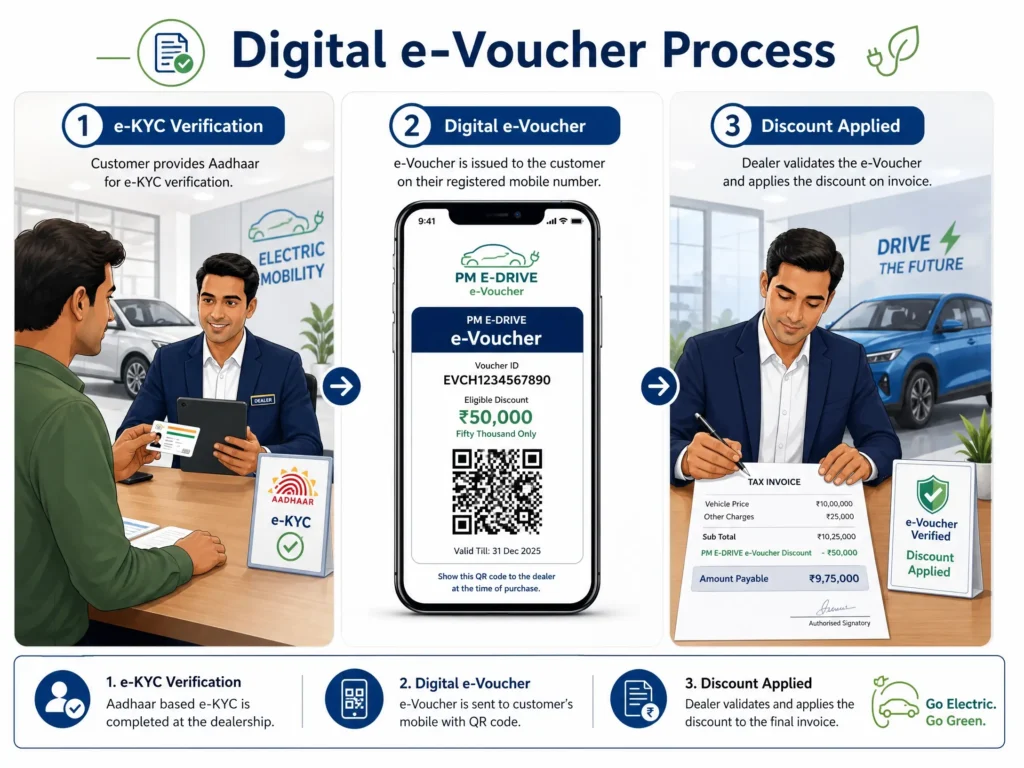
To address the slow processing times and paperwork errors of older frameworks, the Ministry of Heavy Industries introduced a streamlined, tech-driven e-Voucher system. This digitizes the process, making it transparent and instantaneous for the end consumer.
The customer does not have to file reimbursement paperwork with a government office. Instead, the entire process is handled directly at the dealership during the purchase window via an integrated portal.
+---------------------------------------------------------+
|                  THE E-VOUCHER PROCESS                  |
+---------------------------------------------------------+
|                                                         |
|  1. BUYER SELECTION                                     |
|     Customer selects an approved e-2W model at an       |
|     authorized OEM dealership.                          |
|                           v                             |
|  2. PORTAL ENTRY & e-KYC                                |
|     Dealer enters buyer details into the PM E-DRIVE     |
|     portal. Buyer completes Aadhaar FACE verification.  |
|                           v                             |
|  3. e-VOUCHER GENERATION                                |
|     System generates a digital voucher. A secure link   |
|     is pushed to the buyer's registered mobile number.  |
|                           v                             |
|  4. INVOICE DEDUCTION                                   |
|     Dealer applies the subsidy value directly as an     |
|     upfront discount on the vehicle's invoice.          |
|                           v                             |
|  5. SIGN & UPLOAD                                       |
|     Buyer signs the voucher copy. Dealer uploads the    |
|     signed voucher to claim reimbursement from MHI.     |
|                                                         |
+---------------------------------------------------------+
Critical Verification Guidelines
To ensure this digital sequence executes without a hitch at the time of your delivery, double-check that your identity documents match perfectly:
- Aadhaar Mobile Linkage: Your active mobile number must be officially linked to your Aadhaar card. If it is not, the Aadhaar-based e-KYC system will fail to trigger, blocking the generation of the mandatory e-voucher.
- Face Authentication Readiness: The updated system leverages an advanced e-KYC Aadhaar FACE authentication mechanism. Ensure your physical presentation allows for clear camera verification at the dealership.
- Instant Validation: Once the digital e-voucher is processed and verified, the dealer applies the financial deduction instantly to your on-road calculation sheets.
Eligible Manufacturers and Approved Models
To protect consumers from unverified brands, only vehicles from Original Equipment Manufacturers (OEMs) approved by the Ministry of Heavy Industries are eligible for the subsidy portal. The government maintains a dynamic, updated ledger of verified vehicles on its central web portal.
Several major automotive companies currently dominate the eligibility list with highly popular commuter variants:
1. TVS Motor Company
TVS has successfully integrated its main electric lineup into the core PM E-DRIVE approval databases. The highly successful TVS iQube series (spanning across the standard, S, and various battery pack trims) qualifies cleanly for the upfront central discounts. Additionally, newer entries like the TVS Orbiter are cataloged within the system, giving buyers a wide range of choice across different riding preferences.
2. Ola Electric
As one of the largest volume players in the Indian electric two-wheeler market, Ola Electric maintains broad eligibility across its core platform matrix. Approved models include the diverse Ola S1 variants and the utility-focused Ola S1 X model lines. These models stay well within the ex-factory price cap of ₹1.5 lakh, ensuring access to the ₹5,000 maximum demand incentive.
3. Greaves Electric Mobility (Ampere)
Catering extensively to value-focused urban commuters, Greaves Electric Mobility features strong representation in the registry. The long-standing Ampere Magnus variants—specifically the certified Ampere Magnus FE13A and Ampere Magnus FE13B variants—are fully approved, alongside newer models like the Ampere Nexus series.
4. Other Notable Players
Beyond these brands, major players like Ather Energy (450X and Rizta model families), Bajaj Auto (Chetak electric series), and Revolt Motors (RV400 electric motorcycles) are fully active on the portal, giving consumers a wide selection across India.
Consumer Pro-Tip: Because model variants, battery capacities, and trim levels shift periodically based on manufacturer updates, always cross-verify the specific variant code on the official PM E-DRIVE Model Approval Portal (pmedrive.heavyindustries.gov.in/models) before finalizing your payment.
Maximizing Value: Stacking Central and State Incentives
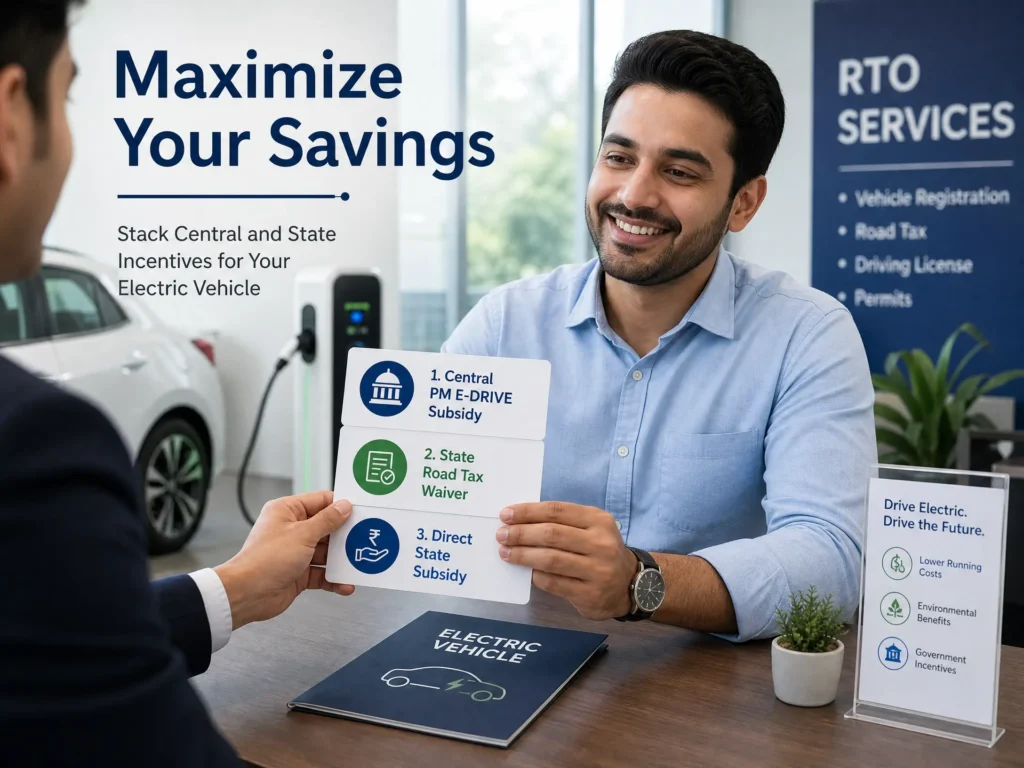
One of the most effective strategies for a prospective EV buyer in India is understanding subsidy stacking. While the central PM E-DRIVE scheme offers a reliable, flat upfront discount across the entire country, it does not prevent you from taking advantage of regional benefits.
Many state governments run independent Electric Vehicle Policies designed to work alongside central guidelines. Depending on where you live and register your vehicle, you can save thousands more through the following state-level mechanisms:
- Road Tax Exemptions: States like Telangana, Tamil Nadu, and Maharashtra provide complete 100% waivers on registration fees and road taxes for electric two-wheelers, which instantly slashes the on-road price.
- Direct State Subsidies: Certain states offer an additional per-kWh cash incentive that stacks directly on top of the central ₹5,000 cap, significantly lowering your final out-of-pocket cost.
State-by-State Incentive Comparison
The table below illustrates how different states across India provide additional financial relief for electric two-wheeler buyers alongside the central PM E-DRIVE framework:
| State / UT | Primary EV Incentives (Electric Two-Wheelers) | Fiscal Impact for Buyers |
|---|---|---|
| Delhi | Comprehensive road tax waivers; full registration fee exemptions; tapering per-kWh support under active EV Policy 2.0 frameworks. | Saves an extra ₹4,000 to ₹8,000 on registration overheads. |
| Maharashtra | Complete exemption from road tax and regional registration filing fees. | Significantly drops the final on-road price compared to internal combustion vehicles. |
| Gujarat | Direct state-level incentives capped effectively based on battery metrics, stacked with local registration support. | Provides some of the lowest net acquisition costs for premium commuter models. |
| Telangana | 100% absolute exemption on road taxes and registration fees for electric two-wheelers through late 2026. | Eliminates statutory state transport overhead costs at the RTO level. |
| Tamil Nadu | 100% absolute road tax waiver structure formalized through late 2027. | Ensures long-term financial predictability for premium variants like the TVS iQube S. |
Essential Checklist for Prospective EV Buyers
If you want to purchase an electric scooter before the subsidy window closes, use this practical checklist to ensure a smooth, risk-free transaction:
- Verify the Ex-Factory Price: Confirm with the dealer that the base ex-factory cost of your specific variant is strictly at or below ₹1.5 lakh.
- Check the Portal Registry: Ask the dealer to show you the active inclusion of that specific model variant code on the official PM E-DRIVE platform.
- Update Your Aadhaar Linkage: Ensure your current mobile number is active and successfully linked to your Aadhaar card to handle the e-KYC step without error.
- Confirm the Delivery Timeline: Ask the dealership for a written commitment on delivery and registration dates. Remember: if the vehicle is delivered or registered after July 31, 2026, or after the quota funds run out, you will lose the subsidy.
- Inquire About State Benefits: Have the dealer break down all available state-level road tax waivers and local subsidies to maximize your savings.
Act Swiftly to Secure Your Subsidy
The four-month extension of the PM E-DRIVE demand incentive to July 31, 2026, represents a final opportunity for Indian consumers to buy an electric two-wheeler with direct central subsidy support. The government’s policy focus is clearly moving away from long-term retail purchase discounts and redirecting resources toward charging infrastructure and manufacturing supply chains.
Because the program is strictly fund-limited and capped by a national unit quota, waiting until the final weeks of July carries a high risk of missing out due to budget exhaustion or portal congestion. If you want to transition to clean energy while maximizing your savings, your best move is to evaluate eligible models, coordinate with an authorized dealership, and complete your purchase well ahead of the summer deadline.
For a deeper perspective on how this policy change impacts the broader market, you can watch this helpful Market Extension Analysis. This video details the underlying structural factors and fund utilization patterns that led the Ministry of Heavy Industries to extend the consumer EV subsidy window.