
With electric vehicles (EVs) transitioning from a futuristic trend to a mainstream reality on Indian roads, residential complexes are facing a new infrastructure shift. For apartment dwellers, the excitement of purchasing an EV is quickly followed by a practical, crucial question: “How much will it cost to install an EV charger in my apartment parking slot?”
Unlike standalone homes where installation is as simple as calling a local electrician, setting up a reliable charging point in a multi-story apartment building involves navigating shared spaces, long wiring paths, and community regulations.
The total EV charger installation cost in apartment India varies significantly based on factors like hardware choice, safety modules, and the distance between your parking spot and the electricity meter.This comprehensive guide provides a detailed breakdown of the upfront capital expenses (CAPEX) required to establish a safe, dedicated, and compliant EV charging point within an Indian residential society.
Why EV Charging in Apartments is Unique
Installing an EV charger in a residential society comes with a distinct set of structural and bureaucratic challenges that standalone properties do not face.
- The Distance Dilemma: In a typical Indian apartment complex, the main meter room is located on the ground floor or basement ceiling, while your assigned parking bay could be dozens of meters away in another basement level or open courtyard. This requires long cable runs through common common areas.
- Electrical Load Capacity: Multi-story buildings operate on a carefully calculated total sanctioned electrical load. Adding several high-capacity chargers can stress the society’s internal grid, often requiring Resident Welfare Association (RWA) oversight to monitor and regulate power distribution.
- RWA and Community Approvals: Because cables must pass through shared corridors, walls, and conduits, you cannot install a charger without an explicit No Objection Certificate (NOC) from your RWA. The RWA ensures the installation adheres to fire safety norms and doesn’t infringe on neighbors’ space.
While some forward-thinking societies partner with Charge Point Operators (CPOs) to build shared charging hubs in common areas, having a dedicated personal charger at your assigned spot remains the gold standard for daily convenience and predictable domestic electricity tariffs.
Detailed Breakdown of EV Charger Installation Capital Expenses
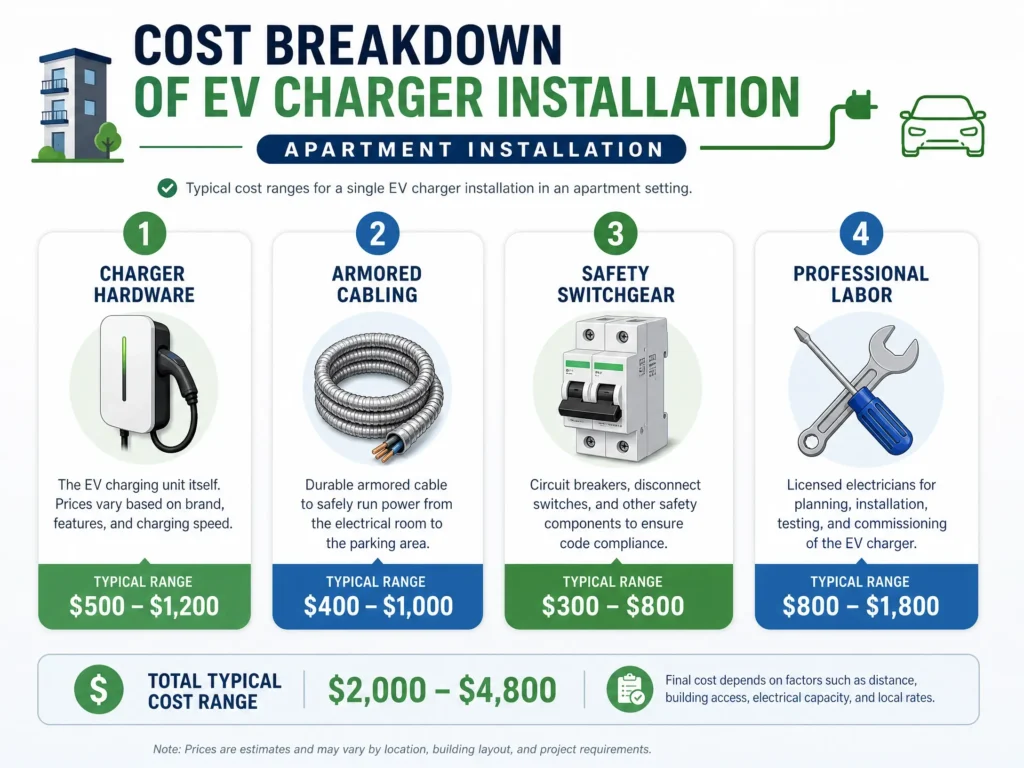
To accurately budget for an individual setup, the capital expenditure can be split into four primary buckets: the charger hardware, the heavy-duty cabling, safety and protection components, and professional labor charges.
Charger Unit Costs (Hardware)
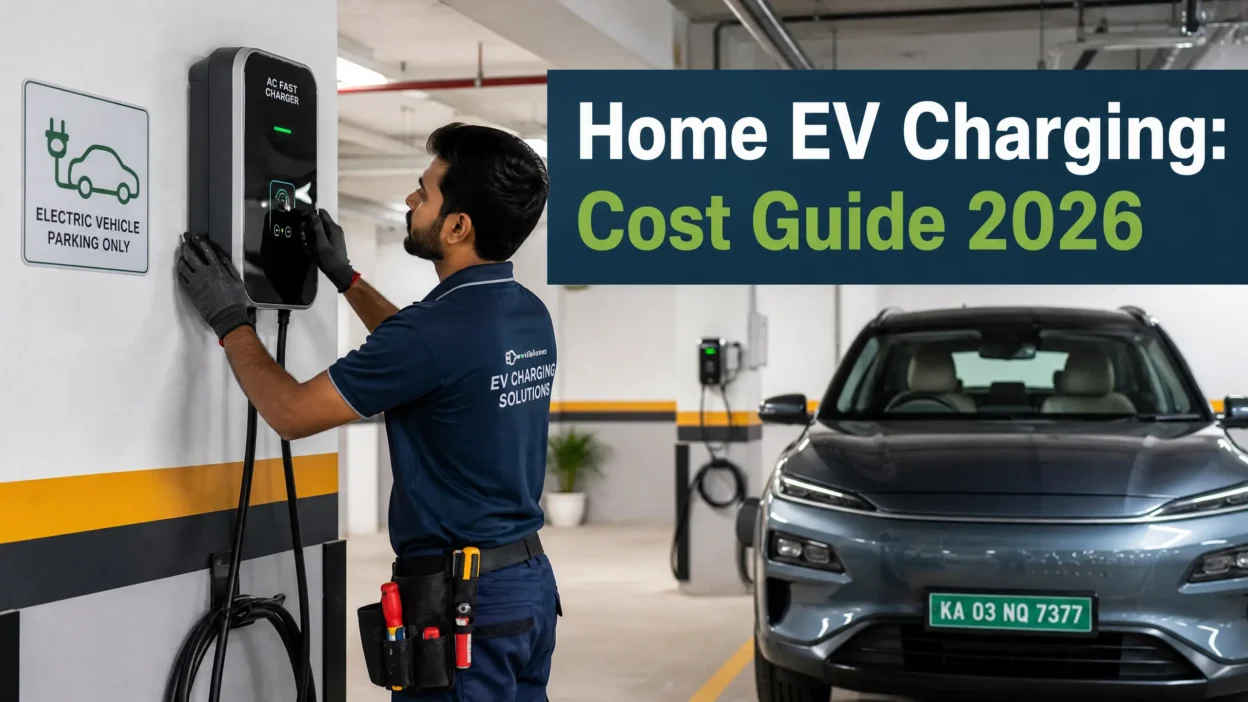
The hardware is the visible centerpiece of your investment. The cost depends almost entirely on the charging speed (measured in kilowatts) and the built-in smart features you choose.
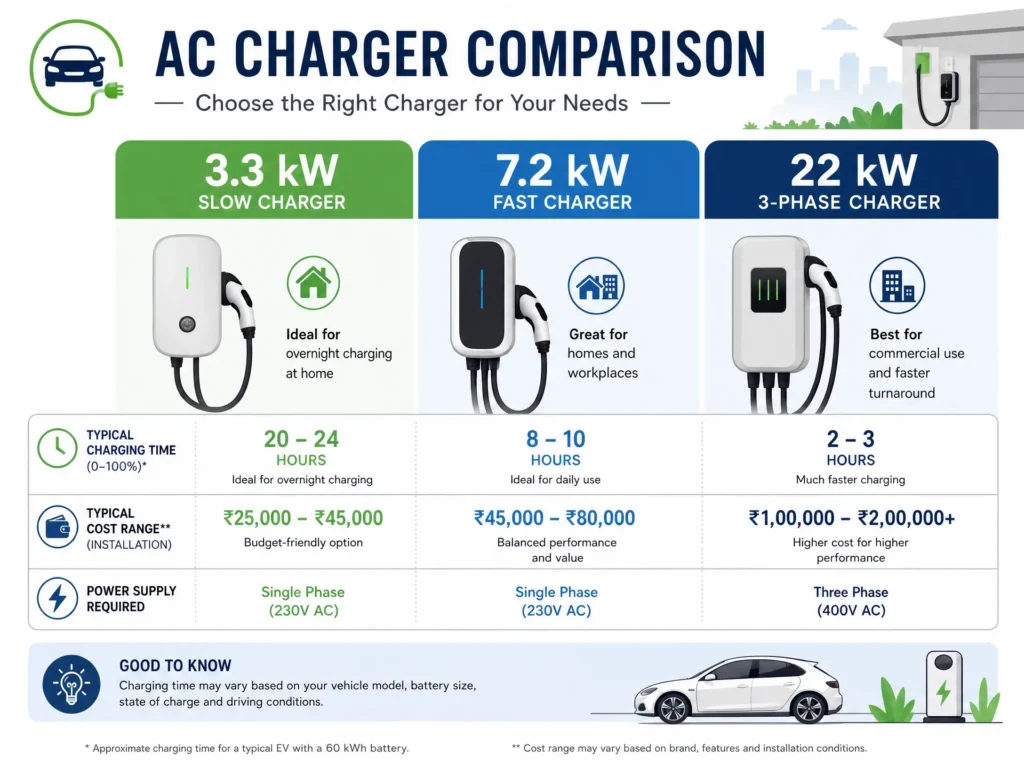
- 3.3 kW AC Slow Charger (₹15,000 – ₹25,000): This unit acts as a permanent, smart version of a standard 15A industrial plug point. It draws lower current and adds roughly 15 to 20 km of range per hour, making it highly suitable for overnight charging sessions spanning 10 to 12 hours.
- 7.2 kW – 7.4 kW AC Wallbox Charger (₹35,000 – ₹55,000): The sweet spot for modern electric cars in India. Operating on a 32A single-phase line, it can replenish a mid-sized EV battery (like a 40 kWh pack) fully in 5 to 6 hours.Note: Many major automobile OEMs (Original Equipment Manufacturers) bundle a 3.3 kW or 7.2 kW charger for free with the purchase of the vehicle, which can immediately eliminate this hardware line-item from your budget.
- 11 kW – 22 kW AC Charger (₹60,000 – ₹90,000): These heavy-duty AC chargers require a robust 3-phase connection. They are rarely used for personal apartment slots unless your vehicle features a high-capacity onboard AC charger and your flat has an abundance of spare sanctioned load.
Premium Features that Increase Price:
Basic hardware keeps costs low, but adding outdoor weatherproofing (IP65 or IP66 enclosures), integrated LCD screens, RFID card access (essential to prevent electricity theft in shared basements), Wi-Fi connectivity, and app tracking will push the cost toward the higher end of the spectrum.
Cabling Costs (The Most Variable Factor)
Because an EV charger pulls continuous high current for hours at a time, skipping standard residential wires is necessary to prevent thermal degradation and fire risks. You must use heavy-duty, armored copper wiring.
- Cable Specification: For a standard 7.2 kW charger, a 4 sq mm or 6 sq mm armored copper cable is standard. The armoring protects the copper conductor from physical pinching, rodents, and moisture inside basement conduits.
- Cost Per Meter: High-quality armored copper wire, inclusive of protective PVC conduit piping or metal casing, ranges from ₹150 to ₹350 per meter depending on the brand and thickness.
- The Distance Impact: If your parking spot is directly adjacent to the building’s meter room (a short 15-meter run), your cabling cost stays around ₹3,000 to ₹5,000. However, if you live on a higher floor or park in a secondary basement level requiring a 100-meter winding cable run, the wiring cost alone can skyrocket to ₹25,000 to ₹35,000+.
Safety and Protection Units
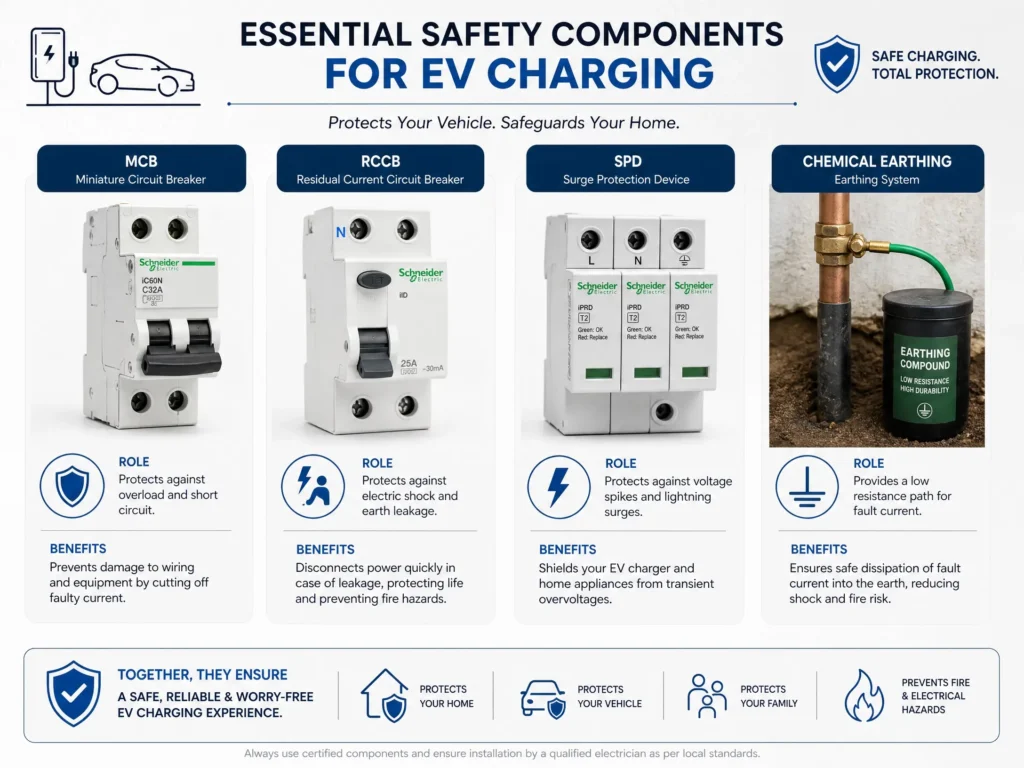
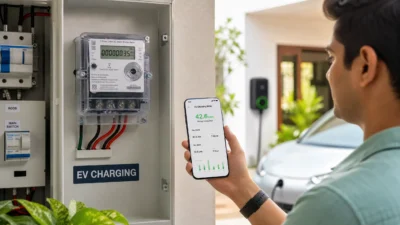
A dedicated distribution box containing individual electrical safety switchgear must be installed between your main electricity meter and your charger unit.
- Miniature Circuit Breaker (MCB): Safeguards the system against overcurrent and short circuits. Cost: ₹800 – ₹1,200.
- Residual Current Circuit Breaker / RCBO: This is a critical life-saving component. It detects tiny current leakages (earth faults) and instantly trips the circuit to prevent electrical shocks if someone touches the vehicle body during a fault. Cost: ₹2,500 – ₹4,500.
- Surge Protection Device (SPD): Protects the sensitive electronic motherboards inside both your charger and your car from voltage spikes caused by lightning or grid fluctuations. Cost: ₹1,500 – ₹3,000.
- Industrial Socket & Enclosure Box: A weatherproof metal or heavy plastic box to neatly contain the safety switches and host the charger mount. Cost: ₹1,000 – ₹2,500.
- Dedicated Chemical Earthing: EVs are sensitive to earthing values. If your building’s collective grounding is weak or registers higher than 5 ohms, the charger will display an error code and refuse to function. Installing a dedicated chemical earth pit ensures steady performance and true ground protection. Cost: ₹4,000 – ₹7,000.
Labor and Installation Charges
Laying heavy armored cables across basement ceilings and mounting distribution boards requires professional expertise.
- Standard Technical Labor: Mounting the wallbox, testing electrical resistance, terminating connections, and verifying safety parameters generally ranges from ₹2,000 to ₹5,000.
- Civil Work Adjustments: Hammering anchors, core-drilling through reinforced concrete walls, fixing overhead cable trays, or executing minor ground trenching adds another ₹1,000 to ₹3,000 to the labor pool.
Total Estimated One-Time Investment (CAPEX) Summary
To bring all these variables together, look at how the total budget shapes up under two common scenarios assuming a standard, average cable run of 30 to 40 meters.
| Cost Component | Budget Range (Agnostic/Bought Separately) | OEM Bundled Scenario (Free Charger) |
| Charger Hardware (7.2 kW AC) | ₹35,000 – ₹55,000 | ₹0 (Complimentary) |
| Armored Cabling & Conduits | ₹6,000 – ₹12,000 | ₹3,000 – ₹6,000 (Exceeding base limits) |
| Safety Switchgear (MCB, RCCB, SPD) | ₹4,800 – ₹8,700 | ₹4,800 – ₹8,700 |
| Dedicated Chemical Earthing | ₹4,000 – ₹7,000 | ₹4,000 – ₹7,000 |
| Civil & Electrical Labor | ₹3,000 – ₹8,000 | ₹0 – ₹3,000 (Basic labor is often covered) |
| Total Estimated CAPEX | ₹52,800 – ₹90,700 | ₹11,800 – ₹24,700 |
Pro-Tip on Free OEM Installation: Most car manufacturers package “complimentary standard installation” with their vehicles. However, read the fine print: this typically covers only 15 meters of basic cabling and basic surface mounting. In large Indian apartments, you will almost always pay out-of-pocket for extra cable lengths, customized conduits, or dedicated earthing upgrades.
Key Factors Influencing the Final Bill
No two apartment installations cost exactly the same because your final receipt is highly situational:
- The Linear Distance: The layout of your tower dictates the wiring length. A parking spot right next to the shaft keeps costs low, while a distant corner parking spot dramatically expands the line item for copper wire.
- Sanctioned Load Enhancement Fees: If you install a 7.2 kW charger, your flat’s current load limit (e.g., 4 kW or 5 kW) will be exceeded. You must apply to your local electricity distribution company (DISCOM) for a load enhancement. Depending on your state, load expansion costs add minor administrative fees and security deposits ranging from ₹1,000 to ₹5,000.
- Component Brand and Quality: Choosing premium switchgear brands like Schneider, Siemens, or Legrand for your MCBs and RCBOs costs marginally more upfront but ensures immediate response times during fluctuations, safeguarding your car’s battery management system (BMS).
Navigating RWA Approvals and Society Guidelines
The physical installation is only half the battle; structural and legal compliance requires working closely with your society management board.
- Securing the NOC: Submit a formal written application detailing your vehicle specifications, desired charger capacity, and the credentials of your certified installer.
- The Installation Blueprint: Most RWAs require a clear schematic drawing showing the proposed cable route through common ceilings. This reassures the committee that your line won’t obstruct fire safety lines or clutter existing utility pathways.
- Safety Certifications: Upon completing the installation, you may need to provide an electrician’s continuity and earthing test report (such as Form A1 compliance in certain regions) to confirm the circuit operates well below dangerous thermal limits.
Government Incentives and Subsidies
To accelerate private green infrastructure, several Indian states offer direct financial support for residential setups. For example, the Delhi EV Policy offers specialized low residential charging tariffs alongside flat capital incentives for early-bird residential installations.Similarly, states like Maharashtra and Karnataka have streamlined rules to waive certain DISCOM permissions for individual home charging setups. Always check your specific state’s active EV portal before beginning your build, as these subsidies can offset a portion of your hardware or equipment costs.
Long-Term Benefits and ROI
While an upfront investment of ₹15,000 to ₹80,000 can feel substantial, the return on investment (ROI) materializes rapidly.
Charging your EV at home using domestic slabs typically costs around ₹5 to ₹10 per unit (kWh). In comparison, reliance on public DC fast-charging hubs costs anywhere from ₹18 to ₹25+ per unit (excluding tax and parking convenience charges). For an average commuter driving 40–50 km daily, shifting from public fast chargers to a personal overnight home port saves thousands of rupees monthly, enabling the infrastructure to pay for itself within the first year of ownership. Furthermore, a dedicated, safe charging point future-proofs your parking space and adds a notable valuation premium to your apartment asset.
Conclusion
Setting up an EV charging station in an Indian apartment requires balancing personal convenience with collective safety.By understanding the cost breakdown across hardware, specialized armored cabling, and vital protection components like RCBOs and dedicated earthing, you avoid unexpected hidden fees during the process.
Take the first step by measuring the distance from your parking spot to the meter room and initiating an informational discussion with your RWA. Partnering with certified, professional installers guarantees your vehicle charges safely and reliably night after night.