
The Indian automotive landscape is undergoing a massive shift. With fluctuating fuel prices and a growing push toward sustainable transportation, electric vehicles (EVs) have moved from a futuristic concept to a practical daily choice. However, brand-new factory-made electric cars often come with a premium price tag that may not fit every budget.
This financial gap has sparked immense interest in an alternative approach: transforming existing internal combustion engine (ICE) vehicles into eco-friendly alternatives. If you love your current vehicle but hate the rising fuel bills, understanding the RTO approved electric car conversion kit price India is the first step toward making an informed decision. Retrofitting allows car owners to bypass the steep purchase cost of a new EV while retaining a vehicle they already know and trust.
What Is an Electric Car Conversion Kit?
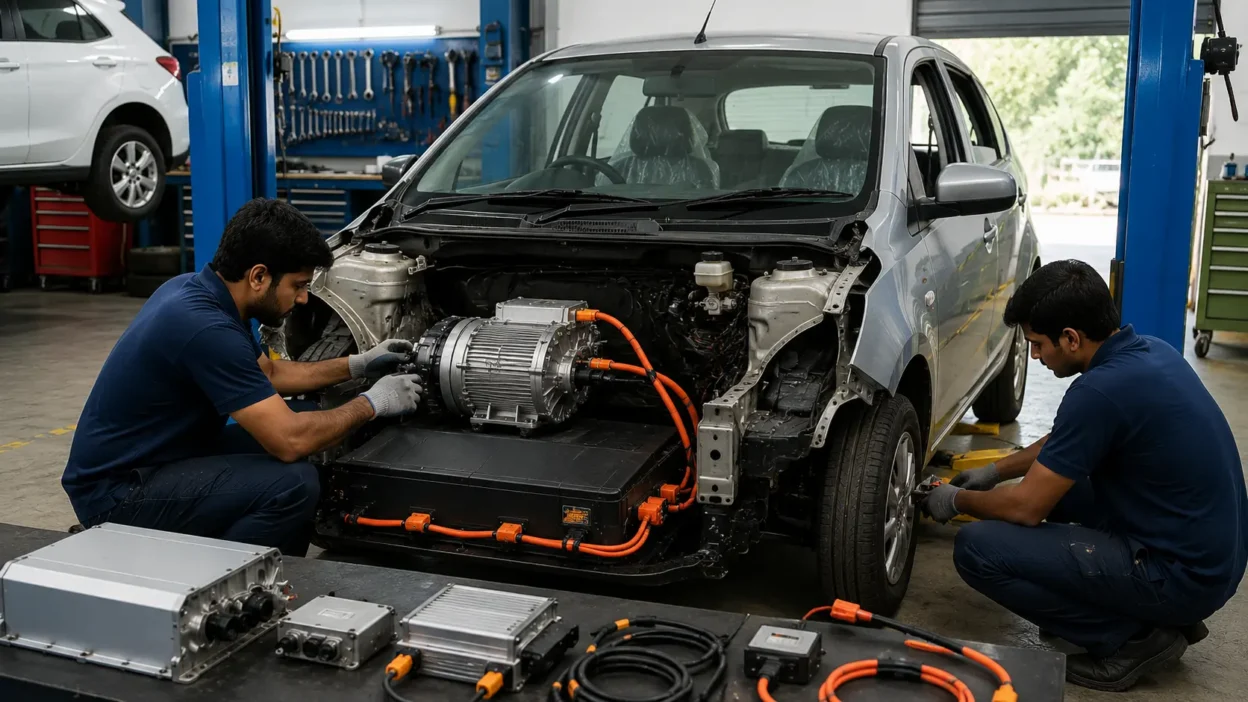
An electric car conversion kit is a curated bundle of components engineered to replace a vehicle’s internal combustion engine, fuel lines, exhaust system, and fuel tank. Instead of relying on petrol or diesel combustion, the retrofitted vehicle runs completely on electric power.
During a typical conversion, a certified mechanic removes the traditional powertrain and installs the following primary electric components:
- Electric Motor: Generates the mechanical rotation needed to turn the wheels.
- Motor Controller: Acts as the brain of the vehicle, regulating power flow from the battery to the motor based on accelerator inputs.
- Lithium-ion Battery Pack: Stores the electrical energy required to power the car.
- Power Electronics & Wiring: Manages ancillary functions such as keeping the 12V cabin electronics running, supporting power steering, and maintaining vacuum pressure for brakes.
Conversion vs. Factory EV
A factory-built EV is designed from scratch, with structural engineering optimized for a heavy floor-mounted battery pack. A converted EV uses an existing chassis, meaning the placement of components—especially the heavy battery cells—must be carefully calculated to balance weight distribution without altering the vehicle’s mechanical safety.
Why People Are Searching for Electric Car Conversion in India
Several distinct socioeconomic and environmental factors drive the growing interest in EV retrofitting across Indian states:
- Financial Shield Against Fuel Volatility: Petrol and diesel prices remain a significant recurring monthly expense for city commuters. Electric drivetrains dramatically lower the daily cost per kilometer.
- Life Extension for Scrappage-Threatened Vehicles: Under current National Green Tribunal (NGT) rules applied in regions like Delhi-NCR, diesel vehicles older than 10 years and petrol vehicles older than 15 years face mandatory deregistration. Retrofitting offers a lawful loophole to preserve a well-maintained vehicle body.
- Minimizing Electronic and Manufacturing Waste: Reusing an existing chassis avoids the heavy industrial carbon footprint associated with manufacturing a brand-new car from scratch.
- Targeted Urban Use Cases: Many owners require a vehicle strictly for localized daily errands, school drops, or fixed office commutes where extreme highway ranges are unnecessary.
Is Electric Car Conversion Legal in India? (RTO Rules)
The short answer is yes, but only under strict legal frameworks. You cannot simply buy a cheap, unbranded motor online, install it in a local garage, and drive it on public roads.
Central Motor Vehicle Rules (CMVR)
Under Section 52 of the Central Motor Vehicle Rules, making structural modifications to a motor vehicle requires official state authorization. The Ministry of Road Transport and Highways (MoRTH) has established clear compliance standards specifically for EV retrofitting.
The Role of ARAI and ICAT
Before any conversion kit hits the open market, the manufacturer must submit prototypes to national testing agencies like the Automotive Research Association of India (ARAI) or the International Centre for Automotive Technology (ICAT). These bodies test the components for electrical insulation, crash safety, thermal runaway resistance, and structural integrity.
A conversion kit is only legally viable if it holds a valid ARAI or ICAT type-approval certificate for your specific vehicle make and model.
Critical Warning: Installing a non-certified, unapproved conversion kit from an unauthorized workshop is illegal under Indian law. Unapproved modifications will lead to heavy RTO penalties, vehicle impoundment, and an immediate cancellation of your motor insurance policy cover.
The Step-by-Step RTO Approval Process
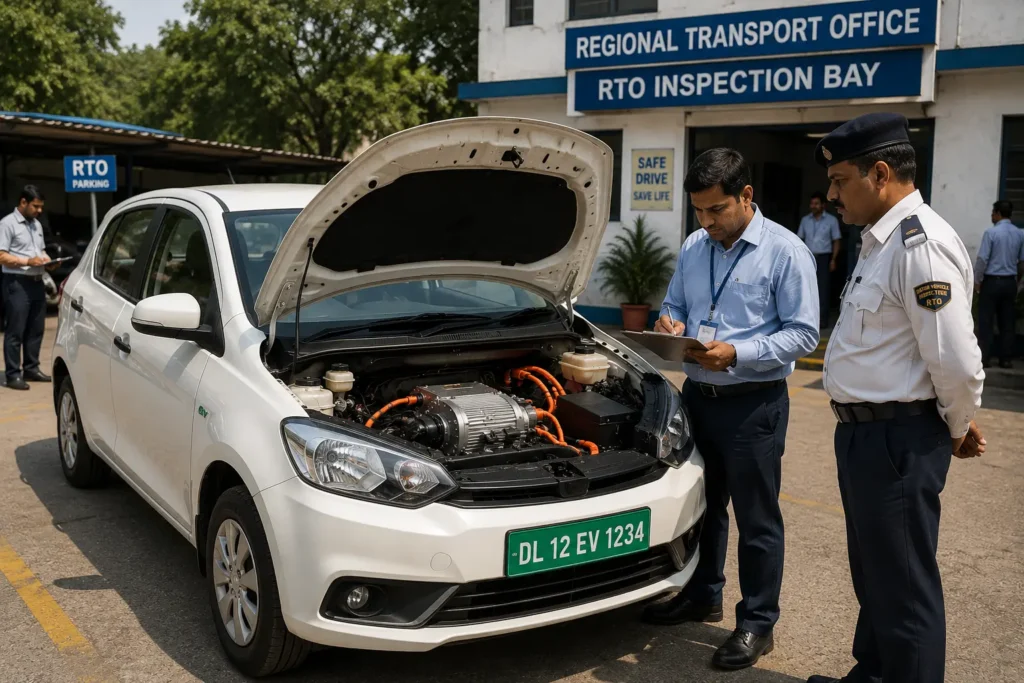
To drive a converted electric car legally with a valid registration certificate (RC), you must follow a structured official workflow.
1.Verify Kit Compatibility:Pre-check.
Ensure the conversion kit company holds a valid ARAI/ICAT approval certificate specifically matching your car’s model and variant.
2.Authorized Workshop Installation:Mechanical Phase.
Have the kit fitted exclusively by an authorized workshop certified by the kit manufacturer. They must provide an installation certificate along with invoice details for the motor and battery pack.
3.RTO Inspection Application:Documentation.
Submit an application to your local Regional Transport Office (RTO) requesting an alteration of the vehicle’s fuel type, presenting the original RC, insurance, identity proofs, and the kit’s type-approval certificate.
4.Physical RTO Inspection:Verification.
Bring the retrofitted car to the RTO premises. A motor vehicle inspector will verify the chassis number, cross-reference the serial numbers of the newly installed electric motor, and evaluate basic roadworthiness.
5.RC Update and Green Plate Issuance:Final Approval.
Upon successful inspection, pay the amendment fees. The RTO will update your physical or digital RC to list the fuel type as “Electric” (EV), allowing you to mount official green registration plates.
RTO Approved Electric Car Conversion Kit Price in India
The cost of converting an ICE car into an electric vehicle is influenced by vehicle weight, motor capacity, and desired battery range. The actual investment required can vary considerably across different car form factors.
The baseline RTO approved electric car conversion kit price India generally ranges between ₹3,00,000 and ₹9,00,000.This cost usually includes the core electric components but can scale upward if you opt for high-capacity battery packs designed for maximum driving range.
| Vehicle Segment | Typical Models Eligible | Estimated Kit Price Range (INR) |
| Small Hatchbacks | Maruti Alto, WagonR, Hyundai i10 | ₹3,00,000 – ₹5,00,000 |
| Mid-Size Sedans | Maruti Dzire, Honda Amaze, Hyundai Verna | ₹5,00,000 – ₹7,50,000 |
| Compact SUVs / Vans | Maruti Eeco, Tata Ace, Older Vitara Brezza | ₹6,50,000 – ₹9,50,000+ |
Note: The price ranges shown above are market estimates.Total out-of-pocket expenses depend on regional labor rates, state-level taxes, and specific battery capacity selections.
Cost Breakdown of Electric Car Conversion
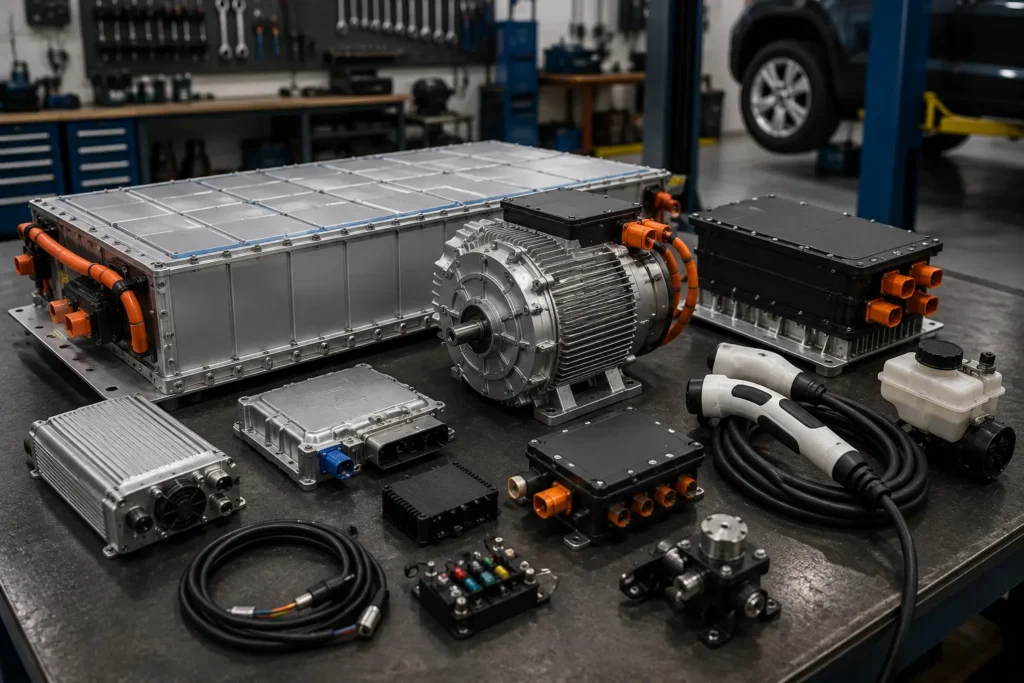
To understand why the upfront cost is significant, it helps to examine where your money is allocated during the conversion process:
Lithium-Ion Battery Pack (40% to 50% of Total Cost)
The battery pack is the single most expensive component.Its price scales directly with kilowatt-hour (kWh) capacity. High-quality Lithium Iron Phosphate (LiFePO4) or Nickel Manganese Cobalt (NMC) cells equipped with an advanced Battery Management System (BMS) are essential for durability and thermal protection in high-ambient Indian temperatures.
Electric Motor & Controller (20% to 25% of Total Cost)
Most car retrofitters deploy a Permanent Magnet Synchronous Motor (PMSM) or a highly efficient AC Induction Motor. The motor is paired with a matching digital controller that dictates acceleration calibration, power delivery curves, and regenerative braking features.
On-Board Charger & Sub-systems (10% of Total Cost)
This includes the AC charging interface, DC-to-DC converters (to power the car’s standard 12V cabin electronics), and customized mounting brackets tailored to secure the new hardware inside the empty engine bay.
Installation Labor & Engineering Work (10% of Total Cost)
Retrofitting is an intricate technical job. Mechanics must safely interface the electric motor with the existing manual or automatic transmission system, upgrade or adjust suspension springs to handle modified weight distribution, and correctly link the braking vacuum lines.
RTO Endorsement & Documentation Fees (2% to 5% of Total Cost)
This covers the specialized administrative work, physical inspection charges, state cess fees, and processing costs to secure an updated registration certificate.
Battery Capacity, Range, and Charging Expectations
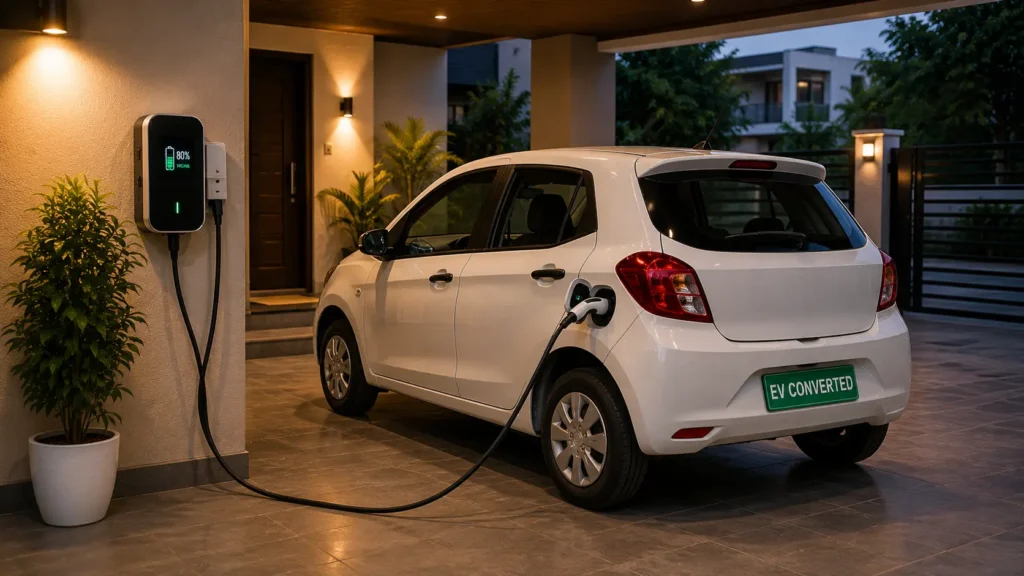
When retrofitting an older car, managing performance expectations is crucial. Converted vehicles generally do not achieve the high-speed efficiency or extended range profiles of modern, ground-up factory EVs.
- Average Battery Pack Options: Most standard hatchback and sedan conversion kits deploy packs ranging from 12 kWh to 22 kWh.
- Real-World Driving Range: A typical 15 kWh battery pack installed in a light hatchback delivers a practical urban range of roughly 80 km to 120 km on a full charge. Real-world range depends heavily on air conditioning usage, passenger load, and city traffic density.
- Charging infrastructure Constraints: The vast majority of affordable passenger car conversion kits rely exclusively on standard Level 5A/15A home wall sockets or dedicated 3.3 kW AC wallbox systems. A complete charge cycle typically takes between 4 and 7 hours. Public DC fast-charging compatibility is rarely found in aftermarket retrofit kits due to the high cost and complexity of fast-charge cooling controls.
Running Cost Comparison: Petrol/Diesel vs. Converted EV
The primary financial justification for conversion lies in the immediate reduction of daily operational costs.
Let us evaluate a standard urban commuter car covering an average distance of 40 kilometers per day (~1,200 km per month):
Traditional Fuel Running Costs
- Average Fuel Efficiency: 14 km per liter.
- Fuel Price Assumption: ₹100 per liter.
- Per Kilometer Running Cost: ~₹7.14 per km.
- Total Monthly Expense: ~₹8,568
Converted Electric Car Running Costs
- Power Consumption: Roughly 1.5 units of electricity (kWh) per 10 kilometers.
- Electricity Tariff Assumption: ₹8 per unit of electricity.
- Per Kilometer Running Cost: ~₹1.20 per km.
- Total Monthly Expense: ~₹1,440
Projected Operational Savings
Converting to an electric drivetrain can save an owner more than ₹7,000 every month on fuel expenses alone. Furthermore, removing the internal combustion engine eliminates routine maintenance costs like replacing engine oil, oil filters, spark plugs, air filters, and timing belts.
Pros and Cons of Electric Car Conversion in India
Before making an investment, it is helpful to weigh the advantages against the practical limitations of aftermarket vehicle retrofitting.
The Benefits
- Lower Daily Running Costs: Reduces operational costs significantly compared to volatile fossil fuels.
- Bypasses Scrappage Constraints: Allows you to continue driving older, well-maintained cars in regions facing strict emissions-based age limits.
- Smooth Urban Driving: Eliminates clutch operation and gear shifts in city traffic, delivering instant torque and a quiet cabin experience.
- Environmental Contribution: Zero tailpipe emissions reduces localized urban air pollution.
The Drawbacks
- Substantial Initial Outlay: Requires a significant upfront payment that must be weighed against fuel savings.
- Limited Highway Utility: Modest real-world driving ranges restrict these vehicles primarily to city commuting.
- Reduced Luggage Space: Battery pack installation often occupies a large portion of the car’s boot space.
- Component Warranty Limitations: Aftermarket conversion kit components typically carry shorter warranties (often 1 to 3 years) compared to the 8-year warranties found on factory EV batteries.
Who Should Consider vs. Who Should Avoid Conversion?
Conversion makes practical sense if:
- You are a city commuter who drives 40–60 km daily in congested stop-and-go traffic.
- You own an older hatchback or compact sedan with a perfectly intact chassis, suspension, and steering system.
- You have access to a secure, dedicated parking spot with a nearby 15A electrical outlet for reliable overnight charging.
- You operate a localized commercial fleet or delivery route with predictable daily distances.
You should probably avoid conversion if:
- Your daily routine demands regular long-distance highway travel across different cities.
- Your current vehicle has significant frame rust, compromised body panels, or worn-out mechanical steering racks.
- You rely entirely on street parking without a safe, accessible method to plug in and charge the car.
- You expect performance profiles, high top speeds, and advanced tech features identical to a new factory-built electric car.
Important Things to Check Before Purchasing a Kit
To protect your investment and ensure on-road safety, always verify the following details before signing a contract with an installation workshop:
- Verify Official Certification: Request the physical ARAI/ICAT certificate from the dealer. Confirm that your car’s exact model year and engine displacement (cc) are explicitly covered by the type approval.
- Understand Battery Warranty Policies: Get clear, written details regarding the battery pack’s warranty terms. Clarify what constitutes battery degradation and how claims are handled if a cell fails prematurely.
- Confirm RTO Support: Ensure the kit provider gives you all necessary paperwork, including the official Annexure forms, layout drawings, and invoice clearances needed by your local RTO for a smooth RC update.
- Consult Your Insurance Provider: Contact your motor insurance agent before starting the teardown. Confirm that they will endorse the vehicle alteration on your policy once the updated RC is issued.
Frequently Asked Questions (FAQs)
Is electric car conversion fully legal in India?
Yes, electric car conversion is completely legal in India, provided you install an ARAI or ICAT certified type-approved retrofit kit through an authorized installation center and successfully update the vehicle’s fuel type details on your Registration Certificate (RC) at the local RTO.
How much does it cost to convert a normal petrol car to electric?
The total conversion cost typically ranges between ₹3,00,000 and ₹7,50,000 for standard hatchbacks and mid-size sedans. Final pricing depends heavily on the chosen battery capacity, motor power rating, and regional workshop labor fees.
Can I convert an old diesel car into an electric vehicle?
Yes, diesel cars can be converted to electric using approved retrofit kits.This approach is increasingly popular in regions like Delhi-NCR, where it allows owners to extend the operational life of vehicles that otherwise face mandatory scrappage under local 10-year diesel age limits.
Will the RTO issue a green number plate for a converted vehicle?
Yes. Once an authorized workshop installs a certified kit, the vehicle must undergo a physical inspection by a local motor vehicle inspector. After the RTO updates the fuel status to “Electric” on the physical RC, you are legally entitled to mount standard green EV registration plates.
Is it mandatory to update my car insurance after an EV conversion?
Yes, updating your vehicle insurance is absolutely mandatory. Failing to inform your insurer about the engine removal and EV conversion will completely invalidate your third-party and comprehensive insurance coverage, leaving you personally liable for damages.
Is converting an older vehicle cheaper than buying a brand-new EV?
Generally, yes. Retrofitting an older vehicle costs a fraction of the price of a new factory-built electric car. However, you must weigh this lower upfront cost against a more modest real-world driving range, reduced cargo space, and the shorter overall component warranties typical of aftermarket kits.
Final Verdict
Retrofitting an older vehicle offers a practical middle ground for owners who want to bypass volatile fuel costs without committing to the expense of a new factory-built EV. It provides a reliable way to extend the lifespan of a well-maintained vehicle, transforming it into an efficient, low-maintenance city commuter.
However, conversion requires careful planning. If you need extensive real-world driving range, regular highway capability, and long-term component warranties, saving for a factory-engineered EV may be the more practical choice. If you decide to go ahead with retrofitting, always prioritize safety by choosing an ARAI or ICAT approved kit installed by a certified workshop. This ensures your vehicle remains reliable, fully insured, and completely compliant with Indian road laws.