
The Indian transport landscape is changing fast. If you step out on the road today, you will notice a huge shift toward electric mobility. With petrol prices staying high and public transport getting more crowded, everyday commuters are looking for affordable alternatives. While buying a brand-new electric scooter or an off-the-shelf electric bicycle is a great option, it can require a heavy upfront investment.
This is exactly why the e-bike conversion kit with battery price in India has become one of the most searched topics for budget-conscious commuters.
An electric cycle conversion kit allows you to transform your existing, regular bicycle into a high-functioning electric cycle at a fraction of the cost of a new EV. It is a practical, eco-friendly, and highly satisfying DIY project that saves you money on your daily travel. If you have an old bicycle lying around in your garage, you can easily upgrade it and join the green mobility movement.
What Is an E-Bike Conversion Kit?
In simple terms, an e-bike conversion kit is a collection of electronic and mechanical components designed to add electric power to a traditional bicycle. Instead of relying entirely on muscle power, the kit provides an electric motor to assist or completely take over the propulsion duties.
Difference Between a Normal Bicycle and an Electric Cycle
- Normal Bicycle: Relies 100% on manual pedaling. It can be tiring for long commutes, steep flyovers, or hot summer days.
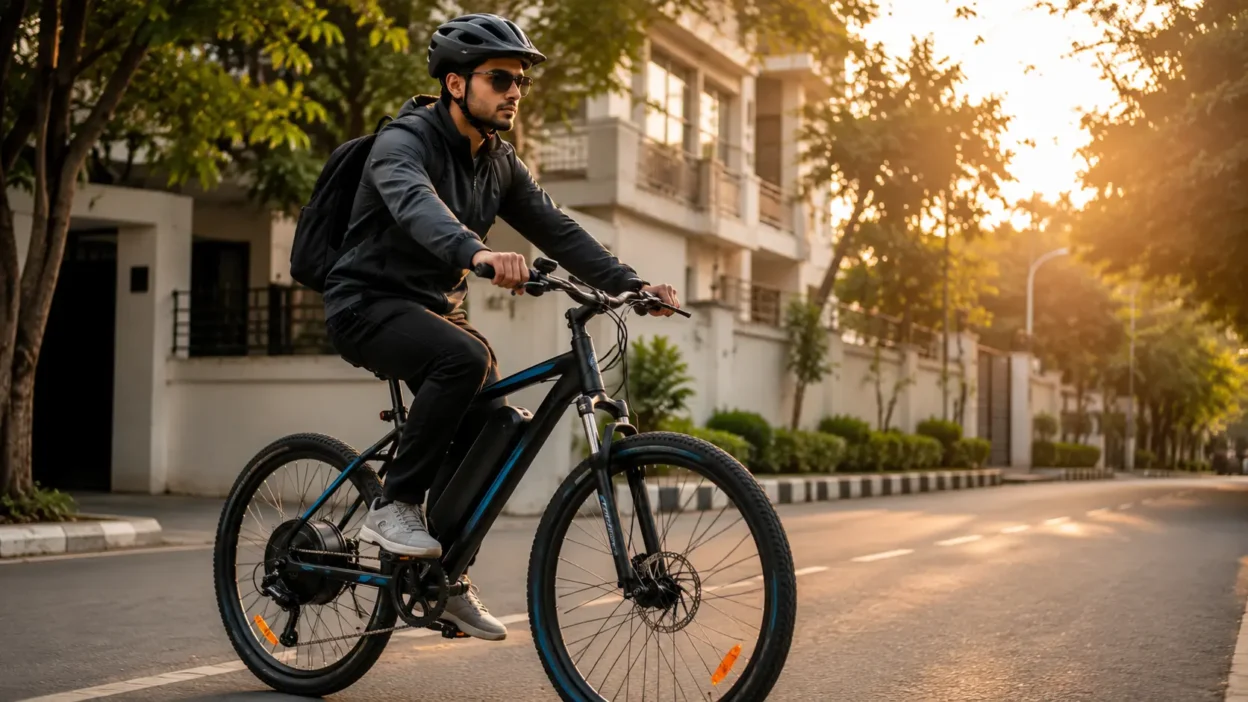
- Electric Cycle (E-Bike): Features an onboard battery, an electric motor, and a controller. You can ride it like a normal cycle, use the Throttle Mode to ride like a scooter without pedaling, or use Pedal Assist Mode (PAS) where the motor kicks in to make pedaling incredibly light and effortless.
By installing a cycle to e-bike conversion kit, you essentially bridge this gap without throwing away your perfectly good frame.
Types of E-Bike Conversion Kits in India
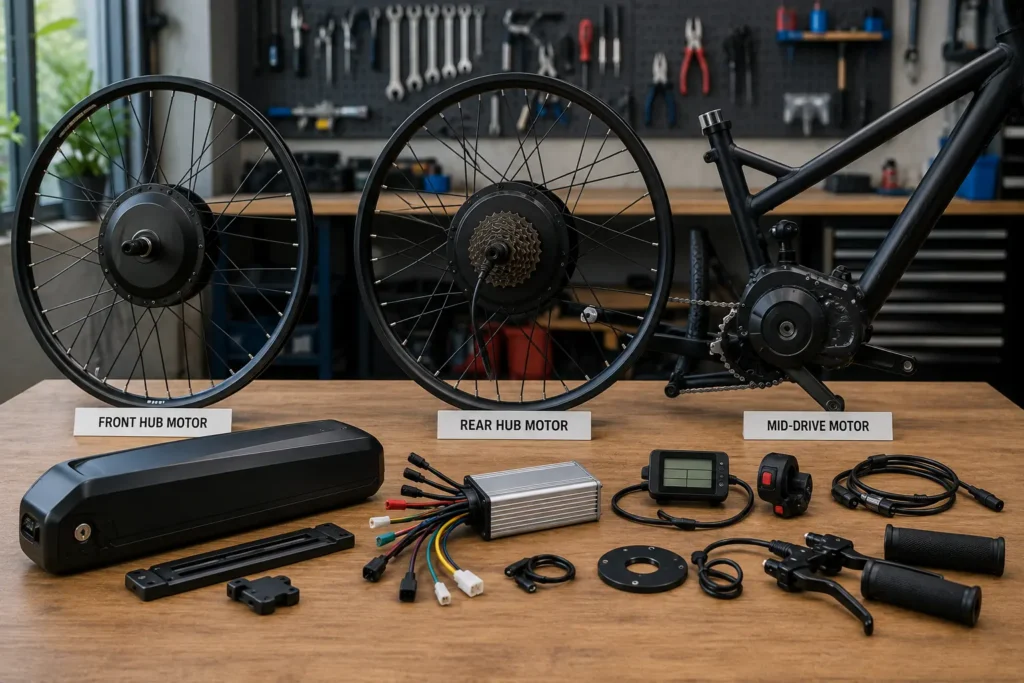
When looking for a kit in the Indian market, you will generally run into two major categories based on installation types, alongside different motor placements:
1. DIY E-Bike Conversion Kits
These are unbranded or generic component bundles meant for hobbyists and engineering enthusiasts.They include raw motors, controllers, loose wires, and basic throttles. While they are highly affordable, they require a fair amount of mechanical skill, soldering, and custom mounting to fit perfectly.
2. Ready-to-Install Commercial Kits
Designed for the average commuter, these are plug-and-play kits offered by established Indian EV startups and component brands. They come with waterproof connectors, pre-laced motor rims, clear instruction manuals, and dedicated battery mounts. They are much safer and more reliable for daily use.
Motor Types: Hub Motors vs. Mid-Drive & Chain-Drive
- Hub Motors (Front or Rear): The most popular choice in India. The motor sits inside the center of the wheel hub. They are highly reliable, dustproof, waterproof, and require zero maintenance.
- Chain-Drive / Side-Drive Motors: These motors mount externally on the frame and connect to the wheel using an additional chain. They are cheaper but generate more mechanical noise and require periodic chain tension adjustment.
E-Bike Conversion Kit with Battery Price in India
The overall budget for converting your cycle depends heavily on the motor capacity, battery quality, and brand warranty. Generally, a reliable e-bike conversion kit with battery price in India ranges from ₹15,000 to ₹45,000+.
Below is an overview of the current estimated market pricing for comprehensive conversion bundles (including a Lithium-ion battery and charger):
| Motor Power & Type | Battery Specifications | Estimated Price Range (INR) | Ideal Use Case |
| 24V 250W Geared / Hub Motor | 24V 12Ah Lithium-ion / LFP | ₹13,000 – ₹16,000 | Budget commuters, flat city roads |
| 36V 250W BLDC Hub Motor | 36V 7.8Ah / 10Ah Lithium-ion | ₹17,000 – ₹22,000 | Standard daily office/school runs |
| 36V 350W BLDC Hub Motor | 36V 11Ah / 12Ah Lithium-ion | ₹20,000 – ₹26,000 | Flyovers, pocket-friendly food deliveries |
| 48V 750W / 1000W High Power Kit | 48V 15Ah+ High Capacity Lithium | ₹32,000 – ₹45,000+ | Heavy cargo loading or off-road tracking |
Important Price Note: You might find cheap motor-only kits online for ₹4,000 to ₹7,000. Keep in mind that these prices do not include the battery and charger. The e-bike battery price India market commands a separate ₹8,000 to ₹18,000 depending on its storage capacity (Ah rating).
Battery Types Used in E-Bike Kits
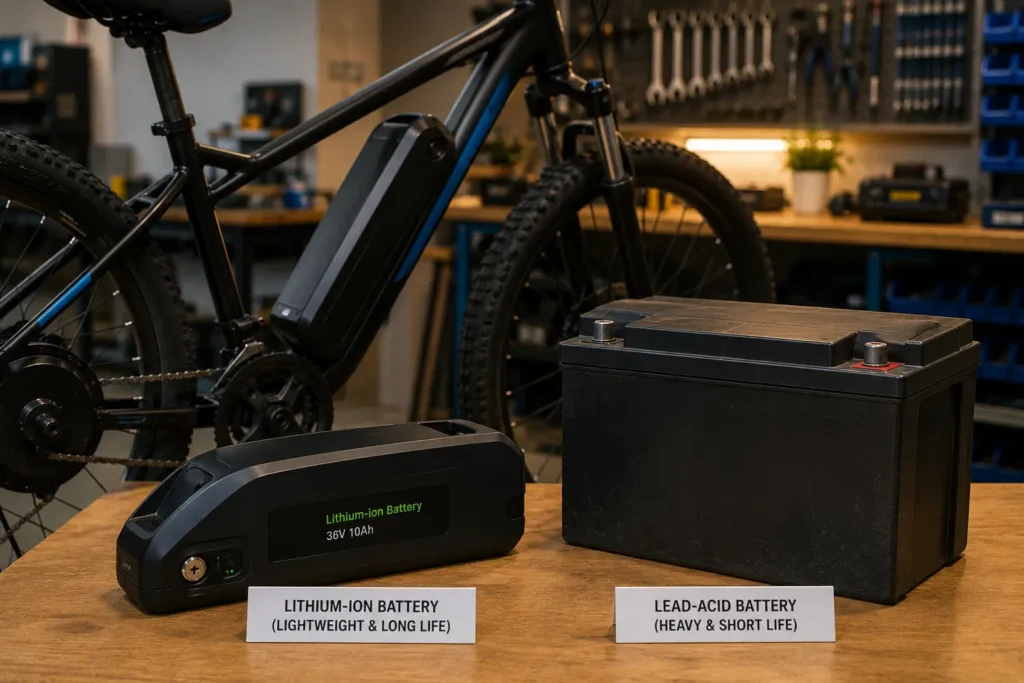
The battery is the absolute heart of your electric bicycle; it accounts for nearly 50% to 60% of the entire kit’s cost. There are two main types of batteries available in the Indian market:
Lithium-Ion (Li-ion) / Lithium Ferro-Phosphate (LFP)
This is the modern standard for electric vehicles. LFP and Li-ion options are lightweight, compact, and fit neatly inside water-bottle-shaped or frame-mounted cases. They support quick charging, maintain consistent performance, and easily last for 800 to 1,500 charge cycles (roughly 3 to 5 years of daily use).
Lead-Acid (Dry / Gel Batteries)
These are older, heavy batteries similar to the ones used in conventional UPS systems or automotive starters. While they are very cheap upfront, they are incredibly heavy (weighing 12 to 18 kg), which ruins the balance of a bicycle. Furthermore, they only last for 200 to 300 charge cycles, meaning you will have to replace them every 8 to 12 months.
Expert Advice: Avoid saving short-term money on lead-acid options. Investing in a Lithium-ion e-bike conversion kit is safer, lighter, and far more economical in the long run.
DIY vs. Commercial E-Bike Conversion Kits
Choosing between a completely loose DIY kit and a commercial ready-to-fit kit comes down to your personal skill level and requirements.
DIY Loose Kits
- Pros: Lowest possible initial cost; high scope for personalization and custom component selection.
- Cons: Exposed wiring poses risks in Indian rains; no unified product warranty; requires custom fabrication.
- Best For: Engineering students, hobbyists, and DIY lovers.
Commercial Branded Kits
- Pros: Plug-and-play waterproof wiring harnesses; elegant detachable battery packs with anti-theft key locks; standard 1-year product warranty.
- Cons: Higher initial price tag.
- Best For: Office goers, delivery riders, and anyone needing a reliable daily commuter machine.
Range, Speed & Charging Time Expectations
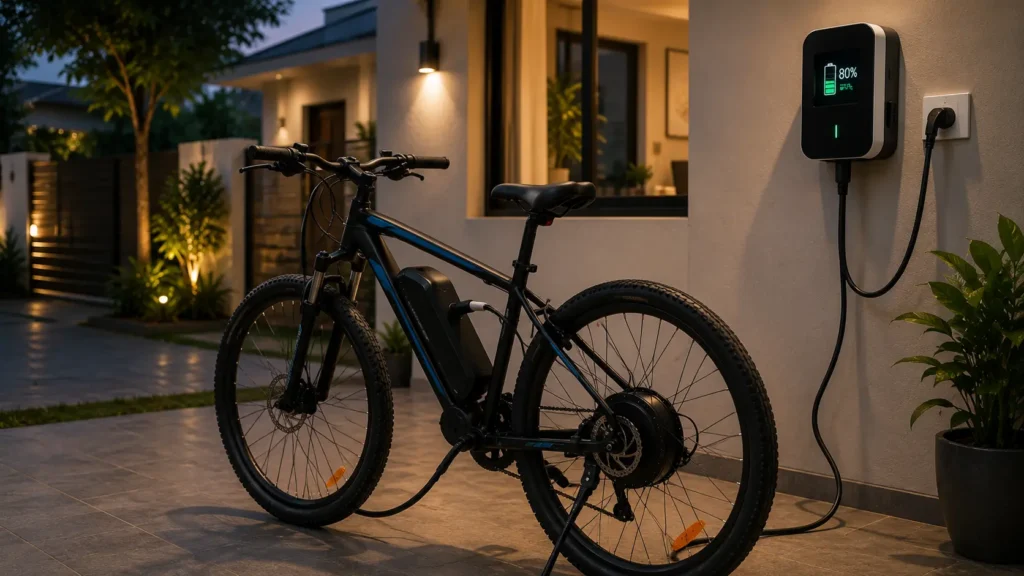
What can you realistically expect from a standard 250W or 350W electric cycle conversion setup under typical Indian road conditions?
- Real-World Range: A standard 36V 10Ah Lithium battery provides a realistic range of 25 to 35 km on pure throttle mode. If you use Pedal Assist Mode smarty, you can extend that range to 45 to 60 km on a single charge.
- Top Speed: To comply with standard Indian motor vehicle regulations, commercial 250W kits are restricted to a safe top speed of 25 km/h. High-power 48V kits can hit speeds up to 40 km/h but come with legal restrictions.
- Charging From Home Sockets: These kits ship with compact smart chargers that plug directly into any standard 5A or 6A home wall socket (just like your laptop or smartphone). A typical Lithium battery takes about 3 to 5 hours to charge completely from empty.
Is E-Bike Conversion Legal in India?
Yes, transforming your cycle into an electric hybrid is legal in India, provided you strictly stay within the exemption limits laid down by the Ministry of Road Transport and Highways (MoRTH).
According to the Central Motor Vehicles Rules (CMVR):
- The electric motor power must be 250 Watts or less.
- The maximum speed of the vehicle must cut off at 25 km/h.
If your converted cycle satisfies these two specific criteria, it is legally classified as a non-motorized vehicle. This means you do not need a driving license, vehicle registration, road tax, or mandatory third-party insurance to ride it on public roads. However, if you install a heavy 750W or 1000W motor kit, the cycle enters motor-vehicle territory and technically requires transport department approvals.
Running Cost & Savings: Converted E-Bike vs. Petrol Bike
Let us look at a practical financial breakdown to see how much money you can save by switching over to an electric cycle for your daily errands.
Assume your daily round-trip commute is 30 kilometers.
Petrol Commute Cost
- Average mileage of a 100cc-110cc commuter bike: 55 km/liter
- Petrol consumed daily: ~0.55 Liters
- Daily fuel cost (with petrol at ~₹105/liter): ₹57.75
- Monthly Fuel Expense: ~₹1,732
Electric Cycle Commute Cost
- A standard 36V 10Ah battery consumes around 0.36 to 0.4 units of electricity per full charge.
- Average domestic electricity tariff in India: ~₹7 to ₹8 per unit.
- Cost per full charge: ~₹3 to ₹3.50 (giving a 30 km range).
- Daily charging cost: ₹3.50
- Monthly Charging Expense: ~₹105
The Financial Takeaway: By saving over ₹1,600 every month on fuel, a reliable ₹18,000 electric cycle conversion kit completely pays for itself within 11 to 12 months of standard usage.
Who Should Buy an E-Bike Conversion Kit?
An electric cycle conversion kit is highly versatile, but it is a perfect match for three specific types of Indian users:
- Students: Ideal for school and college goers who want an independent, trendy, and zero-cost mode of transport without waiting to turn 18 to get a driving license.
- Office Commuters: Perfect for professionals facing heavy traffic during 5 to 15 km daily rides. It allows you to beat gridlock and reach the office fresh and sweat-free via the pedal-assist system.
- Delivery Partners: An excellent upgrade for local e-commerce, food, or grocery delivery agents. Shifting away from a petrol bike straight to an e-bike can double your daily take-home earnings by eliminating fuel expenses.
Things to Check Before Buying a Kit
Before you click buy on an online marketplace or pay a local dealer, check off these crucial parameters:
- Battery Warranty & Certifications: Ensure the battery pack uses grade-A cells and features a reliable BMS (Battery Management System) to protect against overcharging and overheating. Look for a minimum of a 1-year replacement warranty on the battery.
- Motor IP Rating: Indian roads face extreme dust and heavy monsoon logging. Ensure the hub motor carries an IP65 or IP67 waterproof rating so it can handle heavy downpours safely.
- Brake Cut-off Sensors: Safety is paramount. Good commercial conversion kits include brake levers with built-in electronic cut-off switches. The moment you pull the brake, power supply to the motor stops instantly, preventing accidents.
FAQs Section
Q1. Is converting a normal cycle into an e-bike safe?
Yes, it is entirely safe if you use high-quality commercial kits featuring proper insulated wiring, secure frame-mounted battery casings, and brake cut-off sensors.Avoid cheap, open-wired DIY bundles that do not offer weather protection.
Q2. How long does an e-bike battery last before needing replacement?
A premium Lithium-ion or LFP battery pack easily lasts for 3 to 5 years (around 800 to 1,200 full charge cycles) if taken care of properly. Avoid letting the battery drain completely to 0% frequently to extend its overall health.
Q3. Can any type of bicycle be converted to electric?
Almost all standard bicycles can be converted. This includes simple single-speed roadsters, geared hybrid cycles, and mountain bikes (MTBs) with disc brakes. Just make sure the front or rear dropouts match the hub motor width (usually standard 100mm for front, 135mm for rear).
Q4. Can I ride my converted electric bicycle in heavy rain?
If your kit features a motor with an IP65 or higher water-resistance rating and a sealed battery box, you can comfortably ride it in normal to heavy rain. However, avoid riding through deep waterlogged streets where the motor or controller gets completely submerged under water.
Q5. What happens if the battery runs out of charge mid-way?
The best part about an electric cycle is that it remains a bicycle. If your battery dies, you can simply pedal it back home normally. The hub motor adds a tiny bit of weight but doesn’t lock the wheel, ensuring a smooth manual ride.
Final Conclusion
Investing in a high-quality e-bike conversion kit with battery price in India is an incredibly smart, value-driven way to step into the world of electric mobility. For an investment of around ₹17,000 to ₹22,000, you breathe brand-new life into an old mechanical bicycle, transforming it into an efficient green machine that costs pennies to run.
If your goal is to slash monthly fuel costs, beat city traffic jams, and reduce your carbon footprint, a 250W hub motor kit paired with a reliable Lithium-ion battery is the perfect choice. Skip the ultra-cheap unbranded options, choose a seller offering a solid product warranty, and enjoy a smarter, cleaner daily commute.