
The Syros nameplate had a tricky start in India — a premium compact SUV that impressed reviewers but struggled to translate that into strong sales. With the Syros EV, launched on 23 July 2026, Kia is hoping the electric version can succeed where the petrol model found it tough. This Kia Syros EV review looks at whether Kia’s most affordable electric SUV yet has what it takes to stand out in an increasingly crowded segment.
Kia Syros EV Price in India 2026
The Syros EV launched at a starting price of ₹13.49–13.50 lakh (ex-showroom), going up to ₹20 lakh for the top X-Line ER variant — positioning it as Kia’s most affordable electric SUV in India. Under the Battery-as-a-Service (BaaS) scheme, ownership starts from as low as ₹7.99 lakh, with battery usage charges from ₹3.3 per km.
The lineup spans five main variants:
- HTK (42 kWh only) — ₹13.50 lakh
- HTK Plus (both batteries) — ₹15 lakh (42 kWh)
- HTX (both batteries) — ₹16 lakh (42 kWh)
- HTX Plus (51.4 kWh only)
- X-Line (51.4 kWh only) — up to ₹20 lakh
Worth flagging upfront: early buyer feedback has pointed out that the base HTK variant doesn’t get a rear camera — a genuine deal-breaker for some, since upgrading to HTK Plus for that one feature (along with cruise control and a 100W charger) costs an extra ₹1.5 lakh. If a rear camera matters to you, budget for at least the HTK Plus trim from the start.
Comparing this against Tata’s compact EV lineup? Read our Tata Nexon EV Long Term Review.
Design — Familiar Shape, EV-Specific Details
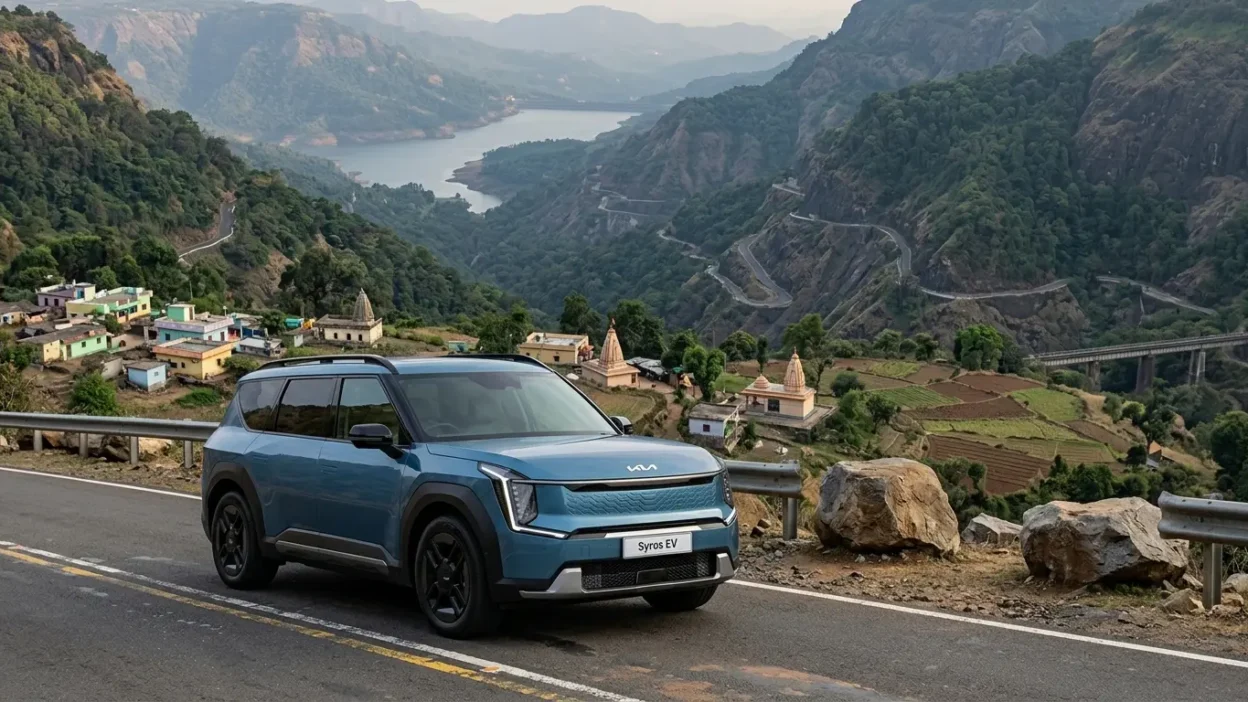
Kia has kept the Syros EV’s design largely identical to its petrol sibling — a deliberate choice, since the Syros ICE was already well-received on looks. The EV version gets a slightly revised 17-inch alloy wheel design, a slim air intake on the front bumper, and a front fender-mounted charging flap as the key visual differentiators. The rear stays the same too, with a flat tailgate, two-part LED taillamps, and sporty bumpers carrying over unchanged.
It’s a boxy, purposeful design that prioritises cabin space over aggressive styling — a sensible trade-off for a compact SUV aimed at practical daily use.
Range & Battery — Genuine Flexibility Between Value and Range
The Syros EV offers two battery packs:
| Battery | Power / Torque | Claimed Range (MIDC) | DC Fast Charging |
|---|---|---|---|
| 42 kWh | — | 443 km | — |
| 51.4 kWh (Extended Range) | 169–170 bhp / 255 Nm | 526 km | 10-80% in 39 min |
Both packs come in a single-motor, front-wheel-drive configuration. The claimed ARAI figure for the larger battery sits closer to 490 km in real-world certified testing, which is still a genuinely strong number for a compact SUV in this price bracket — expect real-world usage to land somewhere in the 350-380 km range for mixed city and highway driving, based on typical patterns seen with similarly-sized EVs.
The 42 kWh pack is a sensible choice if your driving is mostly city-based and budget matters more than outright range; the 51.4 kWh Extended Range pack is worth the step up if longer commutes or occasional highway trips are part of your routine.
Want to compare against a similarly-priced Tata option? Check our Tata Punch EV Review 2026 in Hindi.
Charging Time & Cost
Kia claims the larger 51.4 kWh battery can be charged from 10% to 80% in 39 minutes using a 100kW DC fast charger — a genuinely competitive figure for this segment. Standard AC home charging options are also available for overnight top-ups.
Kia is backing the Syros EV with a genuinely strong ownership package: a 15-year, unlimited-kilometre high-voltage battery warranty, an assured buyback programme offering up to 80% resale value after 3 years, and the My Convenience e-Plus maintenance and extended warranty packages — collectively one of the more reassuring ownership propositions in the segment right now.
Interior, Features & Tech
The cabin carries over the Syros ICE’s already well-regarded interior quality, with dual 12.3-inch screens, wireless Android Auto and Apple CarPlay, automatic climate control, and multiple drive modes even on the base HTK trim. Higher trims add a panoramic sunroof, rear wiper and defogger (HTX), cruise control and a rear camera (HTK Plus), and an 8-speaker Harman Kardon sound system on top variants.
A genuinely useful practical touch: the Syros EV includes a 16-litre frunk (front storage under the bonnet) — handy for charging cables or a bit of extra luggage space, something not every EV in this segment offers. The column-type shift-by-wire gear selector also makes daily driving feel a touch more modern and less cluttered than a traditional gear lever.
Rear seat space is consistently highlighted as a strength too — window sunshades, a reclining backrest, and seat ventilation on higher trims make it a genuinely comfortable place for tall passengers, not just an afterthought behind the front seats.
Curious how this compares to another feature-loaded compact EV? Read our MG Windsor EV Review.
Safety
The Syros EV comes with 6 airbags as standard across the range — a genuinely reassuring baseline for a car starting under ₹14 lakh. ADAS is also part of the package, though exact availability by trim is worth double-checking against your specific variant before purchase.
Kia Syros EV: Pros and Cons
Pros:
- Genuinely competitive starting price (₹13.49 lakh) for a well-equipped compact EV
- Strong 526 km claimed range on the 51.4 kWh Extended Range pack
- 15-year, unlimited-km battery warranty — one of the strongest in the segment
- Assured buyback programme (up to 80% after 3 years)
- Spacious, comfortable rear seats with ventilation on higher trims
- Useful 16-litre frunk
Cons:
- Base HTK variant lacks a rear camera — a notable early buyer complaint
- Jumping from HTK to HTK Plus for that one feature costs ₹1.5 lakh extra
- Front-wheel-drive only, no AWD option
- New nameplate in the EV space means limited long-term reliability data
- Some feature combinations across trims feel inconsistently distributed (e.g., HTK Plus ER trades back some kit for the bigger battery)
Kia Syros EV vs Competitors
The Syros EV enters a genuinely crowded segment, rivalling the Tata Nexon EV, Tata Curvv EV, Maruti Suzuki e Vitara, Mahindra BE 6, Mahindra XUV 3XO EV, MG Windsor EV, and the VinFast VF6. Kia’s pitch rests on brand appeal, a feature-rich cabin, and genuine flexibility between the two battery packs — letting buyers prioritise value or range based on their actual driving needs, rather than forcing a one-size-fits-all approach.
See how it stacks up against Tata’s compact SUV in our Tata Nexon EV Long Term Review and against MG’s offering in our MG Windsor EV Review.
Weighing your full budget EV options? Check our Best Electric Car Under 15 Lakh India guide.
For official specifications and the latest variant pricing, check Kia India’s official Syros EV page.
Verdict: Should You Buy the Kia Syros EV in 2026?
As a newly launched compact EV, the Syros EV makes a genuinely strong first impression — competitive pricing, a class-leading battery warranty, and real flexibility between value and range. Just be deliberate about your variant choice: skip the base HTK unless you’re comfortable without a rear camera, and go for the HTK Plus or HTX with the 42 kWh battery for the best everyday value, stepping up to the 51.4 kWh Extended Range only if your driving genuinely demands the extra range.
Frequently Asked Questions
What is the launch price of the Kia Syros EV? The Syros EV launched at ₹13.49-13.50 lakh (ex-showroom), going up to ₹20 lakh for the top X-Line ER variant.
What is the range of the Kia Syros EV? The 42 kWh battery offers a claimed MIDC range of 443 km, while the 51.4 kWh Extended Range battery offers up to 526 km.
How fast does the Kia Syros EV charge? The 51.4 kWh battery can charge from 10% to 80% in 39 minutes using a 100kW DC fast charger.
Does the Kia Syros EV have a rear camera on all variants? No, the base HTK variant does not include a rear camera — it’s available from the HTK Plus trim onward.
What is the battery warranty on the Kia Syros EV? Kia offers a 15-year, unlimited-kilometre high-voltage battery warranty on the Syros EV.
Considering the Kia Syros EV or comparing it with another compact electric SUV? Share your questions in the comments below.