
If your Ola Electric scooter’s battery warranty has lapsed and you’re staring at a dead or badly degraded pack, there’s one question on your mind: how much is this actually going to cost me? The honest answer is that it depends heavily on your model, but for most Ola owners, an out-of-warranty battery replacement falls somewhere between ₹55,000 and ₹90,000. That’s a wide range, and a genuinely expensive one, which is exactly why it’s worth understanding what drives that number before you agree to anything at a service centre — because not every battery problem actually needs a full replacement.
What Is the Out-of-Warranty Battery Replacement Cost for an Ola Scooter?
Ola Electric doesn’t publish an official, fixed price list for out-of-warranty battery replacement, so most of the figures circulating online — including the ones in this article — come from service invoices shared by owners, industry reporting, and battery pack cost estimates. Treat them as a realistic ballpark rather than a guaranteed quote.
Based on currently available data, here’s roughly what owners have reported paying:
- Ola S1 (2.98 kWh pack): approximately ₹65,000–₹70,000
- Ola S1 Air (3 kWh pack): approximately ₹68,000–₹75,000
- Ola S1 Pro Gen 2 (4 kWh pack): approximately ₹85,000–₹90,000
- Ola S1 Pro Gen 3 (3 kWh or 4 kWh pack): pricing hasn’t stabilised publicly yet, but expect a similar or slightly higher range than Gen 2 given the newer cell design
A few factors that push the final bill up or down:
- Battery capacity — a 4 kWh pack naturally costs more than a 3 kWh pack, since you’re paying for more cells.
- Labour charges — fitting, calibration, and BMS (Battery Management System) syncing typically add a few thousand rupees on top of the battery price itself.
- Taxes — GST applies to both the battery pack and the labour component, so the on-paper price often looks different from what actually shows up on your invoice.
- Service centre location — pricing can vary slightly between cities due to logistics and local service centre policies.
- Future pricing updates — as domestic battery cell manufacturing scales up in India, these costs are widely expected to trend downward over the next few years, though there’s no fixed timeline for that.
Battery Options Available
Ola S1 Air uses a smaller battery pack aimed at riders with shorter daily commutes. It’s the most affordable Ola model to replace a battery on, simply because there’s less capacity involved.
Ola S1 sits a step above the S1 Air with a slightly larger pack, offering more range for riders who need it, and a moderate replacement cost to match.
Ola S1 Pro Gen 2 was, until recently, Ola’s flagship model, built around a single larger battery pack designed for longer daily riding and higher performance. It carries the highest replacement cost among the older Ola lineup.
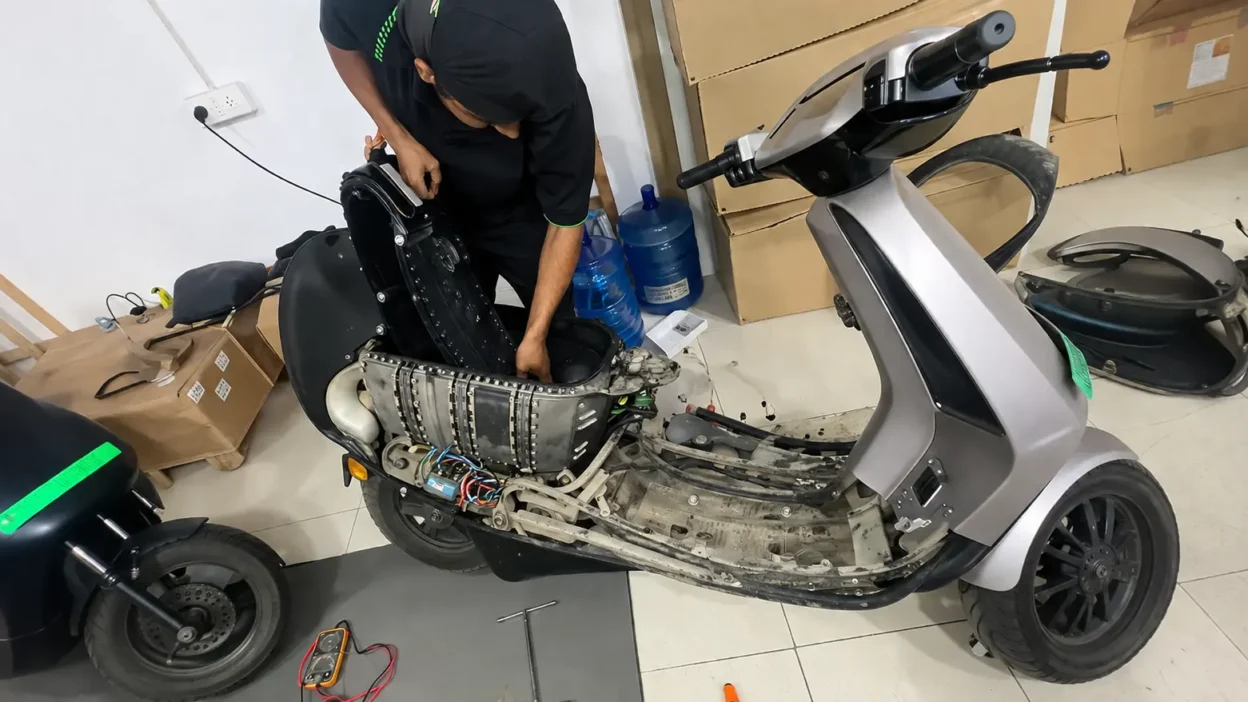
Ola S1 Pro Gen 3 introduced a redesigned, structural battery pack — meaning the battery itself now forms part of the scooter’s frame rather than sitting as a separate component. Gen 3 is also offered in two battery sizes, giving buyers a choice between a lower-cost, shorter-range pack and a higher-capacity one. Because the underlying battery architecture changed significantly between Gen 2 and Gen 3, they aren’t interchangeable, and replacement components aren’t shared between the two generations.
When Does a Battery Actually Need Replacement?
Not every battery issue means you need a brand-new pack. Common warning signs include:
- Reduced range that’s noticeably and consistently worse than what you were getting a year or two ago, not just a one-off dip after a cold morning ride.
- Charging problems — the scooter refuses to charge past a certain percentage, charges unusually slowly, or the charging indicator behaves erratically.
- Battery warning messages appearing on the dashboard or in the Ola app, flagging a fault or health issue.
- Cell imbalance, where individual cells within the pack age unevenly, causing inconsistent power delivery or sudden drops in charge level.
- Deep discharge, where the battery has been left at 0% for an extended period.
- General battery health deterioration that shows up as reduced acceleration, inconsistent top speed, or the scooter cutting out under load.
Some of these symptoms point to genuine cell degradation that only replacement can fix. Others — particularly deep discharge and cell imbalance — are sometimes recoverable without spending on a new pack.
Deep Discharge vs Battery Replacement
This is the section most owners skip past, and it’s often the most expensive mistake they make.
What is deep discharge? It happens when a lithium-ion battery is left completely drained — at or near 0% — for an extended stretch, usually because the scooter sat unused for weeks or months without being topped up. Lithium-ion cells are not designed to sit empty; prolonged deep discharge can push individual cells below their safe voltage threshold.
Can it be restored? In many cases, yes. If the discharge wasn’t prolonged and the cells haven’t dropped below a critical voltage floor, a proper diagnostic and controlled recharge — sometimes called battery balancing — can bring the pack back to usable condition. This is a genuinely different, and far cheaper, process than a full pack replacement.
When restoration works
- The scooter was left discharged for a relatively short period
- Individual cell voltages are still within a recoverable range
- The BMS hasn’t recorded a permanent fault or hard cutoff
- Restoration is attempted by someone who can perform a proper battery diagnostic, not just a visual check
When restoration is impossible
- Cells have dropped below the voltage threshold where they can safely accept charge again
- Physical damage, swelling, or corrosion is present
- The BMS has flagged a permanent fault linked to cell failure, not just low charge
Battery balancing and BMS reset Battery balancing evens out charge levels across individual cells, which can resolve issues that look like full battery failure but are actually just uneven cell behaviour. A BMS reset, where applicable, can also clear certain fault codes that were triggered by the discharge event itself rather than genuine hardware damage. Neither of these should be confused with battery replacement — they’re diagnostic and corrective steps that come first.
The bottom line: a deep-discharged battery does not automatically mean you need a new one. Insist on a proper diagnostic before agreeing to a full pack replacement. For a closer look specifically at costs after a deep discharge scenario, read our Ola scooter battery replacement cost after deep discharge guide.
How to Avoid Diagnostic Scams
Once a warranty expires, some owners report being pushed toward a full battery replacement when a smaller, cheaper repair might have solved the problem. Protecting yourself starts with asking the right questions.
Common misleading service advice includes:
- Being told a battery “cannot be repaired” without being shown any diagnostic data
- Vague explanations that avoid specifics about which cells or components are actually faulty
- Pressure to approve replacement immediately, without time to seek a second opinion
Steps to protect yourself:
- Ask for a written diagnostic report that shows individual cell voltages, overall battery health percentage, and the specific fault detected — not just a verbal “it’s damaged.”
- Understand what a battery health report actually means. A genuine report should reference cell balance, capacity retention, and any BMS fault codes, not just a generic pass/fail.
- Verify your warranty status independently through the Ola app or official channels before accepting a service centre’s claim that you’re out of warranty — occasionally there’s a top-up warranty or extended coverage you may have forgotten about.
- Get a second opinion from an independent EV service centre if the estimate feels disproportionate to the actual symptoms.
- Watch for red flags such as reluctance to share diagnostic data, refusal to explain why restoration isn’t an option, or an unusually high quote compared to figures reported by other owners with similar issues.
A battery that genuinely needs replacement will show clear, documented signs of irreversible damage. If a service centre can’t or won’t produce that documentation, it’s reasonable to pause and verify before spending tens of thousands of rupees.
Battery Refurbishment vs Brand-New Battery
| Factor | Refurbished Battery | Brand-New Battery |
|---|---|---|
| Price | Lower, often 30–50% less | Full retail replacement cost |
| Reliability | Depends heavily on refurbisher quality | Consistent, factory-tested |
| Warranty | Usually shorter or limited | Full manufacturer warranty (where applicable) |
| Performance | Slightly reduced capacity is common | Matches original specifications |
| Expected Lifespan | Shorter than a new pack | Full expected lifespan |
| Availability | Limited to select independent service providers | Available through Ola service centres |
| Best Suited For | Budget-conscious owners planning to sell or replace the scooter soon | Owners planning long-term use who want full performance and safety assurance |
Refurbishment can make sense as a stopgap, particularly if you’re not planning to keep the scooter for many more years. For long-term ownership, a genuine new pack remains the safer, more reliable choice.
Factors That Affect Battery Replacement Cost
- Battery capacity — larger kWh packs cost proportionally more
- Battery chemistry — different cell types and sourcing affect base cost
- Labour — installation, calibration, and testing add to the final bill
- Software updates — some replacements require a firmware or BMS software update to sync properly with the new pack
- BMS replacement — if the Battery Management System itself is faulty, it may need replacing alongside the cells, adding further cost
- Regional pricing — minor variations exist across cities and service centre networks
- Availability — newer battery designs, like the Gen 3 structural pack, may have longer lead times, which can affect final pricing
- Transportation — logistics costs for shipping battery packs are sometimes reflected in the final invoice
- Taxes — GST is applied on top of both parts and labour
Can Third-Party Battery Replacement Be Trusted?
Independent EV service providers do offer battery repair and replacement for Ola scooters, generally at a lower cost than an authorised service centre. Whether that’s the right call depends on your priorities.
Potential advantages:
- Lower cost compared to authorised replacement
- Faster turnaround in some cases
- Willingness to attempt repair or restoration rather than jumping straight to replacement
Potential disadvantages:
- Compatibility isn’t always guaranteed, especially with newer structural battery designs like the Gen 3 pack
- Safety certification and quality control vary widely between providers
- Using a third-party battery can affect any remaining warranty on other scooter components
- Not all providers offer a meaningful warranty on the replacement battery itself
If you do go this route, ask for certification details, a written warranty on the replacement work, and evidence of experience specifically with your Ola model and generation.
Ways to Extend Ola Scooter Battery Life
- Avoid charging to 100% every single time — stopping around 80–90% for daily use is gentler on long-term battery health
- Avoid letting the battery run down to 0%, especially for extended periods
- Maintain moderate, consistent charging habits rather than irregular extreme cycles
- Keep the scooter’s software and firmware updated, since Ola periodically pushes updates that improve battery management
- Avoid leaving the scooter charging or parked in direct heat for long stretches
- If storing the scooter for weeks or longer, keep the battery at a moderate charge level rather than fully charged or fully empty
- Follow Ola’s recommended charging practices from the owner’s manual rather than relying on assumptions
Frequently Asked Questions
How much does an Ola battery cost after warranty? Depending on the model, expect roughly ₹65,000 to ₹90,000, based on currently reported figures. Ola hasn’t published an official fixed price list, so treat this as an estimate rather than a confirmed quote.
Can only damaged cells be replaced instead of the whole pack? In some cases, yes, if the diagnostic shows the fault is isolated to specific cells rather than the entire pack. This depends on the service provider’s capability and the extent of the damage.
Does deep discharge always damage the battery? No. Short periods of deep discharge are often recoverable through balancing and controlled recharging. Prolonged deep discharge is more likely to cause permanent damage.
Can battery refurbishment save money? Yes, refurbished batteries typically cost less than new ones, though they usually come with reduced performance and a shorter expected lifespan.
How long does a battery replacement take? This varies by service centre and battery availability, ranging from same-day service to a few days if the specific pack needs to be sourced.
Can battery health be checked before replacing it? Yes, and you should insist on it. A proper diagnostic report showing cell voltages and overall health should always come before agreeing to a replacement.
Is battery replacement covered partially after warranty expires? Generally no, unless you’ve purchased an extended warranty or top-up plan. Standard out-of-warranty replacement is a full out-of-pocket cost.
Can I install a third-party battery on my Ola scooter? Technically possible in some cases, but compatibility, safety certification, and warranty implications vary. Proceed only with a provider who can demonstrate experience with your specific model.
How long should an Ola battery last? Battery longevity depends heavily on usage patterns and charging habits, but most lithium-ion EV batteries are designed to retain usable capacity for several years of regular use before significant degradation sets in.
How do I know whether my battery needs replacement? Look for a combination of symptoms — persistent range loss, charging issues, warning messages, and confirmed cell damage on a diagnostic report. A single symptom alone doesn’t always mean replacement is necessary.
Conclusion
An out-of-warranty Ola battery replacement is a genuinely significant expense, and the worst thing you can do is approve one without understanding what’s actually wrong with your battery. Deep discharge doesn’t always mean the pack is finished. Cell imbalance can sometimes be corrected. Refurbishment can be a reasonable middle ground for owners who don’t need the scooter to perform like new for years to come. Before agreeing to spend ₹65,000 or more, get a proper written diagnostic report, understand exactly what it says, and only then decide whether restoration, refurbishment, or full replacement is the right call for your situation.