
Switching from a traditional petrol or diesel car to an electric vehicle brings a completely different ownership experience. In India, Tata Motors has single-handedly fast-tracked this transition, with the Tata Nexon EV leading the charge as one of the country’s most popular electric SUVs. While most potential buyers and current owners spend hours researching the health, range, and replacement costs of the massive under-floor lithium-ion traction battery, there is another silent partner under the hood that often gets ignored until things go wrong: the 12V auxiliary battery.
Every electric car on the road today still relies heavily on a standard 12V small-capacity battery to function. For many Indian car owners, discovering that their modern electric SUV cannot start due to a traditional battery failure comes as a major surprise. Consequently, the Nexon EV 12V auxiliary battery replacement price has become a highly searched topic among owners whose vehicles are now crossing the 2 to 4-year mark. Understanding this component, its exact replacement costs in the Indian market, and how it impacts your EV ownership is essential for stress-free driving.
What Is a 12V Auxiliary Battery in an EV?
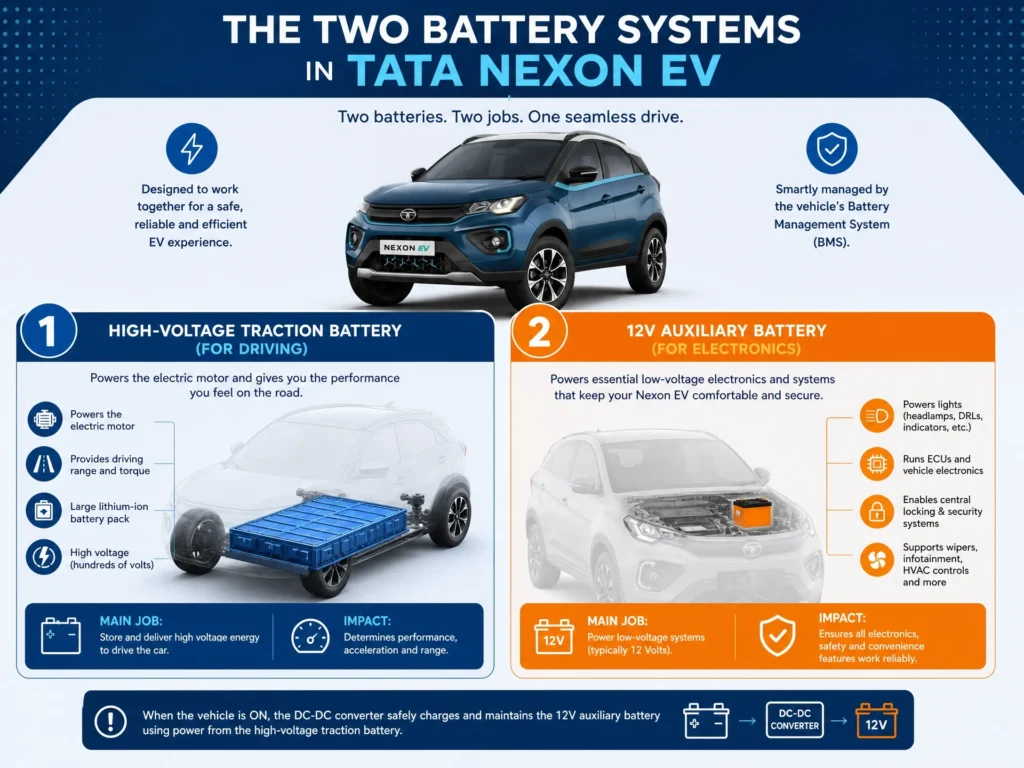
To understand why this component is so critical, it helps to distinguish between the two entirely separate battery systems inside your Tata Nexon EV:
- High-Voltage Traction Battery: This is the large, expensive lithium-ion battery pack (ranging from 30 kWh to 45 kWh depending on whether you own the Prime, Max, or newer Long Range versions). Its sole responsibility is to supply power to the electric motor that turns the wheels and drives the vehicle forward.
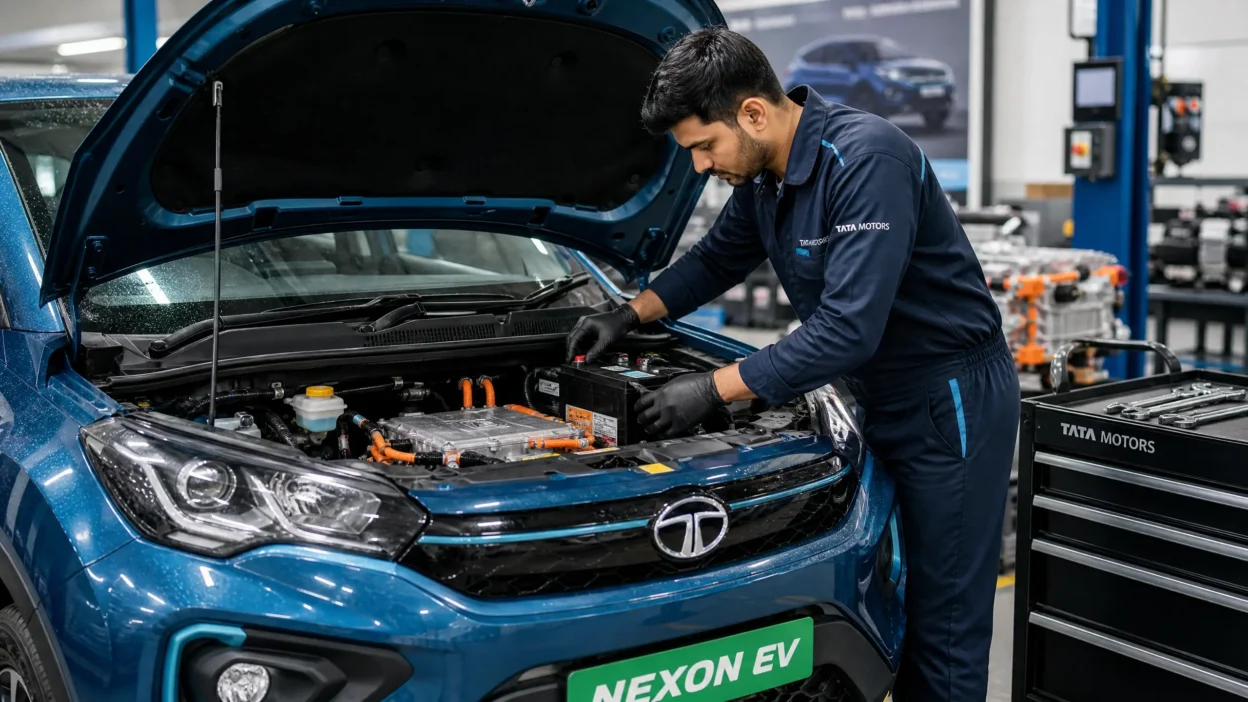
- 12V Auxiliary Battery: This looks exactly like the battery found in any regular petrol or diesel hatchback. It does not provide power to the electric motor, nor does it help move the car. Instead, it acts as the gatekeeper for all the low-voltage electronics in the vehicle.
The 12V auxiliary battery handles a continuous load of critical systems, including:
- The Main ECU & Safety Electronics: The car’s onboard computer network must remain powered even when the car is completely switched off.
- Central Locking & Keyless Entry: Recognizing your key fob and unlocking the doors is managed by the 12V system.
- Infotainment & Instrument Cluster: The digital screens, connected car tech, and audio systems pull power from this unit.
- Safety Lighting: Headlights, taillights, cabin bulbs, and hazard indicators run entirely on 12V power.
Most importantly, the 12V auxiliary battery powers the relays that trigger the high-voltage traction battery. If the 12V battery is completely dead, the car cannot initiate its startup sequence, rendering the entire vehicle unresponsive despite having a fully charged main lithium-ion pack.
Types of 12V Batteries Used in Nexon EV
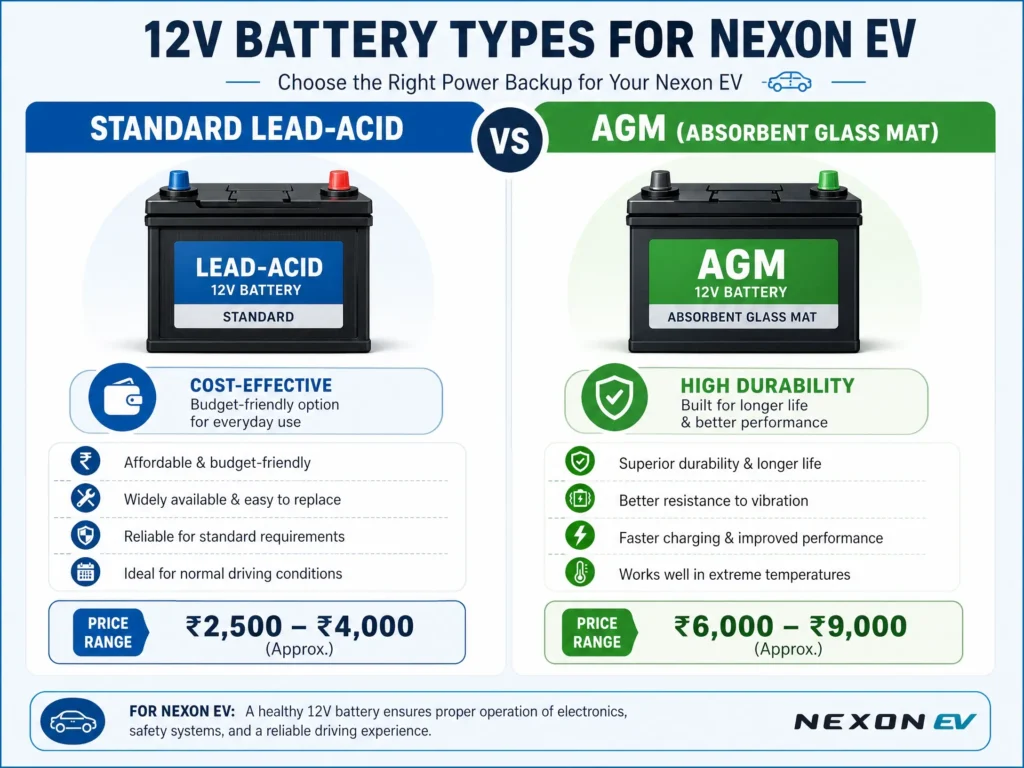
When looking into a replacement, you will generally come across two distinct technological options suitable for automotive applications:
Lead-Acid Battery
This is the traditional, time-tested automotive battery design. It utilizes lead plates submerged in liquid electrolyte (sulfuric acid). Standard lead-acid batteries are highly cost-effective and readily available across India. They perform reliably but are more susceptible to degradation from deep discharge cycles and extreme temperature changes under the hood.
AGM (Absorbent Glass Mat) Battery
An AGM battery is an advanced variant of the lead-acid family. Instead of free-flowing liquid acid, the electrolyte is completely absorbed into specialized fiberglass mat separators wrapped tightly between the plates. This layout makes the battery spill-proof, highly resistant to vibration, and significantly more efficient at handling repeated charge-discharge cycles.
Capacity (Ah Rating) Explained Simply
The capacity of an auxiliary battery is measured in Ampere-hours (Ah). Simply put, the Ah rating indicates how much total electrical energy the battery can hold and deliver over a specific duration. For example, a 44Ah battery can theoretically supply 1 Ampere of current for 44 hours straight before emptying.
The Tata Nexon EV commonly utilizes a 44Ah or 50Ah DIN-standard battery (such as the DIN44 or DIN50 size classification).Using the correct Ah rating specified by Tata Motors is critical, as a lower capacity battery will deplete too quickly under the constant background load of an EV’s connected electronics.
Nexon EV 12V Auxiliary Battery Replacement Price (India)
The actual cost of replacing the 12V battery varies depending on the specific battery technology selected, the brand, and where you choose to purchase it.
Price Breakdown by Battery Type
- Standard Lead-Acid 12V Battery (44Ah – 50Ah): This is the most affordable route. The price typically ranges from ₹4,500 to ₹6,000.
- AGM / EFB 12V Battery (44Ah – 50Ah): Advanced, heavy-duty options designed to handle complex electronics better command a higher price tag, generally ranging between ₹6,000 and ₹8,000.
Component, Labour, and Venue Variations
The final amount you pay is shaped by a few distinct factors:
| Expense Component | Expected Cost Range |
| Base Battery Cost (With Scrap Rebate) | ₹4,500 – ₹6,500 |
| Labour & Installation Fee | Free (at local shops) to ₹300 – ₹500 (at dealerships) |
| Applicable Goods & Services Tax (GST) | Included in retail prices (28% bracket for batteries) |
Purchasing a battery on an “exchange basis” significantly lowers your final out-of-pocket expense. Battery retailers in India offer a direct cash discount (scrap rebate) ranging from ₹800 to ₹1,300 when you trade in your old, depleted battery.
Furthermore, dealer pricing at authorized Tata workshops is usually 15% to 25% higher than local market rates due to rigid parts pricing policies and standardized diagnostic fees. Minor price fluctuations of ₹200 to ₹400 can also occur across different tier-1 and tier-2 cities due to regional supply chains and local logistics.
Authorized Service Center vs. Local Market Replacement
Nexon EV owners facing a battery change generally have to decide between visiting an authorized Tata workshop or visiting a local neighborhood multi-brand battery dealer. Both avenues carry distinct trade-offs.
Tata Authorized Service Center
Going to an official dealer ensures absolute peace of mind. The service technicians use exact OEM-specified parts and know precisely how to navigate an electric vehicle’s electrical layout. They will also run a full diagnostic check on your car’s DC-to-DC converter to confirm that the car is charging the auxiliary battery properly.
The downside is purely financial. You will pay full retail price for the battery, receive a smaller trade-in credit for your old core, and face additional bills for diagnostic testing and manual labour.
Local Battery Shop Pricing
Opting for a local independent auto store or dedicated battery franchise is considerably cheaper. These shops offer steeper upfront discounts, competitive brand comparisons, and a much higher buy-back value for your old dead battery. Installation is almost universally thrown in for free.
The primary risk here centers around improper handling. If an untrained technician accidentally damages a neighboring wiring harness or shortcuts a connection while swapping out the 12V battery, it could trigger complicated fault codes or complicate future electrical warranty claims with Tata Motors.
If your vehicle is well within its original factory bumper-to-bumper warranty period, getting the battery swapped through the dealership is the safest choice to keep your documentation spotless. For out-of-warranty cars, using a reputable local shop with a certified brand warranty is highly economical.
Popular 12V Battery Brands for Nexon EV
When choosing an aftermarket battery for the Nexon EV, sticking to well-established brands ensures consistent power delivery and smooth warranty settlement processes anywhere in India.
- Exide: A dominant name in the Indian market, the Exide Mileage or Exide Epiq series in DIN44 or DIN50 configurations are popular, reliable drops for the Nexon EV. They offer robust nationwide service coverage.
- Amaron: Highly regarded for long-term durability and high reserve capacity, the Amaron Hi-Life or Amaron Flo series are exceptional alternatives that handle Indian summer temperatures beautifully.
- Tata Green: A joint venture between TATA AutoComp and GS Yuasa, these batteries are highly compatible with Tata vehicles and offer excellent value.
- Bosch: While slightly harder to find in smaller towns, Bosch offers premium-grade DIN batteries with excellent build quality and highly stable voltage output.
Warranty and Lifespan Realities
Most premium batteries from these manufacturers come with a comprehensive warranty duration spanning 48 to 60 months. This is usually divided into a “flat/free replacement” window (typically the first 24 to 30 months) and a subsequent “pro-rata” discount period for the remaining months.
Regardless of the long warranty numbers printed on the box, the actual expected real-world lifespan of a 12V auxiliary battery working inside an EV sits between 2 to 4 years. The continuous background draw of connected apps means these batteries cycle far more frequently than those in traditional internal combustion engine vehicles.
Signs That Your Nexon EV 12V Battery Needs Replacement
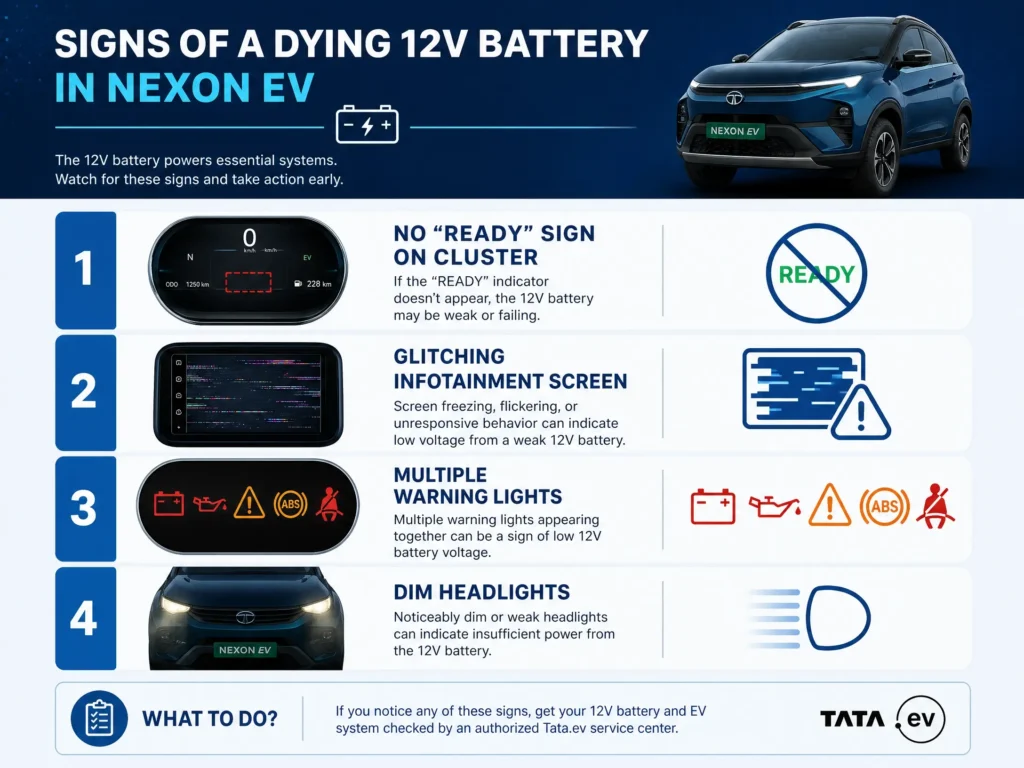
Because electric cars do not use an internal combustion engine, you will not hear the classic slow, struggling engine crank that alerts conventional drivers to a weak battery. Instead, a dying 12V auxiliary battery in a Nexon EV displays sudden and unpredictable electronic symptoms:
- Car Failing to Boot Into “Ready” Mode: You press the Start/Stop button, but the cluster does not show the green “Ready” sign, preventing you from shifting into Drive or Reverse.
- Glitching or Unresponsive Infotainment Screen: The large central touchscreen system takes an unusually long time to turn on, freezes continuously, or randomly reboots while driving.
- An Avalanche of Warning Lights: The digital instrument cluster suddenly illuminates multiple unrelated fault icons simultaneously—such as ABS errors, airbag warnings, or critical traction system faults—caused entirely by low voltage messing with electronic sensors.
- Sluggish Power Windows and Dim Lights: The power windows roll up noticeably slower than usual when the vehicle is parked, or the LED headlights appear weak before stepping inside the cabin.
Replacement Process Explained (Step-by-Step)
The manual replacement process for a Nexon EV’s 12V auxiliary battery is fairly straightforward, but technicians must adhere to rigorous safety protocols to protect the car’s complex computing modules.
How Technicians Complete the Swap
- System Power Down: The technician ensures the vehicle is completely turned off, the key fob is moved away from the vehicle, and the main high-voltage system is inactive.
- Disconnecting the Negative Terminal First: The ground/negative (-) black cable is unbolted first to prevent any accidental short circuits if a tool touches the car’s metallic frame.
- Removing the Positive Terminal: The red positive (+) cable is unbolted next and carefully insulated.
- Unclamping the Bracket: The hold-down bracket securing the battery to the tray is unbolted, and the heavy old battery is lifted straight out.
- Cleaning and Placing the New Unit: The battery tray is cleared of any debris, and the new 44Ah or 50Ah battery is dropped in.
- Reconnecting Terminals in Reverse Order: The positive (+) terminal is secured first, followed cleanly by the negative (-) terminal.
Safety Precautions and DIY Advice
The entire procedure requires roughly 20 to 30 minutes. While it looks identical to a standard car battery change, DIY replacement is generally not recommended for the Nexon EV. Modern EVs require a constant stream of low-voltage power during a swap to preserve underlying electronic calibration settings. Professional installers use a specialized “memory saver” tool plugged into the OBD port to maintain minor current while the main terminals are loose. Swapping the battery entirely unassisted can sometimes trip internal safety locks, requiring a flatbed tow to the dealership to reset the vehicle’s computers.
Can Insurance Cover 12V Battery Replacement?
A common question among new EV owners is whether they can claim the cost of a dead 12V battery through their motor insurance policy.
Standard comprehensive motor insurance policies in India do not cover regular battery replacement. Insurance is structured to pay out for sudden, accidental damage, theft, or external liabilities. A battery losing its capacity over 3 years is classified as standard wear and tear from normal vehicle usage.
Even if you hold premium insurance add-ons like a “Return to Invoice” or a “Zero Depreciation” cover, these additions apply strictly to body panels, glass, and major mechanical assemblies damaged during a collision. Unless your battery is physically cracked or destroyed in an documented road accident, the cost of a routine 12V replacement must be paid entirely out of pocket.
How to Increase 12V Battery Life in Nexon EV
While a 12V battery is ultimately a consumable component that will wear out over time, adopting smart ownership habits can easily push its usable lifespan closer to the 4-year mark:
- Avoid Short, Infrequent Drives: If the Nexon EV sits idle for weeks at a time, the auxiliary battery slowly drains due to the connected telematics and security systems. Drive the car for at least 20 to 30 minutes once a week to let the high-voltage system top up the 12V battery via the internal DC-to-DC converter.
- Do Not Use Accessories in “Utility” Mode Excessively: Avoid sitting in the parked car with the ignition set to ‘Accessory’ mode while running the AC fans, headlights, or sound system for extended periods. This draws directly from the tiny 12V battery without recharging it, leading to deep discharge cycles.
- Keep Up with Software Updates: Ensure your Nexon EV receives all official Tata software updates during scheduled service visits. Some older firmware versions suffered from background bugs that caused the car’s computers to wake up unnecessarily, draining the 12V unit overnight.
- Request Voltage Checks During Service: Always ask the service advisor to check the health and voltage of the 12V battery using a dedicated load tester during every periodic service interval. Catching a dropping voltage early saves you from getting stranded in a parking lot later.
Is 12V Battery Replacement Expensive in EVs?
When comparing maintenance fees, many first-time EV buyers worry that everything associated with an electric car carries an inflated premium. Thankfully, this is not true for the auxiliary system.
Replacing a 12V battery in a Tata Nexon EV costs exactly the same as replacing a battery in a petrol Nexon, a Maruti Suzuki Brezza, or a Hyundai Creta. Because it utilizes standard, mass-produced automotive battery sizes, you do not face any specialized “EV tax” on this part.
When evaluated as a long-term cost-to-value analysis, spending ₹5,000 every 3 years to ensure your ₹15-lakh to ₹19-lakh electric SUV runs smoothly is an exceptionally low maintenance cost. Compared to the massive savings you accumulate by avoiding rising fuel prices and routine engine oil changes, a periodic 12V auxiliary battery change remains a small and manageable part of EV ownership.
FAQ Section
Nexon EV 12V auxiliary battery price in India?
The replacement price typically ranges between ₹4,500 and ₹6,000 for standard lead-acid batteries. If you upgrade to a heavy-duty AGM or EFB battery model, the cost can range from ₹6,000 to ₹8,000 depending on the specific brand and warranty package chosen.
AGM vs lead-acid battery – which is better?
An AGM (or EFB) battery is technically superior for an electric vehicle. It handles frequent electrical cyclic loads much better, charges faster, and lasts longer under a constant electronic draw. However, a standard lead-acid battery is more economical and works perfectly fine if you use your car regularly.
How often does Nexon EV 12V battery need replacement?
On average, the 12V auxiliary battery inside a Nexon EV lasts between 2 to 4 years. Its exact lifespan depends heavily on your driving frequency, local weather conditions, and how often the car is left parked for weeks without being driven.
Can Nexon EV run if 12V battery fails?
No. Even if your main high-voltage lithium-ion battery pack is sitting at 100% charge, the Nexon EV cannot start or move if the 12V auxiliary battery is completely flat. The 12V system is required to power the onboard computers and close the main safety switches that engage the driving motors.
Is jump-starting safe in an EV?
Yes, you can safely jump-start a Nexon EV’s 12V auxiliary battery using a traditional donor car or a portable jump-start power bank, exactly like a normal petrol car. However, you must connect the cables strictly to the 12V terminals under the hood. Never attempt to touch or modify any bright orange high-voltage cables or components.
Conclusion
The 12V auxiliary battery might look simple compared to the advanced electric powertrain inside your Tata Nexon EV, but it remains the fundamental anchor for the car’s entire electronic infrastructure. A sudden breakdown caused by a dead 12V battery can be frustrating, but knowing that a replacement is simple and relatively inexpensive makes it a manageable part of routine maintenance.
For most Nexon EV owners, choosing a high-quality 44Ah or 50Ah battery from trusted Indian brands like Amaron or Exide offers the best balance of reliable performance and long-term warranty backup. Keep an eye out for the early warning signs of low voltage, ensure the battery health is verified during your periodic service visits, and you can enjoy the quiet, cost-effective performance of your electric SUV without any unexpected interruptions.