
The Tata Nexon EV has undeniably been a pioneer in the Indian electric vehicle revolution, transforming the way everyday drivers view electric mobility. For thousands of Indian car buyers, it made the transition from petrol and diesel cars to electric power both practical and highly appealing. However, as the earliest models on Indian roads age, a vital question naturally arises among both current owners and used car buyers: What is the realistic Tata Nexon EV battery replacement cost out of warranty?
The high-voltage battery is essentially the heart of an electric car, accounting for a massive chunk of its original manufacturing value. While the vehicle offers phenomenal savings on running costs during daily commutes, the thought of buying a whole new battery pack after the factory warranty expires can feel incredibly daunting. Understanding these estimated out-of-warranty costs is critical to evaluating the long-term viability of your vehicle, protecting your asset’s resale value, and ensuring you get true peace of mind on the highway.
Tata Nexon EV Battery Warranty Explained
Tata Motors has always provided reassuring warranty packages to ease the concerns of early EV adopters in India. For standard private owners, the standard factory warranty on the high-voltage battery pack and motor across most generations of the Nexon EV stands at 8 years or 1,60,000 kilometres, whichever comes first.
This comprehensive coverage ensures that if your battery experiences a major drop in performance, unexpected capacity loss, or an internal component failure, the manufacturer will repair or replace the affected parts free of charge.
The Lifetime Warranty Upgrade: In a major move to boost long-term trust, Tata introduced an optional Lifetime Battery Warranty scheme (valid for up to 15 years from registration with unlimited kilometres) for original first owners of the premium 45 kWh variant. This benefit is non-transferable and applies solely to the first buyer, making the standard 8-year buffer the primary metric for the used car market.
Crucially, the warranty does not mean your battery must hit a complete zero to qualify for a claim. In standard automotive practice, a battery is considered ready for warranty support if its State-of-Health (SoH) drops below 70% during the coverage period.
What Happens After the Battery Warranty Expires?
When an EV hits its 8th anniversary or crosses the 1.6-lakh-kilometre mark, it officially enters the post-warranty phase.A common misconception is that the battery will suddenly die the day after the warranty expires. In reality, modern Lithium Iron Phosphate (LFP) batteries used in the Nexon EV degrade very gradually, much like a smartphone battery.
Even after 8 years of regular use, a well-maintained battery pack will typically retain roughly 75% to 80% of its original capacity, which translates to a small, predictable drop in driving range rather than total failure.
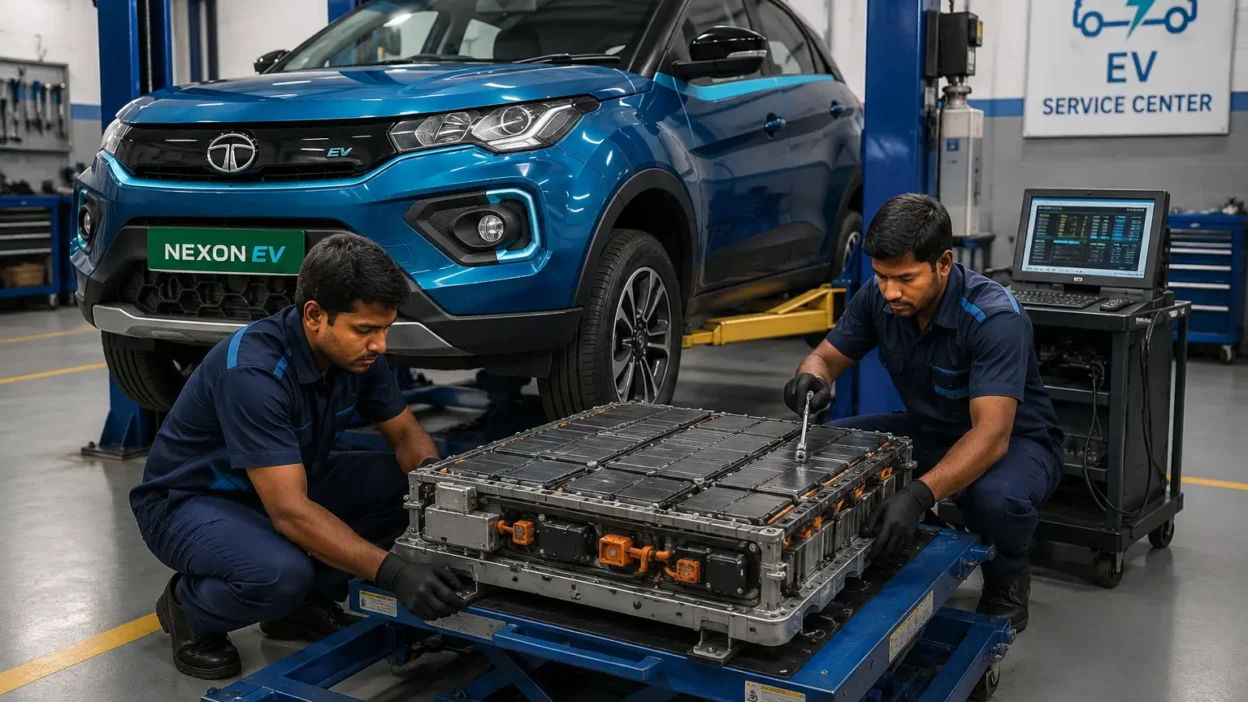
If a component does fail completely out of warranty, the financial responsibility for diagnostics, labor, software recalibration, and hardware shifting falls entirely on the vehicle owner.Understanding your pack’s exact capacity segment helps you project these potential costs effectively.
Tata Nexon EV Battery Replacement Cost Out of Warranty – Overview
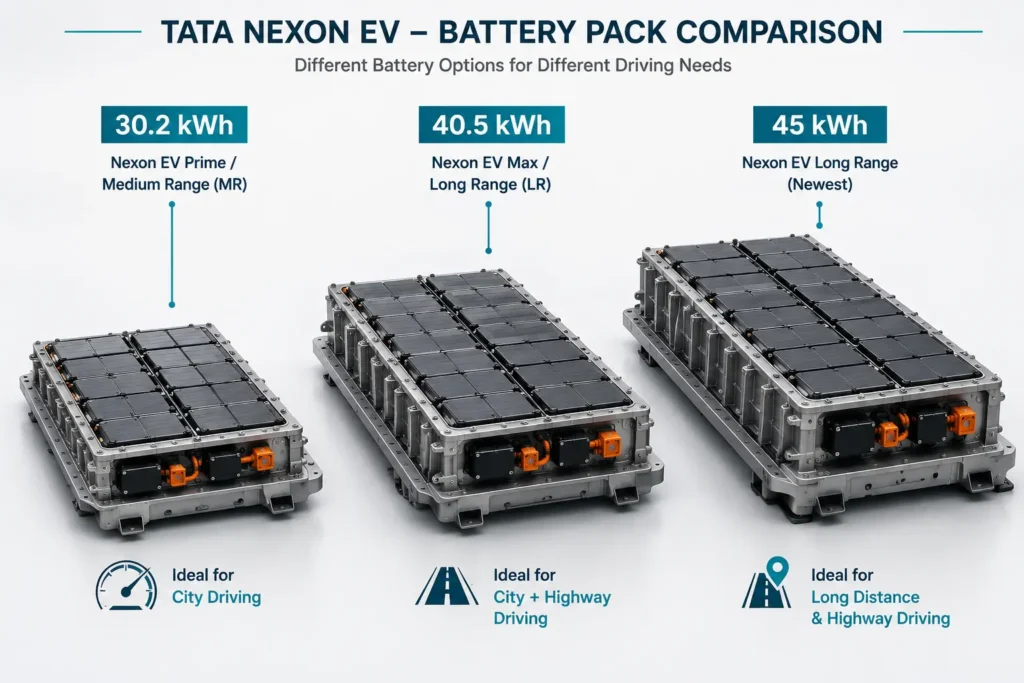
The final out-of-warranty replacement bill for a Tata Nexon EV depends heavily on the specific battery capacity of your variant. Over the years, Tata has updated the Nexon EV lineup with three distinct battery sizes to suit different range requirements.
The table below provides a carefully researched, projected snapshot of the full-pack replacement costs across these segments in India.
| Battery Variant | Pack Capacity (kWh) | Expected Replacement Cost Range (Estimated) | Percentage of Original Vehicle Cost |
| Nexon EV Prime / Medium Range (MR) | 30.2 kWh | ₹4.20 Lakh – ₹5.20 Lakh | ~33% – 38% |
| Nexon EV Max / Long Range (LR) | 40.5 kWh | ₹5.50 Lakh – ₹6.80 Lakh | ~35% – 40% |
| Nexon EV Long Range (Newest) | 45.0 kWh | ₹7.00 Lakh – ₹8.50 Lakh | ~40% – 45% |
Note: The ranges listed above are realistic industry estimates inclusive of basic dealer labor and software flashing, though actual individual service center bills can fluctuate based on localized taxes and scrap buy-back discounts.
30.2 kWh Battery Pack Replacement Cost (Expected Range in India)
The original Nexon EV (later rebranded as the EV Prime or Medium Range) features a 30.2 kWh battery pack.For this variant, a complete out-of-warranty battery pack replacement is expected to cost between ₹4,20,000 and ₹5,20,000. Because this specific 30.2 kWh configuration is no longer in active new-car production, replacement units are typically managed through specialized manufacturer refurbishing chains.
40.5 kWh Battery Pack Replacement Cost (Expected Range in India)
Introduced with the longer-range Nexon EV Max, this mid-tier 40.5 kWh battery pack requires a higher financial layout due to its larger cell count.If you require a complete full-pack changeout outside the warranty window, the approximate expected cost ranges from ₹5,50,000 to ₹6,80,000.
45.0 kWh Battery Pack Replacement Cost (Expected Range in India)
The flagship, highest-capacity battery offered in the Nexon EV lineup is the 45 kWh pack. Given its density and advanced thermal architecture, a full out-of-warranty block replacement sits at the top tier, commanding an estimated range of ₹7,00,000 to ₹8,50,000.
Why Is EV Battery Replacement So Expensive?
It often shocks car owners to see a single replacement part cost as much as a brand-new entry-level hatchback. The premium pricing comes down to three main factors:
- Raw Material Costs: EV battery cells rely on tightly managed, high-grade elements like lithium, high-purity iron, and specialized phosphates. Processing these elements to automotive standards remains an expensive global process.
- Complex Internal Architecture: A Nexon EV battery pack isn’t just a container of cells. It integrates an intricate liquid-cooling jacket (circulating water and ethylene glycol), an automated high-voltage distribution harness, and a dedicated computer framework.
- The Battery Management System (BMS): The BMS continuously monitors voltages down to individual cell strings to prevent overcharging or overheating. Replacing a full unit means paying for this highly sophisticated protective electronic ecosystem.
Battery Replacement vs Tata Nexon EV Resale Value
If your Nexon EV is 9 or 10 years old and requires a brand-new battery pack costing ₹5 Lakh or more, you face a classic automotive dilemma. At that age, the overall market resale value of the car itself might slide to around ₹4 Lakh to ₹6 Lakh.
Spending an amount equivalent to or higher than the car’s market value on a new battery rarely makes financial sense if you plan to sell the car immediately. However, if the car’s chassis, suspension, interior, and electric motor are in excellent working condition, investing in a battery replacement effectively gives the vehicle a completely fresh lease on life, offering another decade of near-zero fuel bills.
Is Partial Battery Repair or Cell Replacement Possible?
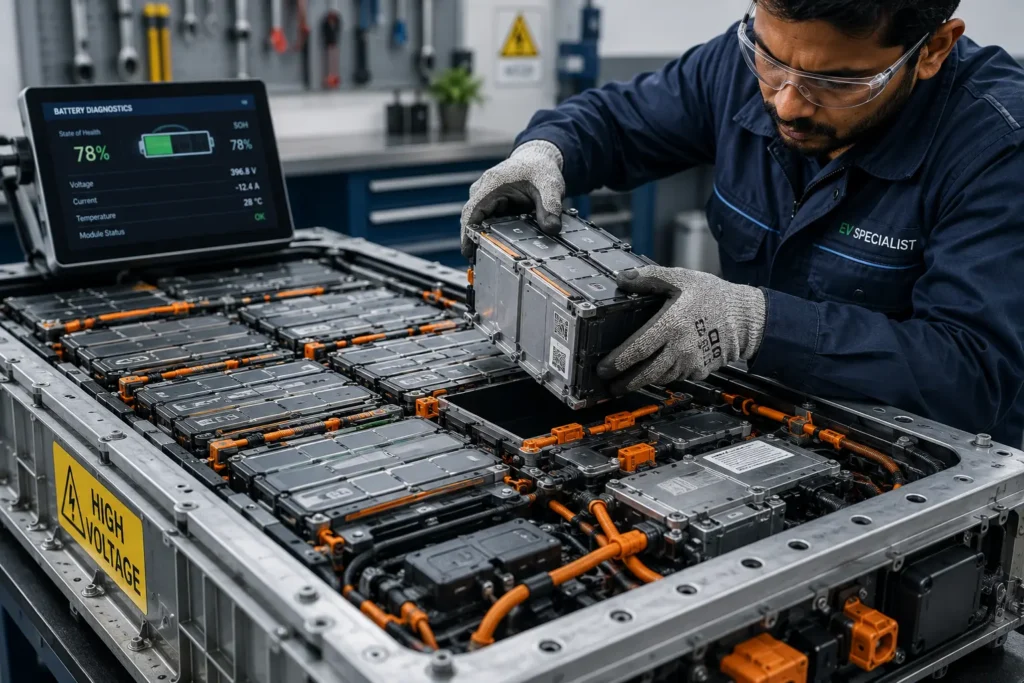
Fortunately, you will rarely ever need to replace a full battery pack out of pocket. Modern EV battery architecture is modular. Instead of being one giant, inseparable block, the Nexon EV pack is made up of multiple individual modules, each housing a series of interconnected cells.
In the vast majority of real-world failure cases, the entire battery pack hasn’t gone bad. Instead, a single module or a specific cell cluster within a module goes out of spec, causing a premature voltage drop or forcing the car into ‘limp mode’.
Authorized service centers and specialized EV repair labs can isolate the specific malfunctioning module using advanced diagnostic scanners. Replacing just that single faulty module typically costs between ₹60,000 and ₹1,50,000, saving you from the massive financial burden of a full-pack replacement.
Practical Tips to Extend Tata Nexon EV Battery Life
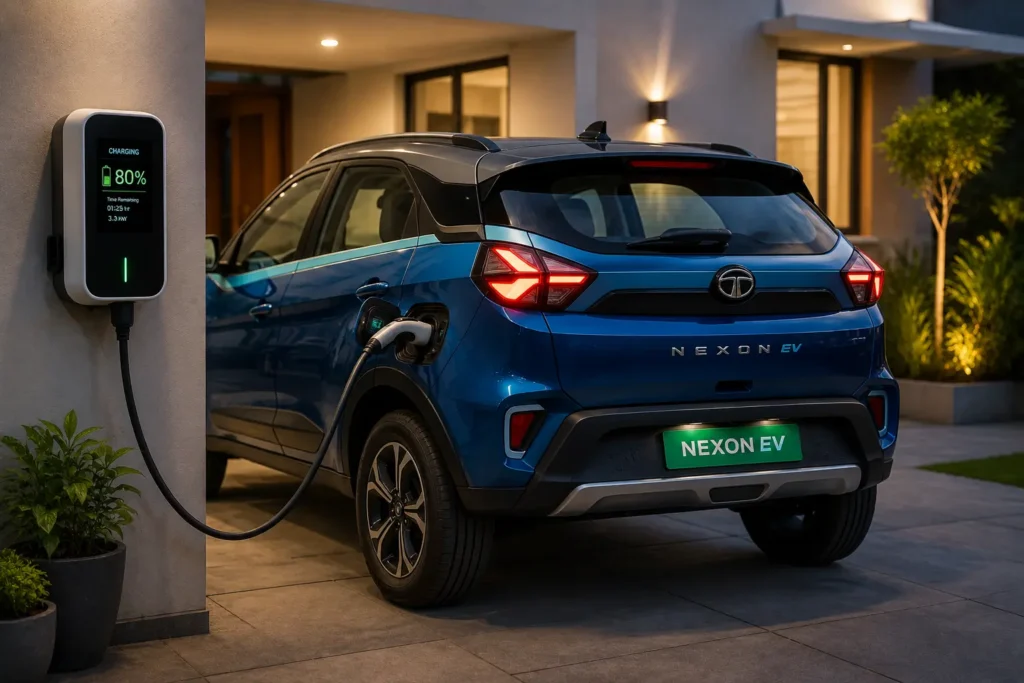
While battery degradation is inevitable over time, your daily charging habits dictate how fast that decline occurs. Follow these expert-backed practices to maximize your pack’s longevity:
- Avoid the Extremes (The 20-80% Rule): Lithium batteries experience the highest chemical stress when sitting completely full or entirely empty. Try to keep your daily state of charge between 20% and 80% for routine city commuting.
- Use DC Fast Chargers Judiciously: While 50 kW or 60 kW highway fast chargers are incredibly convenient, they generate significant heat stress within the cells. Rely on slower 15A home sockets or 7.2 kW AC wall boxes for your regular overnight charging needs.
- Never Leave the Car Sitting Empty: If you plan to park your Nexon EV unused for several weeks, ensure the battery is charged to around 50% to 60%. Leaving it parked at 0% can cause individual cells to drop below their safe voltage floor, permanently damaging them.
- Cool Down Before You Plug In: After a long highway sprint or a heavy driving session in peak Indian summer heat, let the car sit in the shade for 20 to 30 minutes before plugging it into a charger. This allows the liquid cooling system to normalize pack temperatures first.
Insurance Coverage for EV Battery Replacement in India
Given how expensive high-voltage battery components can be, relying on a basic comprehensive insurance policy isn’t enough. Standard motor insurance covers battery damage only if it occurs as a direct result of an external accident, such as a major collision.
To fully protect your wallet, it is highly recommended to opt for an explicit EV Battery Add-on Cover during your annual insurance renewal. This specialized add-on typically costs an extra premium of ₹4,000 to ₹9,000, but it covers catastrophic internal short circuits, sudden electronic failures, and water ingress damage caused by severe urban flooding. Keep in mind that insurers will apply standard depreciation deductions based on the age of the vehicle when settling a claim.
Tata Nexon EV Long-Term Ownership Cost Compared to Petrol Cars
To keep the out-of-warranty battery replacement cost in proper perspective, you have to look at the massive operational savings the vehicle generates over its lifespan.
Let’s look at a realistic long-term cost comparison over a standard 1,50,000 km ownership cycle between a Nexon EV (45 kWh) charged primarily at home and a standard Nexon Petrol variant.
| Cost Factor | Tata Nexon Petrol (1.2L Turbo) | Tata Nexon EV (45 kWh Pack) |
| Fuel / Energy Cost per KM | ~₹7.50 per km (Assuming ₹105/L at 14 km/L) | ~₹1.10 per km (Assuming ₹8/unit home rate) |
| Total Fuel Cost (1,50,000 km) | ₹11,25,000 | ₹1,65,000 |
| Routine Maintenance & Services | ~₹1,20,000 (Engine oil, filters, spark plugs) | ~₹50,000 (Coolant checks, brake pads) |
| Total Lifetime Running Expenses | ₹12,45,000 | ₹2,15,000 |
| Net Lifetime Savings with the EV | Baseline Reference | ₹10,30,000 Savings |
As the math clearly highlights, by the time your Nexon EV drives past its 8-year warranty window at 1.5 lakh kilometres, it has already saved you over ₹10 Lakh in net running expenses compared to an ICE counterpart. Even in a worst-case scenario where a full out-of-warranty battery replacement is required, your lifetime fuel savings comfortably offset the cost, leaving you financially ahead.
Frequently Asked Questions
1. Does the Nexon EV battery degrade completely after 8 years?
No, the battery does not completely stop working after 8 years. Under normal driving conditions in India, a well-cared-for LFP battery will retain roughly 75% to 80% of its initial capacity after 8 years, which means your total driving range will decrease slightly, but the vehicle remains perfectly usable for daily commuting.
2. Can I replace just a single dead cell or module instead of the whole battery?
Yes, partial module-level replacement is highly feasible and is the most common repair method.If an isolated cell or module experiences a voltage fault, technicians can swap out only that specific component. A single module replacement generally costs between ₹60,000 and ₹1,50,000, saving you from a full-pack bill.
3. How much does a full 30.2 kWh Nexon EV battery cost out of warranty?
A full replacement for the older 30.2 kWh battery pack (found in the EV Prime / Medium Range variants) is estimated to cost between ₹4.20 Lakh and ₹5.20 Lakh, depending on labor charges and service center taxes.
4. Is EV battery damage from city floods covered by standard insurance?
A standard car insurance policy will typically reject battery damage caused by driving through deep floodwaters unless you have specifically purchased an EV Battery Add-on or Hydrostatic Lock protector cover. Always review your policy details during renewal.
5. What are the signs that my Nexon EV battery pack is failing?
Key warning signs include a sudden, drastic drop in the state of charge (SoH) over a few days, the car repeatedly entering ‘limp mode’ despite having a high charge percentage, or significant range drops at the lower end of the battery capacity scale.
6. Will the cost of EV batteries go down in India in the future?
Yes, global and localized battery manufacturing costs are on a steady downward trend due to economies of scale and increased localization of components within India. Out-of-warranty replacement options are highly expected to become more affordable over the next few years.
Is Tata Nexon EV Worth Owning After Warranty?
The fear of a massive out-of-warranty battery bill can easily discourage prospective buyers, but a closer look at the actual numbers reveals a highly reassuring reality. Modern LFP battery chemistry is remarkably robust, and total pack failures after the 8-year mark remain exceptionally rare. Thanks to modular assembly designs, minor component issues can usually be resolved through affordable module-level repairs rather than complete pack changes.
When you factor in the massive financial savings generated across years of near-zero fuel bills, the Nexon EV easily justifies its initial premium. Holding onto your car or buying a well-vetted used model past its warranty window remains a highly sensible, economically sound decision—provided you maintain healthy charging habits and protect your asset with the right insurance covers.