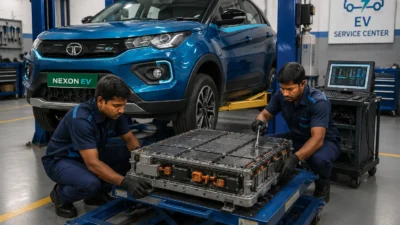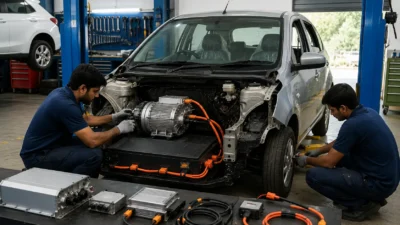

Why Ola Scooter Battery Issues Worry Owners : For an electric scooter owner in India, the battery pack is essentially the heart of the vehicle. It determines your daily range, traffic acceleration, and the overall longevity of your investment. Among mainstream electric two-wheelers, Ola Electric’s S1 lineup—including the S1 Pro, S1 Air, and S1 X variants—has gained massive market share. However, as these scooters age and early buyers cross into post-warranty territory, a specific technical issue has left many owners deeply anxious: deep discharge.
Discovering your EV won’t boot up, display a charging screen, or respond to touch inputs after being parked for a few weeks is a stressful experience. When a lithium-ion battery pack drops past a critical voltage threshold, standard home chargers stop recognizing it. If your vehicle is out of its warranty coverage, fixing this issue can lead to unexpected out-of-pocket expenses.
This comprehensive guide covers everything you need to know about Ola scooter battery deep discharge, exploring the mechanics of why it occurs, warning indicators to monitor, practical restoration options, and realistic out-of-warranty replacement costs in India.
What Is Deep Discharge in an Electric Scooter Battery?
An electric scooter battery enters a state of deep discharge when its overall voltage drops significantly below its safe, minimum operational design limit. Every lithium-ion cell functions within a strict voltage window—typically between 3.0 V (empty) and 4.2 V (fully charged). If a cell’s voltage falls below 2.5 V or lower, chemical changes occur within the cell geometry.
Featured Snippet Context:
Deep discharge occurs when an electric vehicle battery remains uncharged at 0% for an extended period, causing the cells to drop below their minimum safe voltage threshold. When this happens, the internal Battery Management System (BMS) triggers a hard safety shutdown to prevent thermal instability. Consequently, the battery enters a sleep state and will no longer accept a charge from standard EV home chargers, requiring specialized technical intervention or a full pack replacement.
When multiple cell groups inside an Ola battery pack sustain low voltages, the integrated BMS isolates the entire system. This hard lock serves as a mandatory protective measure; attempting to push high current into an overly depleted lithium cell can lead to permanent structural degradation or internal short-circuiting.
Why Does Deep Discharge Happen in Ola Scooters?
Understanding why these battery issues develop helps prevent unexpected downtime. In most real-world scenarios, deep discharge stems from a combination of vehicle architecture and storage habits:
- Continuous Background Vampire Drain: Even when your Ola scooter is completely turned off or locked, its internal computer systems, cellular eSIM telemetry, GPS hardware, and Bluetooth proximity sensors remain continuously active. This baseline idle power draw gradually drains energy from the primary battery pack.
- Prolonged Parking at Low States of Charge: Parking a scooter with less than 10% or 15% remaining battery for weeks at a time is a frequent cause of deep discharge. The idle vampire drain quickly depletes the remaining safety buffer, dragging individual cell modules down into the critical zone.
- Neglecting Vacation Mode: Ola’s MoveOS platform includes a dedicated “Vacation Mode” designed to minimize onboard asset tracking and system activity during extended absences. Leaving the scooter parked for an extended trip without enabling this feature accelerates background drain.
- BMS or Secondary Hardware Faults: Occasionally, a component malfunction within the central tracking modules or a damaged auxiliary $12\text{V}$ battery circuit can cause anomalous energy loops, draining the primary high-voltage architecture much faster than normal.
Common Signs of a Deep Discharged Battery
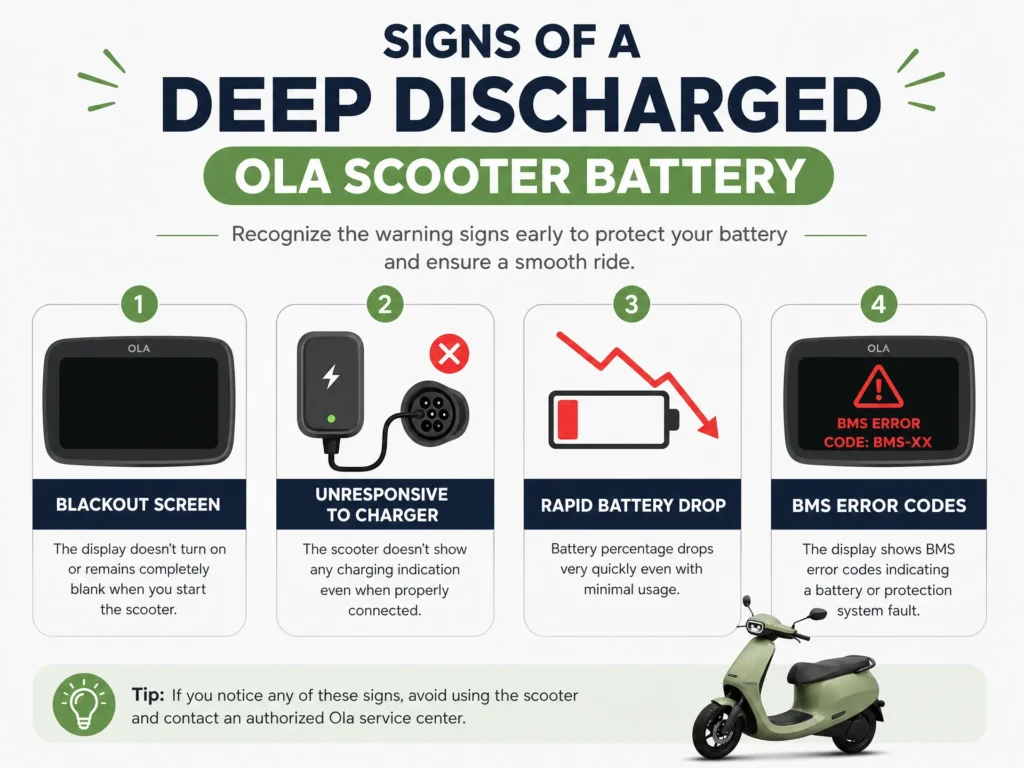
Catching a severe drop in cell voltage early can save you from an expensive replacement bill. If your electric scooter is sliding into a deep discharge state, it will generally display these distinct symptoms:
- Complete Blackout / No Screen Activity: The digital touchscreen display remains entirely dark, and the scooter refuses to unlock via the mobile application, keyless proximity, or manual passcode input.
- Unresponsive to the Home Charger: When you plug the proprietary home charging dock into the charging port, the hyper-charger or home unit fan fails to engage, and no indicators light up on the dashboard. The scooter acts as though no power source is attached.
- Rapid Initial Drop and Sudden Power Loss: If you notice your battery percentage dropping unexpectedly from 30% to 0% in a matter of minutes while riding or shortly after parking, individual cell blocks may be collapsing under structural load.
- BMS Error Warnings on the Dash: Before a complete shutdown, the instrument cluster may display permanent safety error codes related to isolation faults, irregular cell voltages, or central system communication failures.
Can a Deep Discharged Ola Battery Be Repaired?
Yes, a deep-discharged battery pack can often be restored, but the viability of a repair depends heavily on how long the cells have remained completely depleted.
If the vehicle has only been unresponsive for a brief period, authorized service technicians or independent electric vehicle battery specialists can often safely revive the system. This recovery process requires bypassing the standard external ports to connect a specialized industrial DC bench power supply directly to the internal terminals. Technicians apply a low, controlled current to slowly raise the individual cell group voltages back into their safe, nominal operating windows.
Once the baseline voltage rises high enough for the internal BMS to clear its protective safety locks, a standard top-off cycle can proceed.
However, if the cells have remained at absolute zero for multiple months, the internal copper current collectors can dissolve, forming microscopic metallic bridges called dendrites. This internal damage creates permanent short-circuits, rendering the cells unsafe to revive and making a module or pack replacement unavoidable.
Ola Scooter Battery Replacement Cost After Deep Discharge
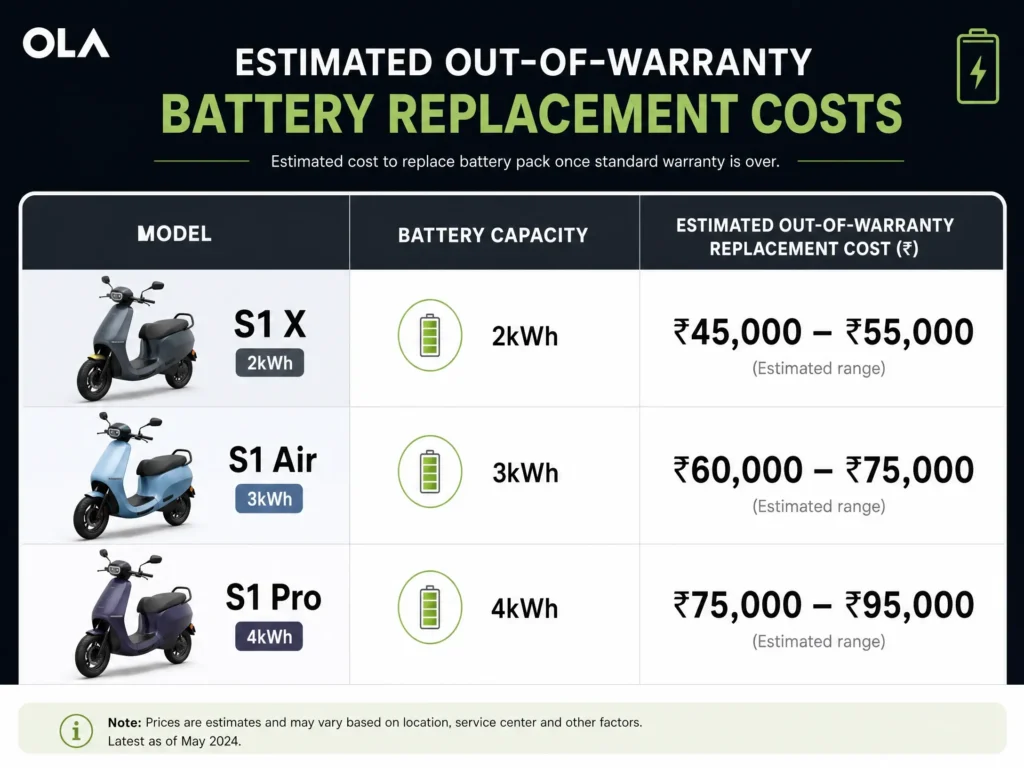
If the battery cells have suffered irreversible chemical degradation, a full pack replacement is necessary. Because lithium-ion cells represent the single largest manufacturing expense in an electric two-wheeler, out-of-warranty replacement costs are significant.
The actual expense varies based on the generation of your vehicle (Gen 1 vs. Gen 2) and its total kilowatt-hour ($\text{kWh}$) capacity.
Out-of-Warranty Charges – What Owners Should Expect
The following table provides estimated, approximate out-of-warranty replacement costs for various Ola electric scooter battery packs based on current market trends and authorized service center data:
| Ola Scooter Model Variant | Battery Pack Capacity (kWh) | Estimated Out-of-Warranty Replacement Cost |
| Ola S1 X (Entry Variant) | 2.0 RkWh | ₹45,000 – ₹50,000 |
| Ola S1 X / S1 Air | 3.0 RkWh | ₹65,000 – ₹72,000 |
| Ola S1 / S1 Pro (Gen 1 & Gen 2) | 4.0 RkWh | ₹85,000 – ₹95,000 |
| Premium / High-Capacity Variants | 5.3 RkWh | ₹1,10,000 – ₹1,20,000 |
Note: These values are realistic approximations based on current manufacturing and component data. Final billing amounts will vary depending on your specific city, applicable local taxes, and component labor costs charged by authorized workshops.
In addition to the hardware costs, out-of-warranty owners are responsible for peripheral workshop charges, including diagnostic line items (approximately ₹1,000 to ₹2,500), technical labor charges, and required platform component updates.
Repair vs Replacement – Which Option Makes Sense?
Faced with a substantial out-of-warranty quote, owners must carefully weigh their options before committing to a full factory replacement.
                  ┌─────────────────────────────────────────┐
                  │ Is the Battery Pack Deep Discharged?   │
                  └────────────────────┬────────────────────┘
                                       │
                    How long has it been completely flat?
                                       │
             ┌─────────────────────────┴─────────────────────────┐
             ▼                                                   ▼
     [ Weeks / Short Term ]                             [ Months / Long Term ]
             │                                                   │
  Cells likely stable.                                Chemical structural damage.
             │                                                   │
             ▼                                                   ▼
 ┌───────────────────────┐                           ┌───────────────────────┐
 │   Deep Discharge      │                           │  Full Factory Battery │
 │   Wake-Up & Balancing │                           │   Pack Replacement    │
 │  (Est: ₹2,500-15,000) │                           │ (Est: ₹45,000-95,000) │
 └───────────────────────┘                           └───────────────────────┘
When to Choose Professional Repair
If a diagnostic test reveals that your cell blocks are healthy and have merely slipped just beneath the safety threshold, a repair is highly cost-effective. Authorized service center recovery options or vetted, independent EV engineering labs typically charge between ₹2,500 and ₹15,000 for cell waking, pack re-balancing, or partial BMS board replacement. This path saves considerable money while preserving the usable lifespan of your original battery pack.
When Replacement is Unavoidable
If a diagnostic scan shows widespread cell swelling, internal short-circuits, or a severe loss of capacity across multiple cell groups, structural repair is no longer a safe option. In these cases, opting for a factory pack replacement ensures long-term safety, restores your scooter’s original range, and includes a fresh manufacturer warranty on the new component.
Does Insurance Cover Battery Damage Due to Deep Discharge?
A common question among out-of-warranty owners is whether their comprehensive vehicle insurance policy will cover a deep discharge replacement.
In almost all cases, standard comprehensive vehicle insurance policies do not cover deep discharge issues. Insurance companies view deep discharge as a gradual maintenance oversight or wear-and-tear event rather than sudden, accidental damage. Unless the battery depletion is the direct result of a covered external accident, fire, or localized flooding, insurance claims for deep discharge will be denied.
To avoid these out-of-pocket costs, third-party extended warranty programs or OEM top-up packages are highly recommended. For context, Ola offers long-term battery warranty extensions (up to 8 years or 1,25,000 km) starting around ₹11,799 to ₹19,999 depending on the tier. Investing in an extended warranty provides excellent financial protection against complex battery and component failures down the road.
How Deep Discharge Affects Scooter Performance & Resale Value
Allowing a lithium-ion battery pack to slip into a deep discharge state can have lasting effects on the vehicle, even after it has been successfully revived:
- Permanent Capacity Loss: Even if a deep-discharged pack is successfully woken up, the cells often sustain a permanent reduction in total energy capacity. You may notice your maximum true range drops by 5% to 15% compared to its pre-discharge performance.
- Increased Internal Resistance: Compromised cells struggle to deliver energy efficiently under heavy loads. This can manifest as sluggish acceleration in Hyper or Sport modes, or premature thermal throttling on hot days.
- Reduced Resale Value: Savvy used-EV buyers often request a certified State of Health (SoH) diagnostic report before purchasing. A battery pack with a history of deep discharge or noticeable degradation will lower the scooter’s market value, as buyers factor in the future cost of a replacement pack.
Practical Tips to Prevent Deep Discharge in Ola Scooters
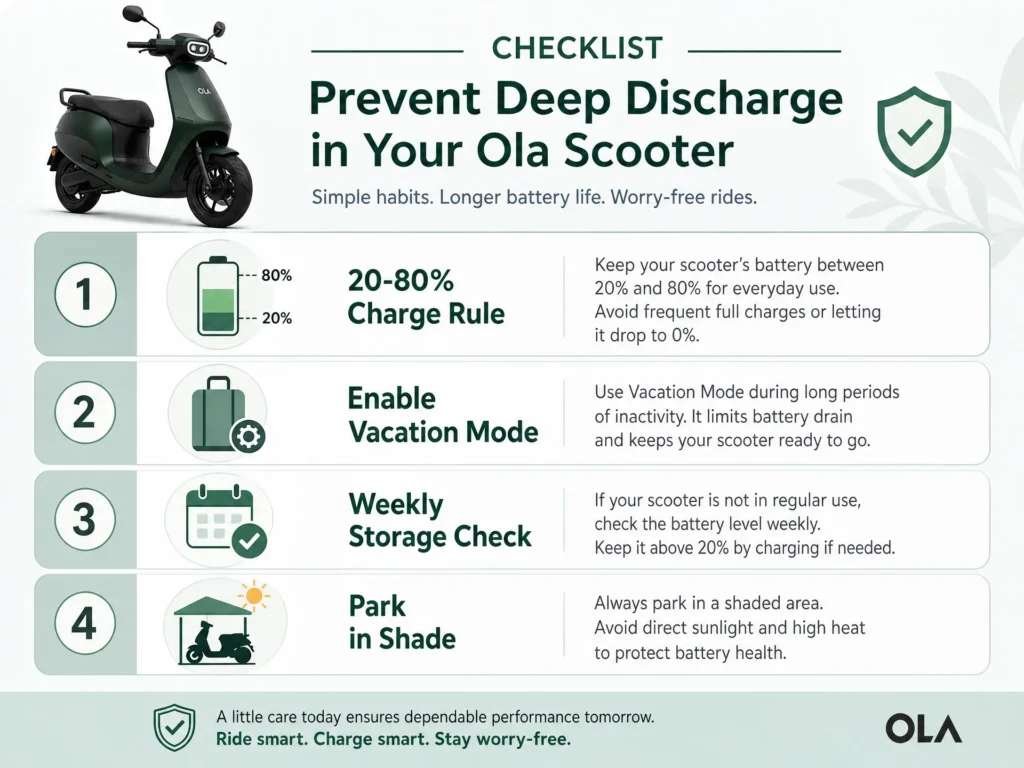
Preventing deep discharge is simple and requires only a few key habits to maintain battery health over the lifespan of the scooter:
- Maintain a 20% to 80% Charge Window: Try not to let your scooter sit near 0% for extended periods. Keeping the state of charge within the 20% to 80% range reduces stress on the cell chemistry and leaves a healthy safety buffer against idle drain.
- Always Engage Vacation Mode for Storage: If you plan to leave your scooter parked for more than four or five days, navigate to the vehicle settings menu and enable Vacation Mode. This disables non-essential background processes and preserves your battery charge for months.
- Perform a Weekly Storage Check: If you must store your vehicle long-term, try to check its charge level via the mobile app or physical dashboard once a week. If the level drops below 30%, plug it in for a brief top-off cycle.
- Avoid Extreme Heat Post-Ride: Park your electric scooter in a shaded, well-ventilated area whenever possible. Letting a hot scooter sit in direct summer sunlight accelerates self-discharge and puts unnecessary stress on the internal chemistry.
Long-Term Ownership Cost of Ola Electric Scooters
When evaluating out-of-warranty battery expenses, it helps to look at the broader financial picture of electric scooter ownership.
Even when factoring in a hypothetical battery service event later in the vehicle’s lifecycle, electric two-wheelers offer significant operational savings over traditional internal combustion engine (ICE) scooters. With lower per-kilometer charging costs and minimal routine maintenance—free from engine oil changes, spark plug replacements, and complex exhaust upkeep—the overall cost of ownership remains highly competitive for regular commuters.
                     [ Total Cost of Ownership Over 5 Years ]

ICE (Petrol) Scooter  ═════════════════════════════════════╣ ₹1,35,000+
                                                            (Fuel, Regular Services)

Ola EV (With Battery Event) ═════════════════════════╣ ₹95,000 - ₹1,15,000
                                                      (Charging, Out-of-Warranty Pack/Repair)
Maintaining disciplined charging habits ensures you maximize these inherent savings while avoiding premature battery degradation.
Frequently Asked Questions
1. Does the standard Ola factory warranty cover deep discharge?
Ola’s standard 3-year factory battery warranty typically covers manufacturing defects, component failures, and premature health degradation below 70%.However, if diagnostic logs show the battery failed because it was left sitting at 0% for months due to owner neglect, the warranty claim may be denied.
2. Can I jump-start a dead Ola scooter battery using a car battery?
No. Ola scooters utilize high-voltage lithium-ion propulsion architectures (72 V to 80 V nominal), whereas standard automobiles run on low-voltage 12 V lead-acid systems. Attempting to bridge these systems can damage your vehicle’s sensitive electronic components.
3. How long does it take for an idle Ola scooter to enter deep discharge?
Depending on your starting charge level and whether Vacation Mode is enabled, idle vampire drain can pull a battery down to 0% in two to four weeks. Once at absolute zero, cells can slip into a critical deep discharge state within just a few days.
4. What should I do if my Ola scooter screen goes pitch black and won’t charge?
First, check your auxiliary 12 V battery if your model uses one, as a dead auxiliary system can prevent the scooter from booting up. If the primary high-voltage battery is deep-discharged, contact an authorized service center or an EV specialist to schedule a system diagnostic scan.
5. Is it safe to buy a refurbished or used Ola battery pack?
Vetted, professionally refurbished lithium packs that have undergone rigorous cell-matching, spot-weld validation, and independent BMS testing can serve as a viable budget option. However, avoid uncertified third-party assemblies, as poor cell balancing presents real safety and performance risks.
6. Can I upgrade my older 3 kWh Ola scooter to a 4 kWh pack during a replacement?
Pack upgrades generally aren’t supported due to strict structural frame dimensions, specific suspension tuning, and matching powertrain controller firmware. Replacement components must match the original design specifications of your specific chassis variant.
Is Battery Replacement After Deep Discharge Worth It?
Dealing with an out-of-warranty deep discharge issue requires a clear look at your scooter’s remaining value. If an authorized service center or an independent EV workshop can safely revive your existing pack through simple re-balancing or a minor component fix, it is always the best path forward. Paying a modest fee to restore your vehicle preserves your original investment and gets you back on the road with minimal hassle.
However, if the pack has suffered permanent chemical damage and requires a full factory replacement, you’ll need to weigh that cost against the age and condition of the scooter. Spending ₹70,000 to ₹90,000 on a brand-new battery makes excellent sense for a newer, well-maintained Gen 2 model, as it essentially resets the core lifecycle of your vehicle. For older, heavily worn first-generation models, you may want to consider selling the chassis for parts or trading it in toward a newer model with fresh warranty coverage.