
The silent revolution on Indian roads is no longer a future prediction—it is a daily reality. From bustling metropolitan hubs to tier-2 cities, electric vehicles (EVs) have transitioned from niche statement pieces to practical, mainstream mobility solutions. As thousands of new EV owners bring their electric cars and two-wheelers home every month, a crucial question arises right at the parking spot: What is the smartest way to power this transition?
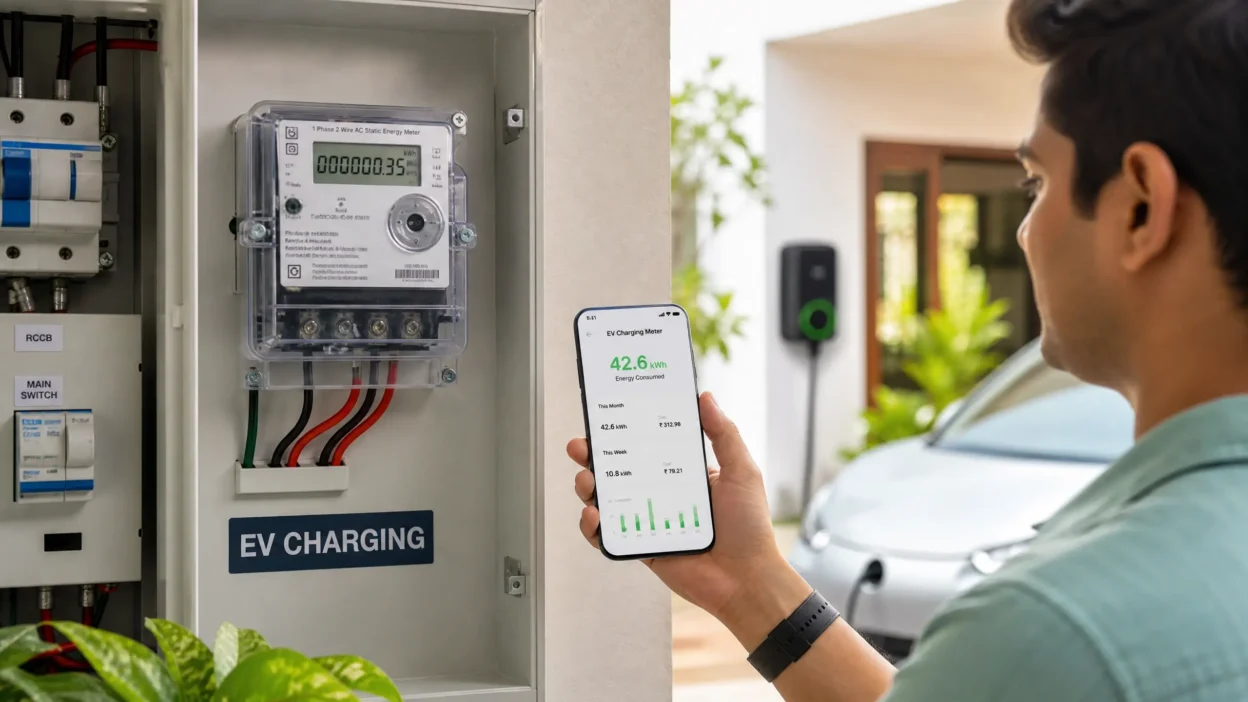
While plugging your vehicle into a standard domestic wall socket is the easiest way to start, it quickly introduces structural billing challenges. As your monthly power consumption creeps upward, your household electricity bill can skyrocket due to steep progressive slab rates. To protect consumers and encourage green mobility, power distribution companies (DISCOMs) across India now allow residential properties to apply for a dedicated, separate electricity meter for EV charging. This comprehensive guide breaks down why a dedicated EV meter is essential, details state-wise electricity tariffs, outlines the DISCOM application process, and analyzes the structural installation costs and long-term financial savings.
Why a Dedicated EV Charging Meter is Essential for Indian Homes
For the average homeowner, a dedicated utility connection might sound like an unnecessary administrative hassle. However, charging an electric vehicle is structurally different from running standard home appliances. A mid-sized electric car with a 40 kWh battery pack draws roughly 42 to 45 units (1 unit = 1 kWh) from the grid for a complete charge, factoring in routine AC-to-DC conversion losses. If you drive 1,200 kilometers a month, your car will require an additional 200 to 250 units of electricity monthly.
Here is why absorbing that consumption into your existing home meter can backfire, and why a separate electricity meter for EV charging provides a massive advantage:
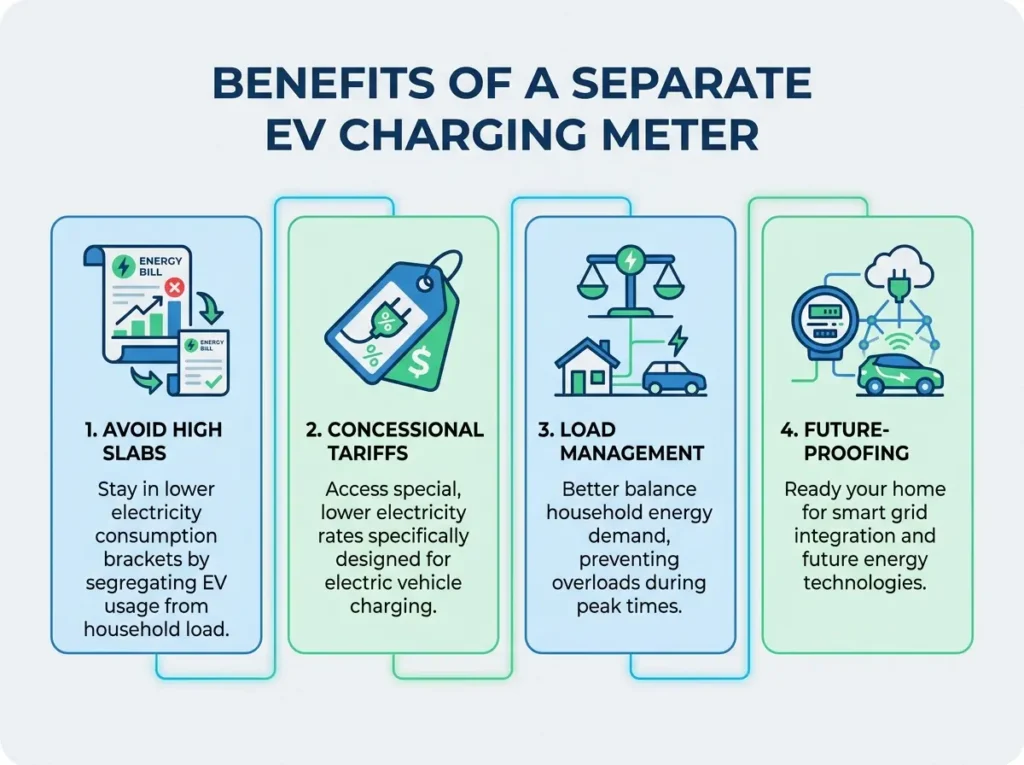
1. Avoiding Steep Residential Electricity Slabs
Most Indian state DISCOMs operate on a progressive telescoping tariff system. This means that as your household consumes more units of electricity, the per-unit cost increases across successive slabs. Adding the significant power demand of an EV to your existing residential meter can quickly push your entire consumption into higher, more expensive tariff brackets.
For instance, consider a scenario where your home typically consumes 300 units a month for lights, fans, and air conditioning, placing you in a moderate slab variant of ₹6 per unit. If you add 250 units of EV charging to that exact same meter, your total consumption hits 550 units. In many states, any consumption beyond 500 units triggers a premium slab pricing tier, frequently reaching ₹9 to ₹11 per unit. Consequently, you end up paying the peak domestic premium rate not just for your car, but potentially for your entire household baseline load. A separate electricity meter for EV charging isolates these two systems completely, ensuring your household consumption remains in its original, lower slab.
2. Accessing Dedicated EV Tariffs and Subsidies
Recognizing the strain heavy vehicle charging can place on domestic grids, State Electricity Regulatory Commissions (SERCs) have introduced concessional, flat-rate EV tariffs. These dedicated categories bypass the standard domestic telescoping slabs entirely. By routing your charger through a dedicated EV meter, you gain immediate access to these subsidized energy rates, which can significantly reduce your baseline charging costs depending on your state of residence. This is a key financial benefit of opting for a separate electricity meter for EV charging home India.
3. Protecting and Increasing Your Sanctioned Load Capacity
Most urban Indian households possess a standard single-phase connection with a sanctioned load ranging between 3 kW and 5 kW. If you intend to install a modern 7.2 kW or 11 kW AC fast wall-box charger at home, your infrastructure requirements change instantly. Running a 7.2 kW fast charger on a standard 5 kW residential line will likely trip your primary circuit breaker if an air conditioner or a water geyser runs simultaneously. Overloading a domestic connection can also result in hefty penalties from your power utility.
A separate EV connection delivers an entirely fresh, independent sanctioned load allocation—typically upgraded to a robust three-phase supply line—ensuring your household appliances run safely without power drops. This upgrade in capacity is crucial for efficient and safe EV charging.
4. Grid Harmonization and Future-Proofing Your Home
A dedicated meter acts as an isolated gateway that prepares your residence for smart charging integration and progressive grid management features. As vehicle-to-home (V2H) technologies and bi-directional charging setups mature over the next few years, having an independent, clean electrical line directly running to your parking bay ensures your home’s infrastructure is fully future-proofed. This foresight can save you significant upgrade costs in the long run.
Understanding EV Charging Tariffs in India: A State-Wise Breakdown
Electricity governance in India is decentralized, meaning every state’s DISCOM establishes independent pricing structures, fixed monthly charges, and baseline policy rules. The financial value of installing a separate electricity meter for EV charging depends closely on the cost gap between your state’s highest residential slab and its dedicated EV charging tariff.
The table below provides a representative breakdown of approximate flat EV tariffs, typical peak residential slab rates, and fixed distribution charges across key Indian states. This data is crucial for understanding potential savings.
| State | Dedicated EV Tariff (Approx. per kWh) | Peak Residential Slab Rate (Approx. per kWh) | Fixed/Demand Charges (Per kW/Month) |
| Delhi | ₹4.50 – ₹5.00 | ₹8.00 – ₹10.00 | Nominal / Waived for EVs |
| Karnataka | ₹4.50 – ₹5.50 | ₹10.00 – ₹11.00 | Approx. ₹60 – ₹100 per kW |
| Maharashtra | ₹5.50 – ₹6.50 | ₹10.00 – ₹12.00 | Waived or highly subsidized |
| Uttar Pradesh | ₹6.00 – ₹7.00 | ₹7.00 – ₹8.00 | Standard LT rates apply |
| Gujarat | ₹6.00 – ₹7.00 | ₹7.00 – ₹7.50 | Exemptions on duty apply |
| Tamil Nadu | ₹6.50 – ₹8.00 | ₹8.00 – ₹9.00 | Fixed slab structural charges |
Note: Tariff structures are subject to periodic revisions by state distribution licensees. Always verify current commercial schedules with your local DISCOM office for the most accurate information.
The Strategic Advantage of Time-of-Day (ToD) Tariffs
Beyond flat concessions, major progressive utilities are actively deploying Time-of-Day (ToD) tariffs. Since EVs are typically parked overnight, they represent highly flexible electrical loads that can be managed easily. Under a ToD structure, the day is split into specific zones:
•Off-Peak Hours (typically 10:00 PM to 6:00 AM): Tariffs are heavily discounted (often by 15% to 30%) to incentivize users to draw power when overall grid demand drops.
•Peak Hours (typically 6:00 PM to 10:00 PM): Tariffs carry a premium surcharge to discourage high-draw activities during maximum grid strain.
By scheduling your dedicated EV connection to activate exclusively past midnight via your smart vehicle app or wall-box interface, you can compound your savings, lowering your effective operational charging costs even further. This intelligent charging strategy maximizes the benefits of having a separate electricity meter for EV charging home India.
The DISCOM Application Process: A Step-by-Step Guide for Your EV Meter
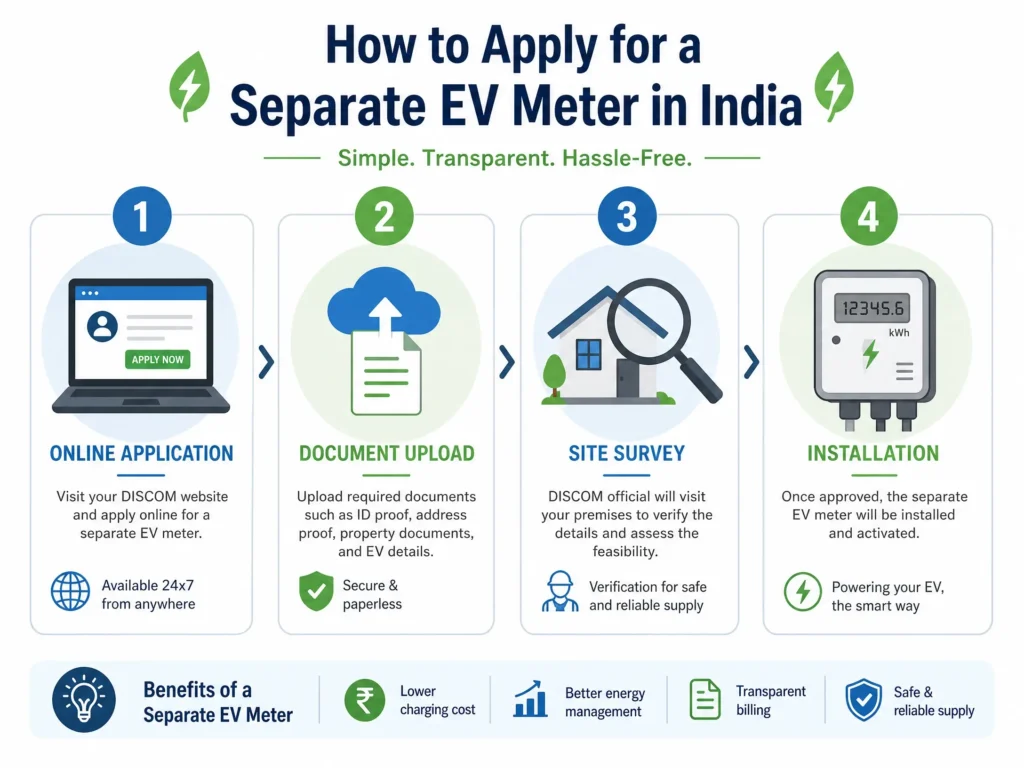
Securing an official independent connection for your EV charging needs mirrors the structured workflow required for setting up a brand-new domestic power utility line. The process has been largely digitized across major urban and semi-urban state circles, making it more accessible for homeowners.
Step 1: Initiate the Online Application
Log directly onto the centralized web portal of your regional electricity distribution company (e.g., Tata Power, BSES, MSEDCL, BESCOM). Navigate to the “New Connection Request” panel and select the dedicated consumer sub-category specifically designated as “Electric Vehicle Charging (EV)” or similar. Fill in all required personal and property details accurately.
Step 2: Compile and Upload Essential Documents
After initiating the application, you will be prompted to upload mandatory documentation. Ensure all scanned certificates are clear and completely legible to prevent administrative rejections or delays. The essential documents typically include:
•Proof of Identity: Aadhaar card, PAN card, or Passport.
•Proof of Property Ownership/Occupancy: Latest property tax receipt, registered sale deed, or an official allotment letter.
•NOC or Dedicated Undertaking: A formal legal declaration, often on stamp paper and notarized, certifying that the new infrastructure will be utilized exclusively for electric vehicle charging operations.
•Licensed Electrician’s Test Report (Form A1): An official structural fitness certificate completed and stamped by a certified government-licensed electrical contractor, verifying that the internal wiring schema matches safety protocols.
Step 3: Undergo the Official Site Survey
A designated DISCOM field team or local technician will schedule an on-site visit to your property. During this survey, they will check the distance from the nearest distribution pillar box, assess whether your building’s current busbar assembly can safely handle the new connection, and finalize the physical layout for the new meter box. This step ensures the technical feasibility and safety of the installation.
Step 4: Settle the Demand Note and Schedule Installation
Once the site survey clears successfully, the DISCOM issues an official financial document known as a Demand Note. This details the mandatory security deposit and local equipment activation fees. Clear this payment online. Once processed, the utility company will physically install the fresh meter assembly on your property, typically in the common meter room. It is important to note that the internal wiring from this new meter to your personal parking bay is generally the owner’s responsibility.
Overcoming Apartment and RWA Hurdles for EV Meter Installation
If you reside in a high-rise apartment complex or a gated multi-family community, you may face additional hurdles from your Resident Welfare Association (RWA). RWAs often express concerns about common-area structural modifications, cable routing safety, and general fire hazards. To clear these hurdles efficiently, provide your RWA with a detailed plan showing your independent cable path and your official Form A1 safety compliance certificate. Many housing societies are shifting toward standardized, designated common charging banks run through shared commercial sub-meters to keep communal spaces clear and organized, which might be an alternative if individual meters are challenging.
Installation Costs: What to Expect for Your Separate EV Meter
Setting up a separate electricity meter for EV charging involves both official utility charges and private material installation costs. The overall investment varies depending on how far your personal parking bay sits from the main building meter room and the specific requirements of your DISCOM.
The total upfront cost typically breaks down across three primary categories:
Plain Text
Total Setup Budget = [DISCOM Fixed Fees] + [Internal Cabling & Core Infrastructure] + [Professional Labor]
1. DISCOM Statutory Fees & Security Deposits
This component covers your formal application processing, meter equipment fees, and the load security deposit. For a standard single-phase or upgraded three-phase low-tension line, this fee scales between ₹5,000 and ₹12,000, depending on your specific state guidelines and chosen kW load capacity. These are mandatory charges levied by the electricity board.
2. Cabling and Core Infrastructure Support
This covers the actual heavy-duty armored copper or aluminum cabling needed to connect your new meter directly to your parking bay. EV charging demands continuous high-amperage current over several hours, meaning standard low-gauge home wiring cannot be used safely. You must use robust, weather-insulated cables (such as 4 mm² or 6 mm² variants). Depending on the quality, materials, and length of the run, cable pricing averages ₹150 to ₹350 per meter. This can be a significant cost factor, especially for longer distances.
3. Professional Labor, Safety Switches, and Earthing
Setting up a safe charging point requires installing dedicated safety components like an independent Earth Leakage Circuit Breaker (ELCB) or Residual Current Circuit Breaker (RCCB) to protect against electrical faults. Additionally, creating a dedicated chemical earthing pit directly near the vehicle bay is highly recommended to protect your vehicle’s sensitive onboard electronics from voltage surges. Professional labor for this setup typically costs between ₹3,000 and ₹6,000, ensuring all safety standards are met.
Total Estimated One-Time Investment for a Separate EV Meter
Combining these three categories, a standard residential setup for a separate electricity meter for EV charging home India can expect an all-inclusive, one-time deployment cost ranging from ₹10,000 to ₹25,000. It is always best to gather multiple quotes from certified, licensed electrical contractors for the internal wiring work to find the right balance of cost and quality materials.
Financial Benefits and Savings Analysis: The ROI of a Dedicated EV Meter
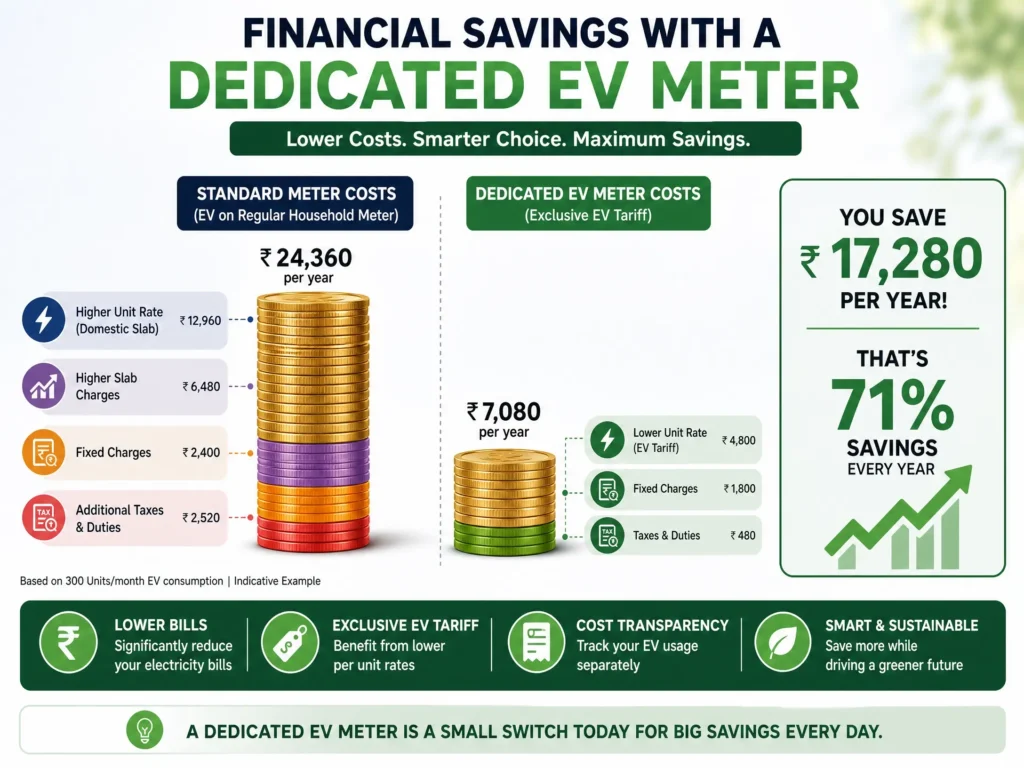
While an upfront investment of up to ₹25,000 may seem significant, separating your EV charging load pays off rapidly over time. The true financial advantage becomes clear when you compare the running costs of a traditional internal combustion engine (ICE) vehicle against an EV running on a standard domestic meter versus an EV on a dedicated concessional meter.
The structural performance data below highlights the running cost differences over an average monthly driving routine, demonstrating the clear benefits of a separate electricity meter for EV charging home India:
| Attribute | Traditional Petrol Vehicle | EV on Standard Domestic Meter (High Slabs) | EV on Dedicated Concessional Meter |
| Fuel / Energy Price | ~₹100 per Liter | ~₹9.50 per kWh (Peak Slab) | ~₹5.00 per kWh (Flat EV) |
| Average Efficiency | ~14 km per Liter | ~6.5 km per kWh | ~6.5 km per kWh |
| Running Cost per km | ~₹7.14 | ~₹1.46 | ~₹0.76 |
| Monthly Cost (1,200 km) | ~₹8,568 | ~₹1,752 | ~₹912 |
Annual Financial Savings and True Return on Investment (ROI)
By evaluating these numbers over a standard operating year, the return on investment (ROI) for a dedicated meter becomes highly compelling:
•EV vs. Petrol: Moving from a traditional petrol car to an EV charged on a dedicated meter saves you roughly ₹7,656 every month, which translates to an incredible ₹91,872 in annual savings.
•Dedicated Meter vs. High Domestic Slabs: Even if you are already driving an electric vehicle, moving your charging load off a high-tier domestic meter (paying ~₹9.50/kWh) and onto a separate concessional meter (paying ~₹5.00/kWh) saves you an extra ₹840 per month. This adds up to ₹10,080 in direct cash savings every single year.
With annual power bill savings crossing the ₹10,000 mark, your separate meter installation pays for itself entirely within the first 12 to 18 months of operation. Over the lifetime of the vehicle, this setup guarantees pure, uninterrupted savings, making a separate electricity meter for EV charging home India a wise investment.
Maximizing Your EV Savings with a Dedicated Meter
Installing a separate electricity meter for home EV charging is one of the most effective long-term upgrades you can make as an electric vehicle owner in India. It keeps your core household power bills predictable, unlocks discounted green energy tariffs, protects your electrical panel from overloads, and delivers clear financial savings that pay off the installation costs in short order.
As state utilities continue to expand Time-of-Day pricing programs and introduce more green incentives, the advantages of having a dedicated connection will only grow. Take a look at your latest home electricity bill, review your local DISCOM’s online tariff guidelines, and jumpstart your application to maximize your vehicle’s savings potential. A separate electricity meter for EV charging home India is not just a convenience; it’s a smart financial decision for every EV owner.