
Tata Tiago EV Battery Replacement Cost: Electric vehicles have transformed from a niche luxury into a mainstream transportation choice for Indian car buyers. At the forefront of this mass-market electric revolution stands Tata Motors, a manufacturer that single-handedly democratised electric mobility in India. By launching accessible, practical, and highly capable electric cars, Tata has captured the lion’s share of the Indian EV segment. Among their stellar lineup, the Tata Tiago EV has emerged as a top choice for city commuters looking to escape soaring fuel prices.
However, despite the clear financial savings on a daily basis, a single question lingers in the minds of almost every potential EV buyer: What happens when the battery dies?
The Tata Tiago EV battery replacement cost remains one of the most common concerns. Because the high-voltage battery pack is the single most expensive component in any electric car, buyers naturally worry that a future replacement might wipe out all the savings accumulated over years of ownership. Understanding the real-world costs, technological lifespan, and warranty structures is essential to clear the air.
Overview of Tata Tiago EV Battery Options
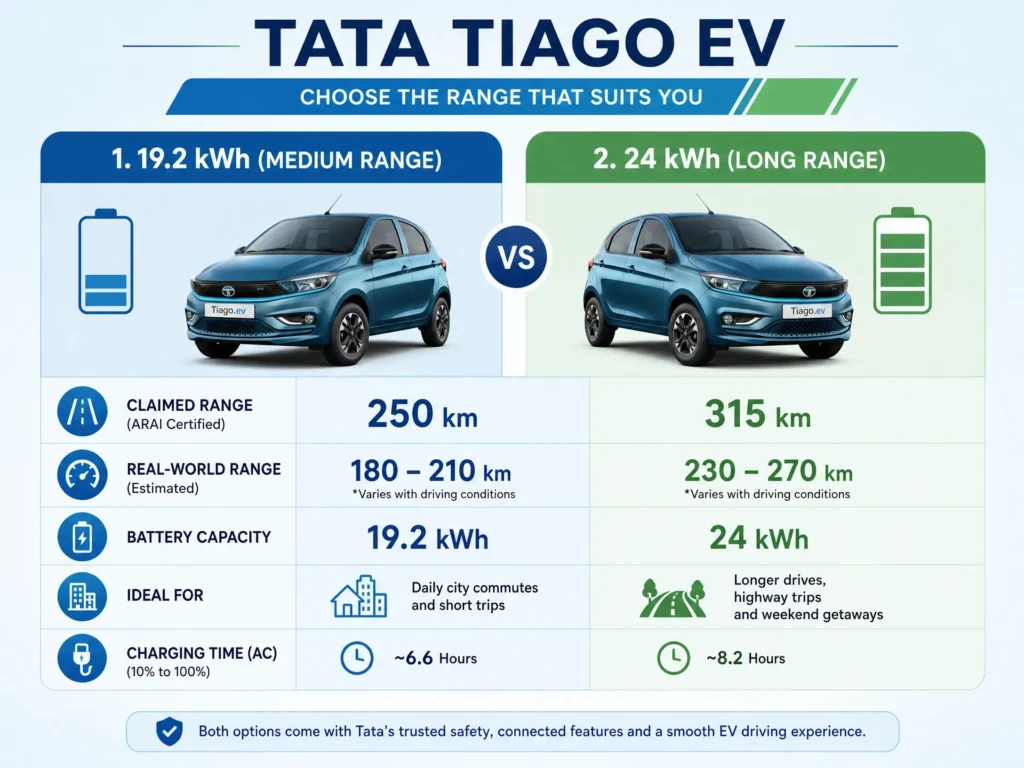
To understand the replacement dynamics, we must first look at what powers this electric hatchback. Tata Motors offers the Tiago EV with two distinct battery pack choices, both utilizing advanced Lithium Iron Phosphate (LFP) chemistry tailored specifically to withstand varied driving conditions.
1. The 19.2 kWh LFP Battery Pack
This is the Medium Range variant of the Tiago EV.It is designed primarily for buyers whose daily commute is strictly limited within city boundaries.
- Claimed Range: Approximately 250 km on a single full charge.
- Real-World Range: Realistically delivers between 150 km to 170 km depending on traffic conditions, air conditioning usage, and driving behavior.
- Best Use Case: Perfect as a secondary family car, daily office commuting in heavy city traffic, or for running household errands.
2. The 24 kWh LFP Battery Pack
This is the Long Range option aimed at providing extra driving reassurance and greater flexibility.
- Claimed Range: Approximately 315 km on a full charge.
- Real-World Range: Realistically yields between 200 km to 220 km in mixed driving conditions.
- Best Use Case: Ideal for buyers who have a longer daily commute, occasional weekend getaways on nearby highways, or those who want minimum charging stops during the week.
Tata Tiago EV Battery Replacement Cost Breakdown
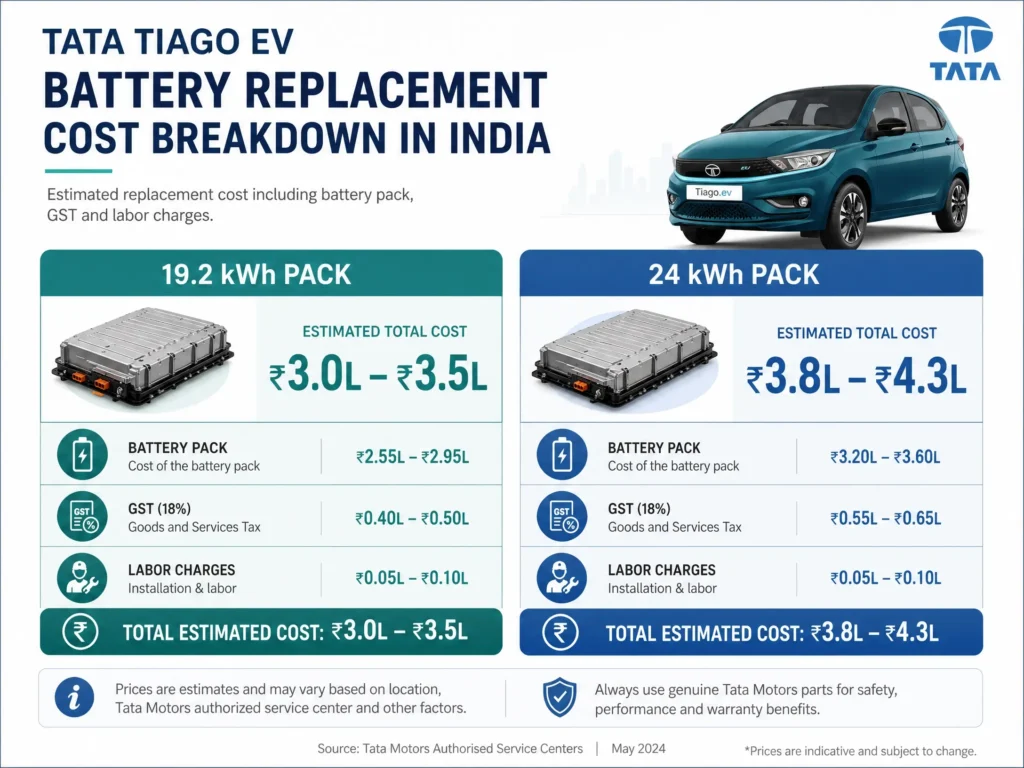
If you look up official parts catalogs, car manufacturers rarely publish the exact out-of-warranty price list for electric car batteries openly. However, based on industry component standards, current battery pack values per kilowatt-hour (kWh), and past dealer replacement instances across Tata’s EV range, we can form an accurate picture of the EV battery replacement cost in India for the Tiago EV.
Currently, the estimated component cost for an LFP battery pack used in mass-market Indian cars hovers around ₹15,000 to ₹18,000 per kWh of capacity. Based on these market benchmarks, here is the projected cost breakdown.
Estimated Replacement Cost for the 19.2 kWh Battery Pack
For the Medium Range Tiago EV, the standalone cost of a brand-new 19.2 kWh LFP battery pack is estimated to be between ₹3,00,000 and ₹3,50,000.
Estimated Replacement Cost for the 24 kWh Battery Pack
For the Long Range version, the larger 24 kWh battery pack naturally commands a higher premium. The estimated standalone cost for this pack lies between ₹3,80,000 and ₹4,30,000.
Final Out-of-Pocket Expense (INR)
When calculating the absolute final invoice at an authorized service center, the battery pack cost is not the only variable. The total cost structure includes:
- The Component Price: ₹3.0 Lakh to ₹4.3 Lakh depending on the chosen battery capacity.
- Goods and Services Tax (GST): In India, electric vehicle parts and components attract specific tax structures. While complete EVs enjoy a subsidized 5% GST rate, standalone lithium-ion spare parts can attract higher tax brackets if bought completely out-of-warranty.
- Labor and Dealership Charges: Replacing a high-voltage EV battery pack is a technical process. It requires specialized technicians, advanced diagnostic equipment, coolant replacement for the thermal management system, and strict safety testing protocols. Labor charges can easily add an extra ₹10,000 to ₹20,000 to the bill.
Therefore, the comprehensive out-of-warranty Tata Tiago EV battery price for a full replacement can range from ₹3.5 Lakh to ₹4.8 Lakh including taxes and labor.
Why EV Battery Replacement Is So Expensive
To a buyer accustomed to traditional petrol or diesel cars—where a standard 12V auxiliary battery costs roughly ₹5,000 to ₹8,000—a multi-lakh bill sounds staggering. However, an EV’s traction battery pack is completely different from a regular car battery.
The Complex Chemistry of LFP Cells
The Tiago EV utilizes Lithium Iron Phosphate (LFP) technology. LFP chemistry is highly valued in tropical climates like India because it is structurally stable, highly thermal-resistant, and inherently less prone to catching fire even under severe ambient heat. However, refining the raw materials (lithium, iron, and phosphate) to an automotive-grade purity level requires sophisticated global supply chains and massive manufacturing investments.
Advanced Safety Architecture
An EV battery pack is not just a collection of simple cells thrown together into a box. It consists of highly engineered safety systems:
- Robust Enclosure: Structural casing designed to withstand severe side impacts, high-speed crashes, and underbody stone strikes without puncturing the inner cells.
- Ingress Protection: The Tiago EV pack features an IP67 rating, meaning it is completely sealed against fine dust particles and water entry during heavy monsoon wading.
- Liquid Cooling Integration: The pack contains complex internal channels that circulate specialized liquid coolant to keep the cells at an optimal operating temperature during fast charging or spirited driving.
The Battery Management System (BMS)
The BMS is the digital brain of the battery. It continuously monitors the voltage, temperature, and health of every individual cell block. It ensures equal distribution of energy during charging and prevents catastrophic situations like overcharging or deep discharging. The development, calibration, and implementation of this software-hardware combination add significantly to the overall production cost.
Tata Tiago EV Battery Warranty Details
The high cost of replacement should not induce immediate panic, thanks to the extensive manufacturer warranty policies provided by Tata Motors. In fact, under normal ownership conditions, the vast majority of original buyers will never have to pay for a replacement out of their own pocket.
Standard Warranty Terms
For the Tiago EV, Tata Motors provides a reassuring 8 years or 1,60,000 kilometres (whichever occurs earlier) warranty on the high-voltage battery pack and the electric motor. Furthermore, Tata has introduced extended lifetime battery options under specific promotional terms for first-time private vehicle registrations.
What is Covered?
- Manufacturing Defects: Any internal hardware malfunction, cell short circuits, or sudden component failures out of the assembly line.
- Excessive Degradation: All lithium-based batteries lose minor capacity over time. However, if the battery capacity drops abnormally below a functional threshold (typically below 70% to 75% State of Health) within the warranty period, it qualifies for a warranty claim.
Conditions That Can Void Your Warranty
Car buyers must exercise caution, as certain actions can completely invalidate this 8-year protection shield:
- Unauthorised Alterations: Splicing factory wiring harnesses or installing aftermarket electrical accessories (like high-power amplifiers or unauthorized ambient lighting) outside official dealerships.
- Negligent Servicing: Getting the vehicle repaired or opened up by local roadside mechanics who are not certified to handle high-voltage EV systems.
- Accidental Damage Neglect: If the car suffers a severe underbody impact that damages the battery casing, and the owner continues driving without getting it inspected at an authorized center.
- Deep Discharge Neglect: Leaving the electric car parked with a completely dead battery (0% charge) for months at a time, causing the cells to enter a permanent state of failure.
Battery Lifespan in Indian Driving Conditions
A crucial metric to understand is the LFP battery lifespan. LFP chemistry is widely praised for its exceptional longevity compared to other lithium-ion variants (like NMC chemistry).
Expected Lifespan in Years and Cycles
An automotive-grade LFP battery pack is typically rated to last between 2,000 to 3,000 full charge-discharge cycles before experiencing noticeable degradation.
- If you drive your Tata Tiago EV for 200 km on a full charge, 2,000 cycles translate into roughly 4,00,000 kilometres of total driving distance.
- For an average Indian user driving 15,000 km per year, the battery pack can easily perform optimally for 12 to 15 years before its real-world driving range drops to a point where replacement becomes necessary.
Real-World Factors Influencing Longevity
- Extreme Ambient Heat: Indian summers can easily push temperatures past 40 to 45 degrees Celsius. While Tata’s active liquid-cooling system does an excellent job keeping temperatures under check, prolonged operation in peak summer heat puts more stress on the thermal cooling system.
- Driving Style: Rapid, aggressive acceleration draws sudden high currents from the battery pack, generating rapid internal heat. Smooth, progressive acceleration preserves health.
- City vs. Highway Usage: City driving inherently favors EV battery health due to continuous regenerative braking. Regenerative braking allows the electric motor to act as a generator during deceleration, feeding gentle packets of energy back into the battery pack and reducing harsh discharge cycles. Continuous high-speed highway driving, on the other hand, drains the battery at a constant high rate with minimal recovery windows.
Practical Ways to Extend Your Tiago EV Battery Life
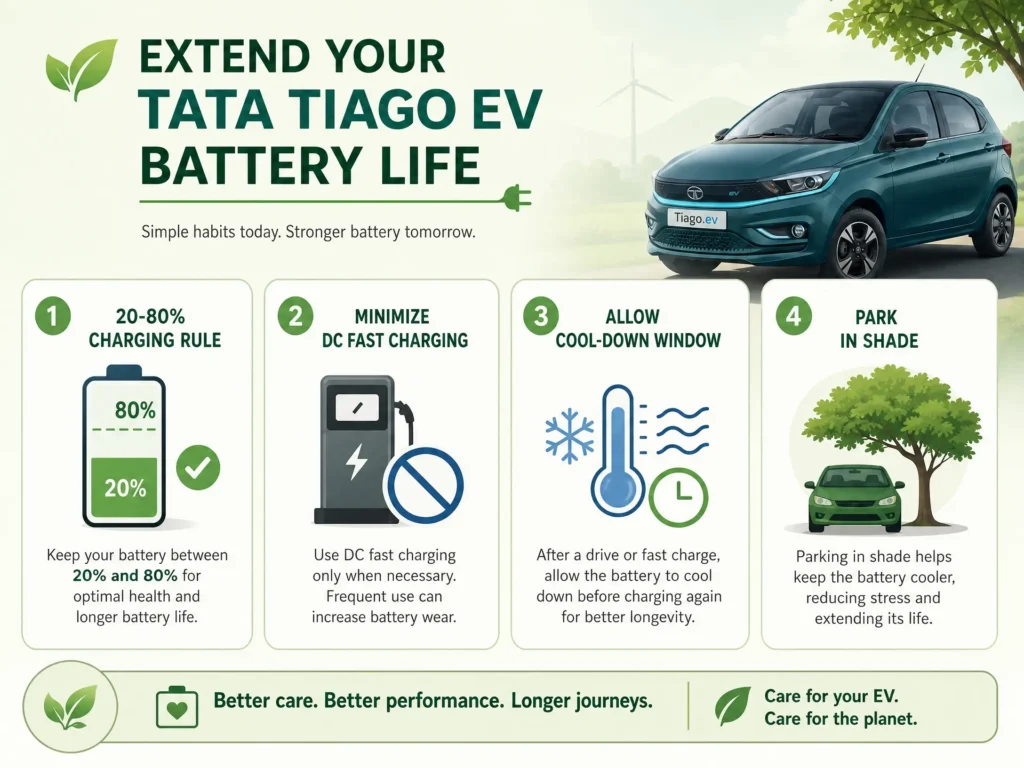
While modern Battery Management Systems handle most protective tasks automatically, adopting healthy charging and driving habits can add years to your LFP battery’s operational life.
- Follow the 20-80% Charging Rule: Try to keep your battery level between 20% and 80% for your daily routine. Avoid letting the battery drop below 10% frequently, and only charge it to 100% when you have an immediate long trip planned.
- Minimise Direct Current (DC) Fast Charging: DC fast chargers are incredibly convenient for highway journeys, but they pump massive amounts of electrical current directly into the cells, creating localized heat stress. Use standard Alternating Current (AC) slow home charging for your regular overnight requirements.
- Allow a Cool-Down Window: Do not plug your car into a charger immediately after a long, strenuous drive in peak summer heat. Let the vehicle sit in the shade for 30 minutes to allow the battery cells to shed residual driving heat naturally before initiating a charge cycle.
- Park in the Shade: Whenever possible, choose covered parking basements or shaded areas. Keeping the car out of direct sunlight prevents the cabin and underbody temperatures from skyrocketing, sparing the thermal management system from working overtime while parked.
Battery Repair vs Full Replacement
When an EV experiences an issue, buyers often assume the entire multi-lakh battery pack must be thrown away. This is a common misconception.
Cell-Level Repair Possibility
An EV battery pack is modular. It is made up of individual cells grouped together into modules, which are then connected to form the final pack. In many cases, an EV breakdown or sudden drop in range is caused by a single faulty cell or a malfunctioning voltage sensor within one module, while the remaining 95% of the pack is perfectly healthy.
Authorized service centers possess advanced diagnostic tools to trace down the exact faulty module. Instead of a full replacement, technicians can simply swap out the single compromised module or repair the faulty internal wiring harness.
Cost Comparison: Repair vs. Replacement
| Service Type | Estimated Cost (INR) | When is it Needed? |
| Component/Module Repair | ₹15,000 – ₹45,000 | Single cell imbalance, sensor failure, or minor module defect. |
| Full Battery Replacement | ₹3,50,000 – ₹4,80,000 | Severe structural damage from accidents, internal flooding, or natural degradation after 12+ years. |
Is Battery Replacement Worth It? A Total Cost of Ownership Perspective
To evaluate if paying for a replacement battery pack makes financial sense down the road, we must look at the overall financial savings accumulated over a typical ownership cycle.
Consider an owner who drives a Tata Tiago EV for 10 years, covering roughly 1,500 km per month (18,000 km per year), totaling 1,800,000 km over a decade.
- Petrol Car Expenses: Running a similar petrol hatchback at a realistic efficiency of 15 km/l with petrol priced at ₹100/litre would cost roughly ₹12,00,000 in fuel alone over 10 years.
- Tiago EV Charging Expenses: Charging a Tiago EV at domestic electricity rates (approx. ₹7 to ₹8 per unit) translates to a running cost of roughly ₹1 to ₹1.2 per km. Over 1,800,000 km, the total charging cost equals roughly ₹2,00,000.
- Net Savings: Even after accounting for routine maintenance, the EV owner saves close to ₹10,00,000 in running costs over a 10-year period compared to a petrol car owner.
If, after 10 or 12 years of out-of-warranty usage, the battery requires replacement, the owner has already saved far more than the cost of a new battery pack. Investing ₹4 Lakh to restore the car to factory-fresh range is a viable alternative to scrapping the car and purchasing a completely new vehicle altogether.
Frequently Asked Questions (FAQs)
What will be the Tata Tiago EV battery price after its warranty expires?
If you require a complete battery pack replacement completely out of warranty, the estimated cost will range from ₹3.5 Lakh for the 19.2 kWh pack to ₹4.8 Lakh for the 24 kWh pack, including current tax structures and dealership labor charges. However, as local manufacturing scales up over the coming years, these component prices are expected to drop significantly.
Can the Tiago EV battery pack be replaced partially?
Yes. Because the battery pack is modular, service centers do not always need to change the entire unit. If diagnostic scans reveal that only a single cell module or internal sensor has failed while the remaining system is healthy, that specific module can be partially replaced at a fraction of the cost.
Does insurance cover EV battery replacement costs?
Yes, provided you have a comprehensive motor insurance policy or an own-damage insurance plan. If the battery pack suffers physical damage due to a road accident, external fire, water logging during floods, or natural calamities, the insurance provider will cover the replacement costs under standard terms. It is highly recommended to opt for an “Engine/Battery Protector” add-on cover for absolute financial peace of mind.
Does continuous fast charging damage the Tiago EV battery?
Frequent, exclusive use of DC fast chargers creates rapid thermal buildup inside the cells, which can accelerate long-term degradation over several years. While occasional fast charging during highway trips is perfectly fine, sticking to standard AC slow home charging for your regular daily needs will keep the battery healthy for a much longer period.
The anxiety surrounding the Tata Tiago EV battery replacement cost is understandable but largely unnecessary for the typical car buyer. With Tata Motors offering a robust 8-year or 1,60,000 km warranty wrapper right out of the showroom, the financial risk during the primary ownership period is virtually zero.
Thanks to the durable nature of modern Lithium Iron Phosphate (LFP) chemistry, the battery pack is engineered to comfortably outlast a decade of real-world use. When you factor in the massive financial savings generated by low electricity running costs month after month, the Tiago EV remains a financially sound, reliable, and highly practical vehicle choice for the modern Indian commuter. Adopting mindful charging habits ensures your electric hatchback will serve you efficiently for years to come.