
One of the biggest hesitations people face before buying an electric vehicle (EV) in India is a simple but serious question: “What happens if my EV battery fails after the warranty expires?”
This concern is completely valid.
In an electric scooter or electric car, the battery pack alone accounts for nearly 35% to 45% of the vehicle’s total cost. If an out-of-warranty battery replacement is done through an authorised dealership, the expense can quickly become overwhelming for most Indian buyers.
The good news is that a failing battery does not always mean the entire battery pack is unusable. In many real-world cases, most internal cells remain healthy. This is where EV battery refurbishment in India has emerged as a cost-effective alternative to full pack replacement, especially through professional aftermarket services.
What Is EV Battery Refurbishment?
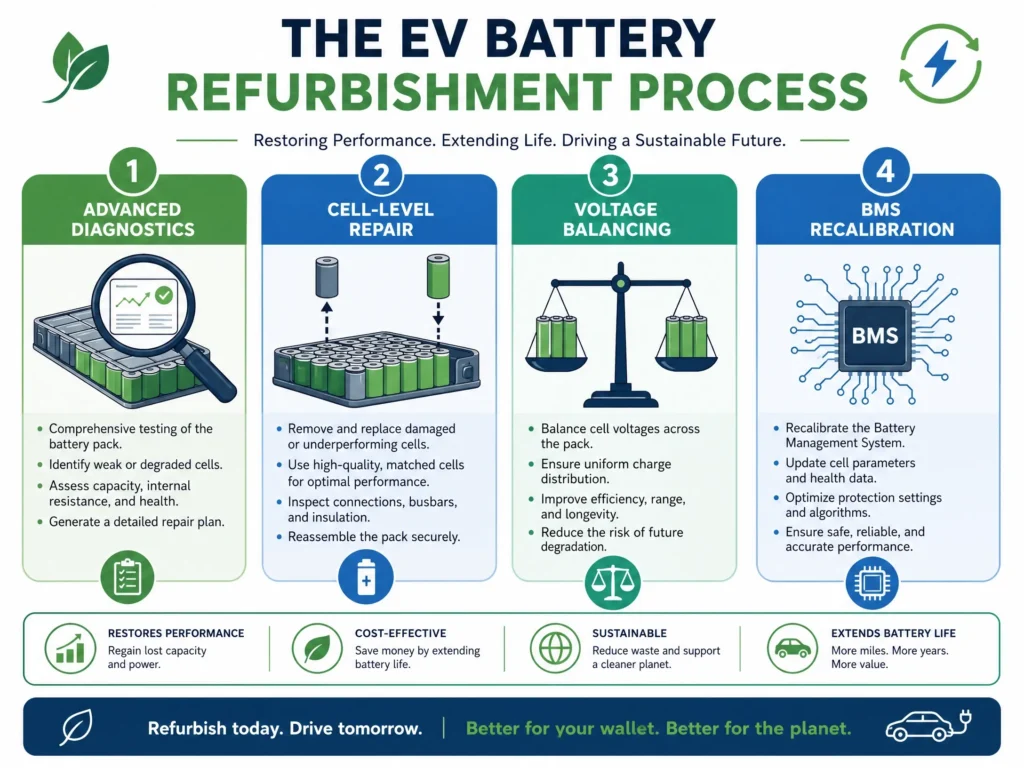
EV battery refurbishment is a technical process where a degraded or non-functional battery pack is opened, analysed, and repaired at a component level instead of being completely replaced.
Think of it like repairing a smartphone. If one internal component fails, you repair that part instead of throwing away the entire device.
Refurbishment vs Full Battery Pack Replacement
- Full Battery Pack Replacement:
The entire battery unit—including all cells, modules, electronics, and casing—is replaced with a brand-new factory pack. - Battery Refurbishment:
Only faulty cells, modules, or electronic components are repaired or replaced after a detailed diagnostic process, while the original pack structure is retained.
Cell-Level Repair Explained
An EV battery pack is made of multiple modules, and each module contains dozens of individual lithium-ion cells. Most battery failures happen because a small group of cells degrade faster than the rest.
What Is Cell-Level Repair?
Cell-level repair focuses on identifying underperforming or imbalanced cells inside the battery pack. These weak cells affect the overall performance, reduce driving range, and sometimes trigger error codes.
Using advanced diagnostics, technicians:
- Detect faulty cells
- Replace only those specific cells
- Balance voltage across all modules
- Recalibrate the Battery Management System (BMS)
When Cell-Level Repair Works Best
- Sudden drop in driving range
- Battery not charging beyond a fixed percentage
- Battery-related warning lights or error codes
Benefits of Cell-Level Refurbishment
- Significant cost savings compared to full replacement
- Environment-friendly, as functional cells are reused
- Faster turnaround time
Limitations
If a battery pack has uniformly aged and most cells have dropped below usable capacity, cell-level repair may no longer be effective. In such cases, replacement becomes unavoidable.
Full Battery Pack Replacement Explained
Some battery failures are too severe to repair safely.
When Replacement Is Necessary
- Major accident damage to battery casing
- Water ingress due to flooding
- Uniform cell degradation after many years of use
Pros and Cons
Pros
- New factory warranty
- Maximum driving range
- Peace of mind
Cons
- Very high cost
- Long waiting periods
- Poor resale value recovery
EV Battery Refurbishment Cost in India (2026 Insight)
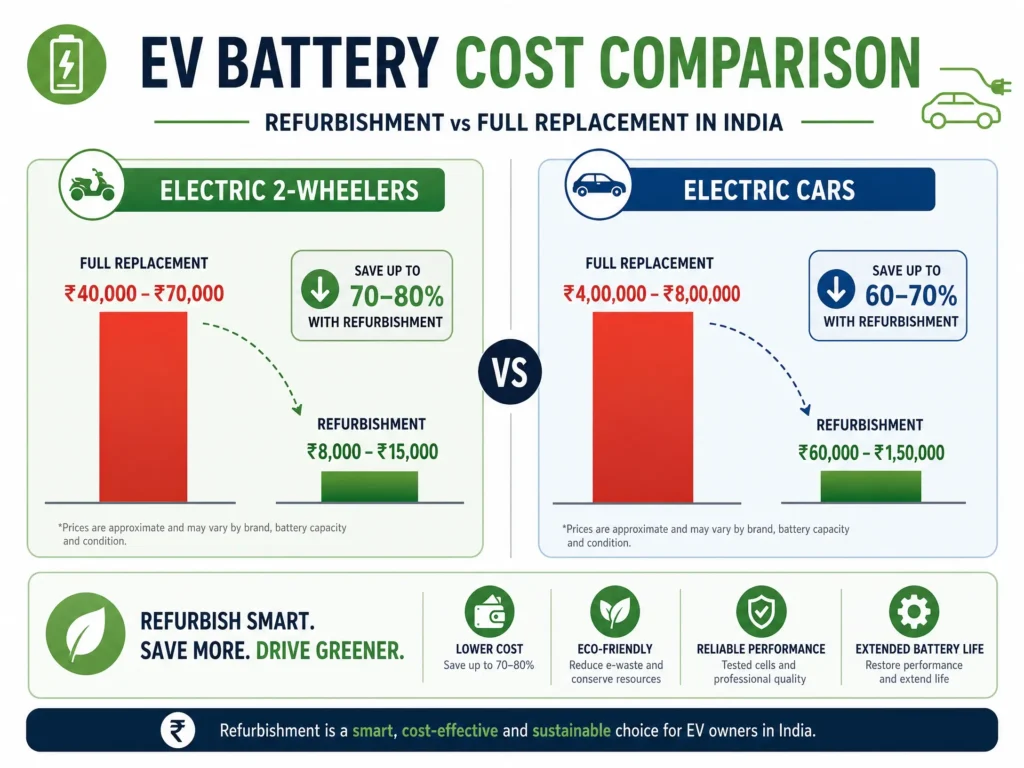
The EV battery refurbishment cost in India is dramatically lower than full pack replacement, especially when handled by professional aftermarket labs.
General Cost Comparison
- Electric two-wheelers:
- Full replacement: ₹30,000 – ₹95,000
- Refurbishment: 10%–30% of replacement cost
- Electric cars:
- Full replacement: ₹3,00,000 – ₹7,50,000+
- Refurbishment: Often ₹40,000 – ₹60,000 (depending on damage)
Example: A battery pack that costs ₹5,00,000 to replace can often be refurbished for a fraction of that amount if the damage is limited to specific cells or electronics.
Factors Affecting Final Cost
- Battery capacity (kWh)
- Number of faulty cells or modules
- Vehicle design and accessibility
- BMS repair or recalibration needs
Yanti & Other Aftermarket EV Battery Services
Independent battery refurbishment labs are changing how Indian EV owners handle post-warranty failures. Companies like Yanti specialise in advanced diagnostics, safe cell replacement, and battery revival rather than blanket replacements.
Why Aftermarket Services Are Growing Rapidly
- Lower ownership cost for EVs
- Faster service turnaround
- Ideal for fleet operators and high-usage vehicles
Typical Diagnostic Process
- Thermal & impedance scanning
- Cell-level health assessment
- Targeted repair or module replacement
- BMS recalibration & stress testing
Cell-Level Repair vs Full Pack Replacement
| Feature | Cell-Level Refurbishment | Full Battery Replacement |
|---|---|---|
| Cost | 10%–30% of new pack | Very high |
| Time | 2–4 working days | Several weeks |
| Warranty | Limited service warranty | Full factory warranty |
| Best For | Isolated faults | Severe or uniform damage |
Is EV Battery Refurbishment Safe in India?
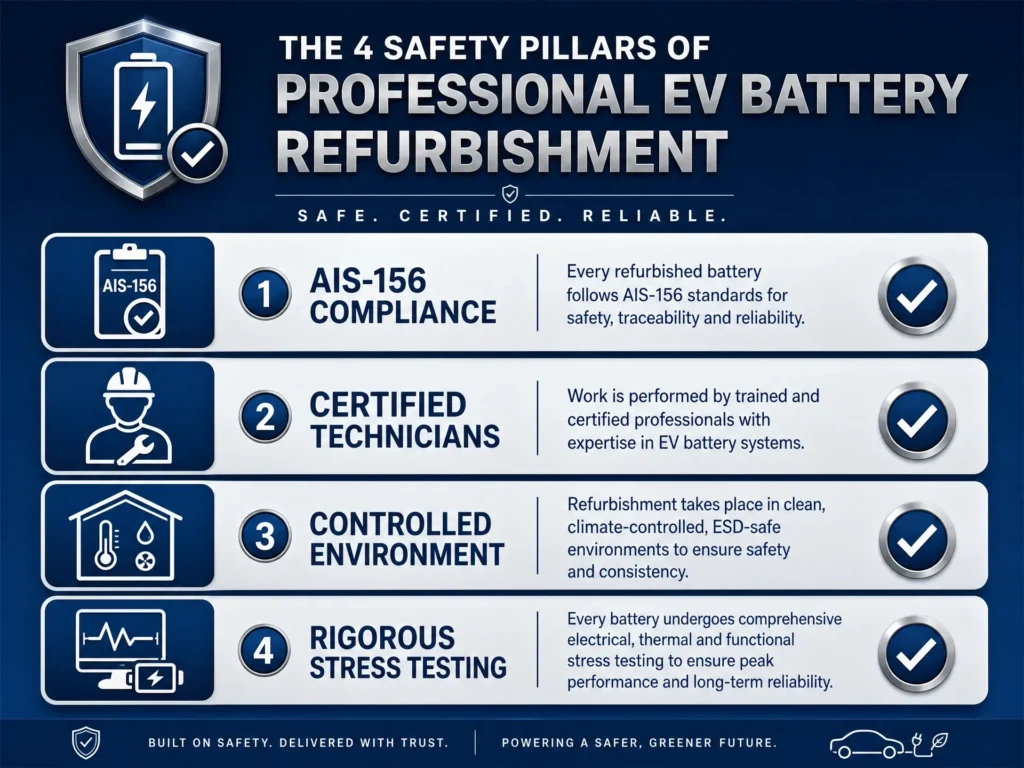
Yes—when done professionally.
Reputed labs follow Indian safety norms such as AIS-156, use controlled environments, certified technicians, and proper sealing techniques to prevent thermal or moisture risks.
Key safety pillars include:
- Correct cell matching
- BMS software calibration
- Proper insulation & resealing
When Should You Choose Refurbishment?
Choose Refurbishment If:
- Warranty has just expired
- Battery issue is isolated
- Vehicle is mechanically sound
Choose Replacement If:
- Battery pack is structurally damaged
- Vehicle has extremely high age or mileage
Things to Check Before Choosing an Aftermarket Service
- Written post-repair warranty
- Transparent diagnostic report
- Certified EV technicians & infrastructure
Conclusion
EV battery refurbishment in India is no longer an experimental solution—it is a practical, cost-effective alternative for out-of-warranty electric vehicles. With proper diagnostics and certified aftermarket services, EV owners can significantly reduce ownership costs while extending battery life safely and responsibly.