
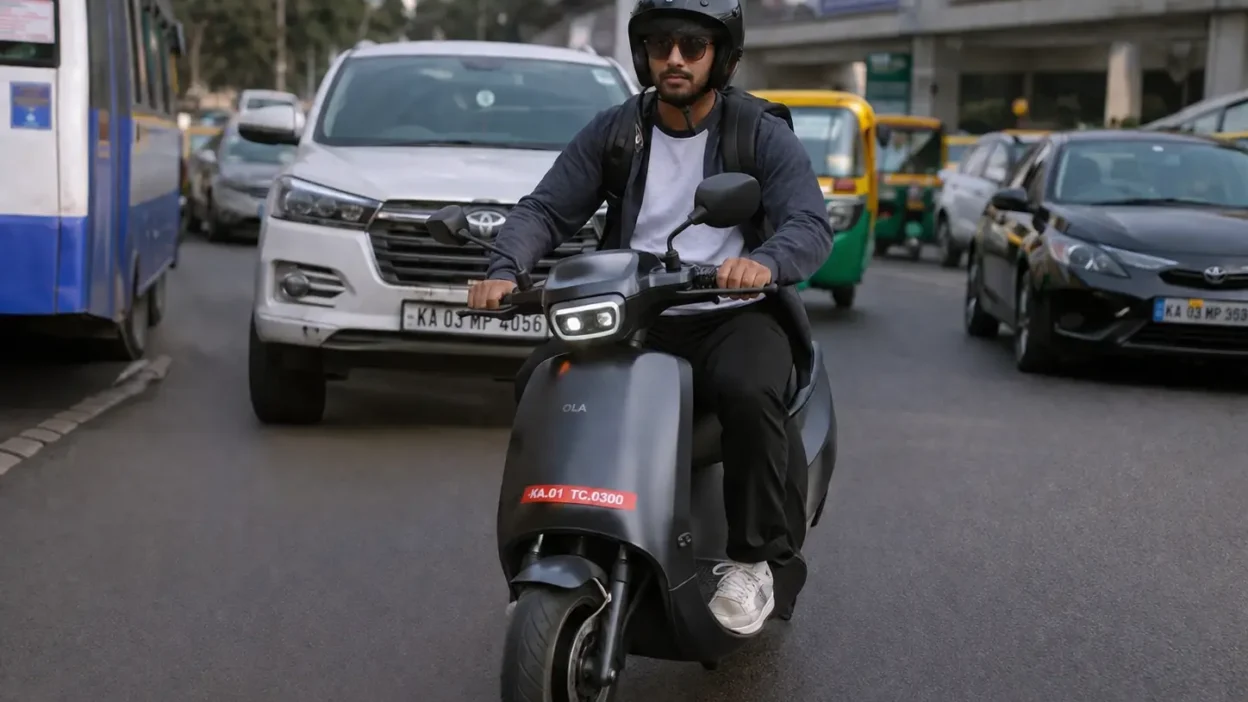
If you’re looking at the entry-level Ola S1 X 2kWh as your first electric scooter, you’ve probably already noticed that the claimed range on the spec sheet and the range owners actually report in forums don’t quite match. This is the most affordable scooter in Ola’s lineup, built specifically for short, predictable commutes rather than long-distance touring, and understanding exactly what it delivers in Eco mode — as opposed to what the IDC certification claims — will save you from either overpaying for range you don’t need or underestimating what this compact commuter can genuinely do.
Ola S1 X 2kWh: The Entry-Level Commuter Battery Explained
The 2kWh variant sits at the bottom of the Ola S1 X range, below the 3kWh and 4kWh options. It uses a smaller lithium-ion pack paired with a motor rated at 2.7 kW continuous power and up to 6 kW peak output, giving it a claimed top speed in the 85–90 km/h range depending on the model year.
This isn’t a scaled-down version of the same experience — it’s a deliberately positioned entry point. Ola trims a few features to hit this price point: a smaller LCD instrument console compared to the higher variants, no keyless proximity unlock, and a reduced feature set around navigation, call and SMS alerts, and OTA updates on some model years. What it doesn’t compromise on is the core riding experience — the frame, suspension, braking hardware, and general build are shared across the S1 X lineup regardless of battery size.
For riders whose daily commute is genuinely short — think 20–30 km round trips within a city — the 2kWh variant is often more scooter than they actually need in terms of battery size, which is exactly why it’s priced as the accessible entry point into the range.
IDC Claimed Range vs What Ola S1 X 2kWh Owners Actually Get
Here’s where things get genuinely confusing for buyers, because the certified range figure for the 2kWh variant varies depending on which generation and source you’re looking at — anywhere from roughly 95 km to just over 100 km under IDC (Indian Driving Cycle) test conditions, depending on the specific model year.
That’s the certification number, tested under controlled lab conditions similar to how four-wheelers get their ARAI ratings. Real-world owner reports consistently come in lower, which is normal and expected — IDC testing doesn’t account for rider weight, stop-start traffic, variable road surfaces, or genuine day-to-day throttle behaviour.
Based on owner-reported figures and independent reviews, the practical real-world range on the 2kWh variant typically falls somewhere in the 75–90 km band on a full charge, with the wide range reflecting how much riding style and conditions genuinely matter on a smaller-capacity battery — proportionally, small differences in efficiency have a bigger effect on a 2kWh pack than they would on a larger one.
Eco Mode: How Much Range Does It Really Add?
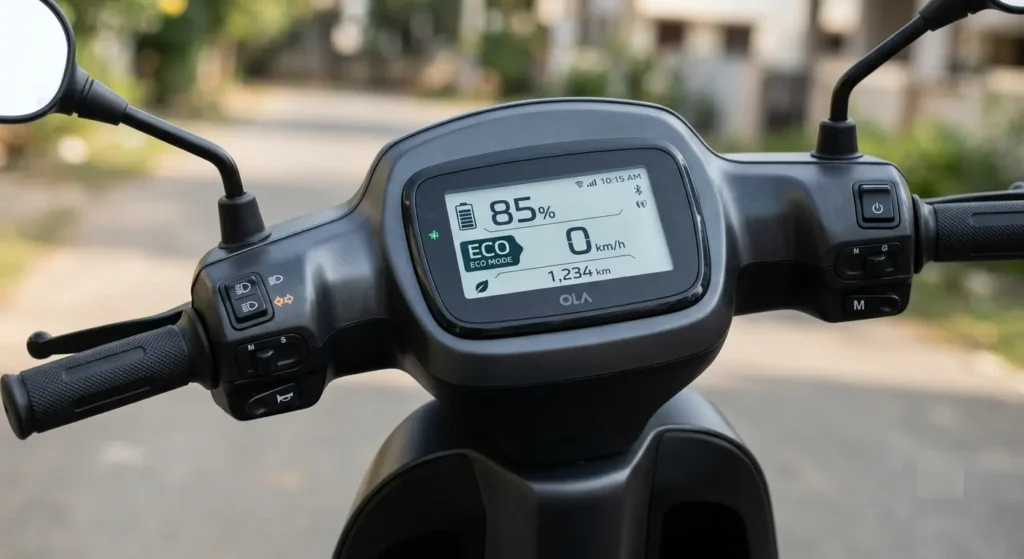
Eco mode is where the 2kWh variant earns most of its real-world usability, and it’s worth understanding what it’s actually doing rather than treating it as just a marketing label.
In Eco mode, the scooter limits peak power delivery and softens throttle response, which reduces the sharp current draw that happens during hard acceleration. Since battery efficiency drops off disproportionately during high-current bursts, smoothing that out has a real, measurable effect on range — not just a placebo “eco” badge on the dashboard.
Across Ola’s S1 X lineup, Eco mode consistently delivers a meaningfully higher range than Normal or Sport modes in both claimed and real-world figures, and the gap tends to be proportionally larger on the smaller 2kWh pack than on the 3kWh or 4kWh variants. Riders who stay in Eco mode for daily commuting typically report range figures toward the upper end of that 75–90 km real-world band, while those who ride primarily in Normal or Sport mode should expect noticeably less — sometimes 15–20% lower.
The trade-off is throttle response. Eco mode noticeably softens acceleration, which some riders find frustrating in stop-start traffic or when merging, particularly on a scooter that’s already on the lighter-power end of Ola’s range.
Physical Key Ignition : A Deliberate Trade-off, Not a Downgrade
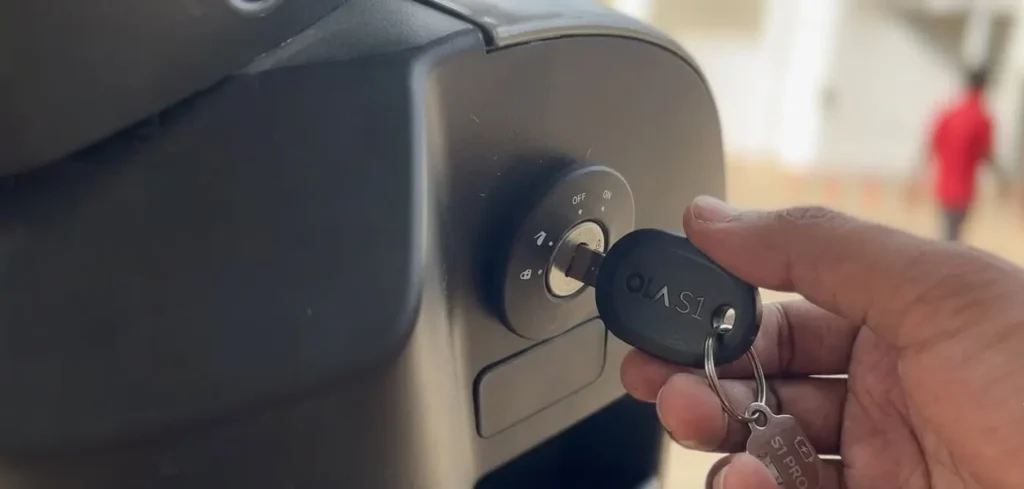
One detail that surprises some first-time buyers: the entry-level Ola S1 X 2kWh uses a conventional physical key for ignition rather than the keyless proximity unlock system found on the S1 Pro and higher S1 X trims.
This is a deliberate cost and feature decision, not a corner cut on build quality. A few practical implications worth knowing:
- No proximity unlock — you won’t get the “walk up and it unlocks” convenience that pricier Ola models offer
- Simpler fault points — a physical key setup has fewer electronic dependencies than a keyless system, which some riders genuinely prefer for long-term reliability and simplicity
- Familiar operation — for buyers switching from a conventional petrol scooter, a physical key is a more familiar transition than a fully app-and-proximity-based unlock system
- Reduced dependency on the companion app for basic day-to-day operation, since starting the scooter doesn’t require Bluetooth pairing or phone proximity
For a genuinely budget-focused entry-level commuter, this is a sensible trade-off rather than a meaningful downgrade — most 2kWh buyers are prioritising affordability and simplicity over premium keyless convenience anyway.
Power Delivery: How the 2 kWh Motor Feels in the Real World
It’s worth being precise here: the Ola S1 X 2kWh uses a hub motor architecture, delivering 2.7 kW of continuous power with a 6 kW peak. Despite occasional loose references online to a “mid-drive” setup on certain S1 X trims, Ola’s own published specifications confirm the S1 X range — including the 2kWh variant — is hub-motor driven.
What actually matters more for day-to-day riding is how that power is delivered through the throttle’s mid-range, which is where most city riding happens — the 20–40 km/h band used for merging into traffic, overtaking slower vehicles, and general acceleration out of a stop. In this mid-throttle band, the 2kWh variant delivers noticeably gentler, more linear power than the larger-battery S1 X variants, since the smaller pack is tuned to prioritise efficiency and range over outright acceleration.
In practice, this means the 2kWh variant doesn’t feel as punchy pulling away from traffic lights compared to the 3kWh or 4kWh versions, but it also doesn’t feel underpowered for genuine city commuting — it’s simply tuned toward a calmer, more range-conscious power delivery rather than outright performance.
Factors That Affect Real-World Range on the 2kWh Variant
- Rider and pillion weight — a smaller battery is proportionally more sensitive to load than a larger one
- Riding mode selection — Eco consistently outperforms Normal and Sport, and the gap matters more here than on larger-battery variants
- Traffic conditions — frequent stop-start riding draws more energy per kilometre than steady-speed cruising
- Tyre pressure — underinflated tyres increase rolling resistance, which has an outsized effect on a smaller battery
- Ambient temperature — very hot or cold weather affects battery efficiency, consistent with lithium-ion behaviour generally
- Charging habits — consistently charging to 100% and running the battery down to near-empty repeatedly can accelerate long-term capacity loss compared to more moderate charging patterns
Ola S1 X 2kWh vs 3kWh vs 4kWh: Is the Base Variant Enough?
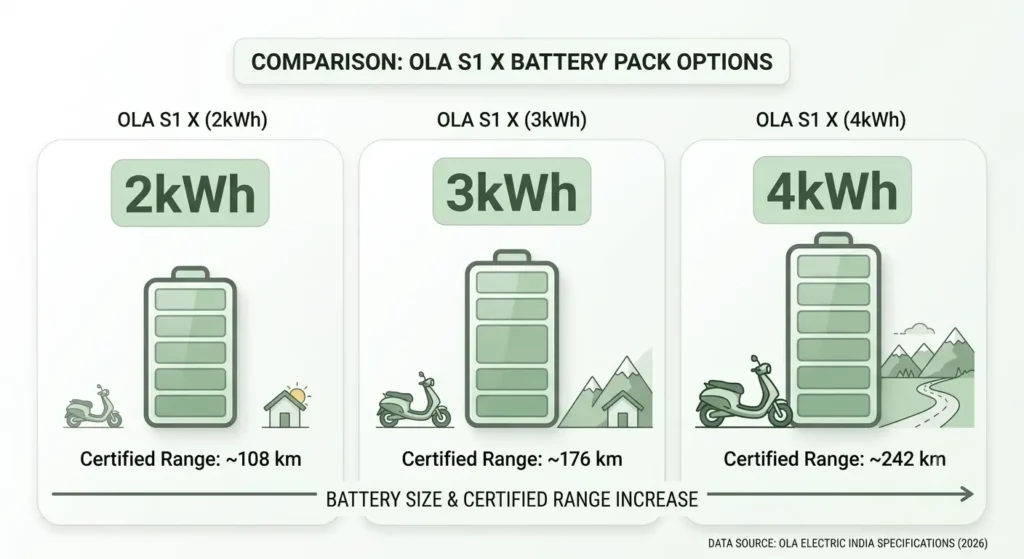
| Variant | Motor Output | Claimed IDC Range | Real-World Eco Mode Range (Approx.) | Best Suited For |
|---|---|---|---|---|
| S1 X 2kWh | 2.7 kW continuous / 6 kW peak | ~95–108 km | ~75–90 km | Short daily commutes under 30 km round trip |
| S1 X 3kWh | 2.7 kW continuous / 6 kW peak | ~143–176 km | ~110–130 km | Moderate daily commuting with some buffer |
| S1 X 4kWh | 2.7 kW continuous / 6 kW peak | ~190–242 km | ~150–170 km | Longer commutes or infrequent charging access |
If your daily riding genuinely stays within a 25–30 km round trip and you have consistent access to charging at home or work, the 2kWh variant is a reasonable, cost-effective choice. If your commute is longer, less predictable, or you don’t want to think about charging every single day, stepping up to the 3kWh variant gives meaningfully more breathing room for a moderate price increase.
Battery Health and Long-Term Range: What to Watch For
A smaller battery pack like the 2kWh variant is more sensitive to degradation patterns over time simply because there’s less total capacity to buffer against normal wear. A few things worth understanding as you plan for long-term ownership:
- Gradual range reduction over years of use is normal for any lithium-ion battery, but on a 2kWh pack, even a modest percentage drop in capacity is more noticeable in real-world kilometres than it would be on a larger battery
- Deep discharge events — leaving the scooter fully drained for extended periods — can affect a smaller battery’s long-term health more noticeably than a larger pack, since there’s less cushion built in
- Out-of-warranty repair costs matter more to factor in on a budget-focused purchase like this, since the economics of the vehicle assume lower running costs overall
If you ever find yourself facing reduced range that seems disproportionate to normal wear, it’s worth understanding your options before assuming a full battery replacement is necessary. This guide on how to avoid Ola battery replacement scams walks through the right questions to ask a service centre, and this breakdown of Ola scooter battery replacement cost out of warranty covers what genuine replacement typically costs if it does turn out to be necessary. If your scooter has been left discharged for an extended period specifically, this guide on Ola battery replacement cost after deep discharge is the more directly relevant read.
Tips to Maximise Range in Eco Mode
- Stay in Eco mode consistently for daily commuting rather than switching between modes, since the gains compound across a full charge cycle
- Maintain recommended tyre pressure, checking it periodically rather than only when it visibly looks low
- Avoid unnecessary hard acceleration from a stop, since high-current bursts disproportionately affect a smaller battery’s efficiency
- Charge to around 80–90% for daily use rather than always topping up to 100%, which is gentler on long-term battery health
- Avoid letting the battery run down to near-zero repeatedly, especially overnight or for extended periods
Frequently Asked Questions
What is the real-world range of the Ola S1 X 2kWh in Eco mode? Based on owner-reported figures and independent reviews, expect somewhere in the range of 75–90 km on a full charge in Eco mode, compared to a claimed IDC figure of roughly 95–108 km depending on the model year.
Why is the real-world range lower than the claimed IDC figure? IDC certification is tested under controlled lab conditions that don’t account for rider weight, traffic conditions, road surface variation, or genuine throttle behaviour, all of which reduce real-world range.
Does Eco mode actually make a meaningful difference on the 2kWh variant? Yes. Eco mode softens throttle response and limits peak power draw, which reduces the high-current bursts that disproportionately affect a smaller battery’s efficiency — the range gain from Eco mode is proportionally larger on the 2kWh pack than on bigger variants.
Does the Ola S1 X 2kWh have a keyless start? No. The entry-level 2kWh variant uses a conventional physical key for ignition, unlike the keyless proximity unlock system available on the Ola S1 Pro and higher S1 X trims.
Is the Ola S1 X 2kWh’s motor a hub motor or mid-drive? It’s a hub motor, delivering 2.7 kW continuous power and up to 6 kW peak, based on Ola’s published specifications — despite some inconsistent references online describing certain S1 X trims as mid-drive.
Is the 2kWh variant enough for a daily commute? For round trips genuinely under 25–30 km with consistent access to charging, yes. For longer or less predictable commutes, the 3kWh or 4kWh variants offer meaningfully more buffer.
Does riding in Normal or Sport mode significantly reduce range? Yes, typically by around 15–20% compared to Eco mode on the 2kWh variant, since both modes allow higher peak power draw and less throttle softening.
How does load affect the 2kWh variant’s range? Proportionally more than on larger battery variants, since there’s less total capacity to absorb the extra energy demand from rider and pillion weight.
Can the 2kWh battery be upgraded to a larger capacity later? Battery packs are generally matched to the specific variant at purchase; upgrading capacity after the fact isn’t a standard supported option, so it’s worth choosing the right variant for your needs upfront.
What affects long-term range degradation on the 2kWh variant most? Charging habits (frequent full discharges or constant 100% charging), extreme temperature exposure, and normal lithium-ion aging over years of use are the main factors, consistent with battery behaviour across the broader S1 X lineup.
Conclusion
The Ola S1 X 2kWh is a genuinely sensible choice for riders with short, predictable commutes who want the lowest-cost entry point into Ola’s lineup — but only if you plan around the real-world 75–90 km Eco mode range rather than the higher IDC-claimed figure. The physical key ignition and simpler feature set aren’t downgrades so much as deliberate trade-offs that keep the price accessible, and the hub motor’s mid-range throttle delivery is tuned for efficiency over outright acceleration. If your daily distance comfortably fits within that real-world range and you can charge consistently, the 2kWh variant does exactly what it’s designed to do.