
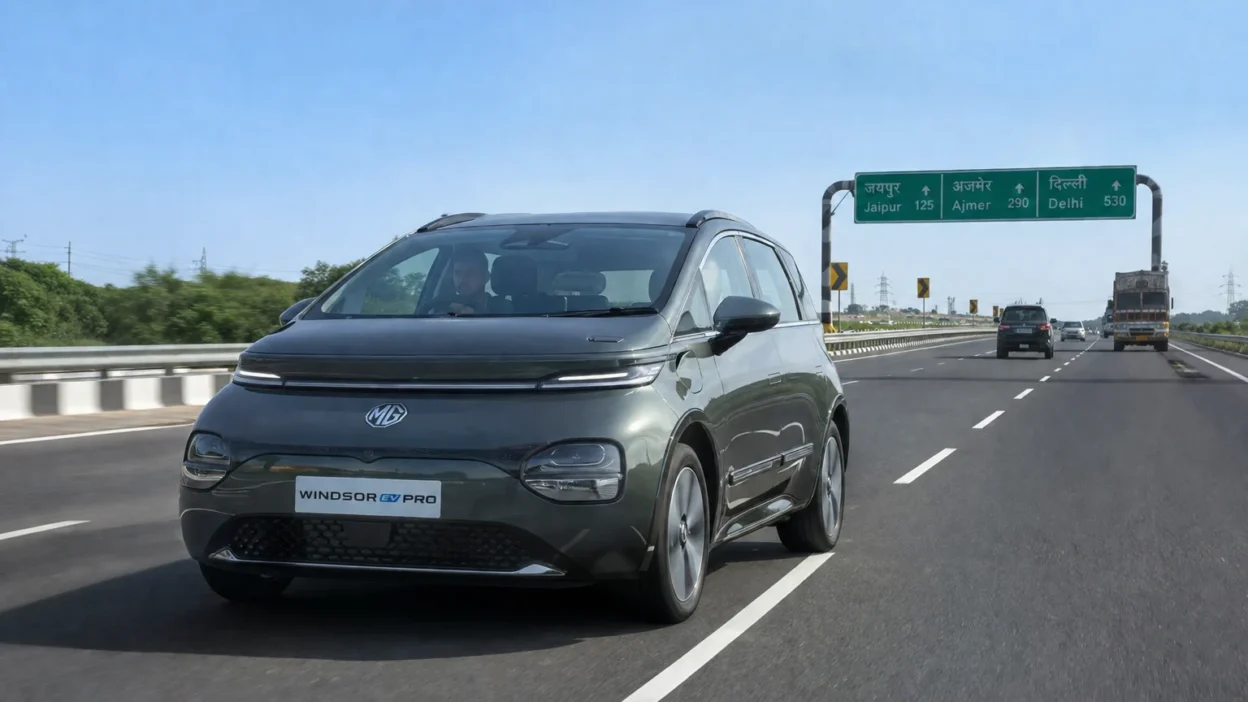
The MG Windsor EV Pro’s claimed 449 km range on the 52.9 kWh battery sounds like enough to comfortably handle most Indian intercity drives without a charging stop. But if you’ve spent any time in EV owner forums, you already know that highway driving tends to be where claimed range figures come apart fastest — and the Windsor Pro is no exception. This review breaks down what the larger battery variant actually delivers at sustained highway speeds, how that compares to city driving, and what’s realistic to expect if you’re planning to use this car for genuine long-distance trips across Indian roads.
MG Windsor EV Pro: The 52.9 kWh Battery Variant Explained
The Windsor Pro sits above the standard Windsor EV, which uses a smaller 38 kWh pack rated at 332 km MIDC range. The Pro variant swaps in a considerably larger 52.9 kWh battery, pushing the ARAI-claimed range up to 449 km — a jump of well over 100 km on paper.
Both battery packs use LFP (lithium iron phosphate) chemistry, but the way the cells are physically built differs meaningfully between the standard and Pro variants, which matters more for real-world performance than the headline kWh number suggests.
Prismatic Cell Density: Why the Pro Pack Behaves Differently
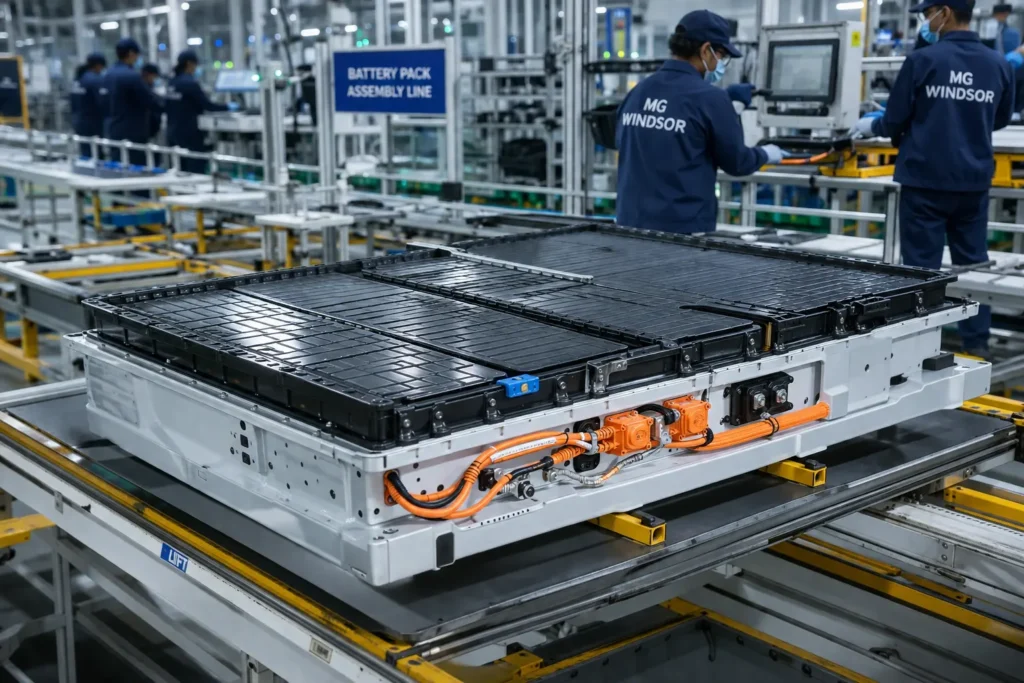
MG’s Windsor Pro battery uses prismatic cells rather than the cylindrical cell format found in some rival EVs. Prismatic cells are rectangular, which allows them to be packed more tightly within the same physical footprint, and manufacturers generally cite three advantages of this format: higher energy density per unit of space, more efficient use of the available underfloor volume, and comparatively better thermal management due to the flatter cell geometry allowing more even heat distribution.
MG’s own Halol battery assembly facility builds the Windsor Pro pack using 98 individual LFP cells per unit, compared with 36 cells in the smaller battery used for MG’s Comet EV. The finished 52.9 kWh pack weighs close to 300 kg, and the density gains from the prismatic format are part of how MG fit a 39% larger battery into the Windsor without dramatically altering the car’s underfloor packaging or ground clearance.
In practical terms, this cell architecture is one reason the Windsor Pro’s efficiency figures hold up reasonably well in mixed driving, even though — as covered below — highway speeds still take a noticeable bite out of range.
High-Speed Efficiency Drops: What Highway Testing Actually Shows
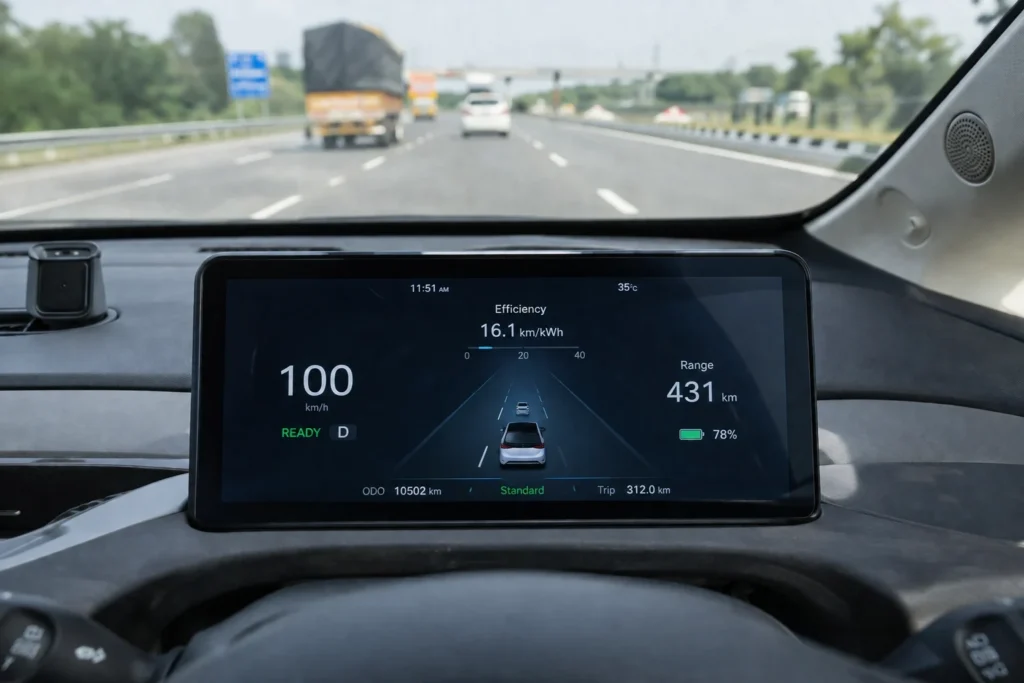
This is the section most buyers considering the Windsor Pro for longer trips actually care about, so here’s what independent testing has shown so far.
Preliminary real-world testing of the Windsor Pro recorded an efficiency of approximately 7.13 km/kWh, which translates to a practical range of around 377 km on a full charge — a meaningful drop from the 449 km ARAI figure, though still a substantial improvement over the smaller battery variant’s real-world numbers.
For context, the standard 38 kWh Windsor (not the Pro) has been more extensively tested, and the pattern it shows is instructive for what to expect from the Pro at sustained highway speeds too:
- City driving in Eco+ mode returned roughly 8.6 km/kWh
- Highway driving in Eco mode dropped to roughly 7.6 km/kWh
- Combined average across both settings came out to 8.1 km/kWh, translating to a real-world range close to 308 km — only about 24 km short of the claimed ARAI figure, which is a tighter gap than many rivals manage
- Switching to ‘Normal’ drive mode under mixed conditions dropped efficiency more sharply, down to around 6 km/kWh, cutting real-world range to approximately 230 km
The consistent theme across both battery variants is that highway speeds reduce efficiency compared to city driving, primarily due to aerodynamic drag increasing sharply at higher, sustained speeds — a physics constraint that affects every EV, not just the Windsor. Independent service data has also flagged a more specific concern: earlier production batches of the Windsor Pro showed range drops of roughly 15–25% at sustained highway speeds when combined with cold weather or heavy air conditioning use. This issue has reportedly been addressed in newer production batches through OTA software updates and manufacturing changes, but it’s worth being aware of if you’re looking at an earlier build.
City vs Highway: Where the Windsor Pro Actually Loses Range
Breaking this down by scenario:
City driving benefits from frequent regenerative braking opportunities during stop-start traffic, and the Windsor’s most efficient drive modes (Eco+ and Eco) are specifically tuned to maximise this. This is where both Windsor variants post their best efficiency figures.
Highway driving at sustained speeds above roughly 80–100 km/h faces two compounding factors: aerodynamic drag rises sharply with speed, and there’s less opportunity for regenerative braking to claw energy back, since highway driving involves fewer deceleration events than city traffic.
Combined mixed driving — a realistic blend of both — tends to land closer to the low-to-mid 300s km range for the Pro variant based on currently available testing, rather than the 449 km claimed figure.
If your typical usage is a mix of city commuting with occasional 150–200 km highway trips, the Pro variant’s real-world buffer is comfortable. If you’re planning frequent, sustained highway runs of 300+ km in one stretch, it’s worth budgeting for at least one fast-charging stop rather than assuming the claimed range holds up end-to-end.
Level 2 ADAS Performance on Indian Highway Routes
The Windsor Pro is one of the more accessible EVs in India to offer Level 2 ADAS as standard, and it’s a genuinely relevant feature for highway driving specifically, since that’s where adaptive systems tend to add the most value.
The system bundles 12 individual functions, including:
- Adaptive cruise control
- Lane departure warning and lane-keep assistance
- Automatic emergency braking (AEB)
- Intelligent headlamp control
On paper, this puts the Windsor Pro’s safety suite ahead of most vehicles in its price bracket. In practice, Indian highway conditions present a genuinely different challenge than the road environments these systems are typically calibrated for — inconsistent lane markings, mixed-speed traffic including two-wheelers and slower vehicles sharing the same lane, and construction zones that appear without much warning. Adaptive cruise control and lane-keep systems generally perform best on well-marked, divided highways such as national expressways, and owners should expect more frequent manual intervention on state highways or older road stretches with faded lane markings.
None of this makes the ADAS suite less valuable — a system that meaningfully assists on 70% of a long highway drive is still a real safety benefit — but it’s worth setting expectations that Level 2 ADAS on Indian routes doesn’t always behave with textbook consistency, particularly compared to how these systems are marketed globally.
Comparison Table: Windsor Pro vs Standard Windsor Real-World Range
| Variant | Battery | ARAI-Claimed Range | Real-World Range (Reported) | Efficiency |
|---|---|---|---|---|
| Standard Windsor EV | 38 kWh | 332 km | ~308 km (combined city + highway) | ~8.1 km/kWh combined |
| Windsor EV Pro | 52.9 kWh | 449 km | ~377 km (preliminary testing) | ~7.13 km/kWh |
These figures should be treated as reference points from testing conducted under specific conditions — your own results will vary with driving mode, tyre pressure, AC usage, and ambient temperature.
Factors That Affect Windsor Pro Highway Range
- Drive mode selection — Eco+ and Eco modes consistently outperform Normal and Sport modes in efficiency testing, sometimes by a significant margin
- Regenerative braking setting — the Windsor offers Light, Normal, and Heavy regen settings; heavier regen helps more in city stop-start conditions than on steady highway cruising
- Tyre pressure — MG recommends a relatively high tyre pressure (around 36 psi) specifically to reduce rolling resistance and improve efficiency
- Air conditioning use — heavier AC load, particularly in hot weather, has a measurable impact on range, consistent with what’s been observed across the wider EV segment in India
- Sustained speed — every additional increment of steady-state speed above roughly 90–100 km/h increases aerodynamic drag disproportionately, cutting into range faster than the same speed increase would in city conditions
Tips for Maximising Real-World Highway Range
- Use Eco or Eco+ mode for sustained highway stretches rather than Normal or Sport
- Maintain manufacturer-recommended tyre pressure, checking it before any long trip
- Plan charging stops around the tested real-world range (approximately 350–380 km) rather than the claimed 449 km figure, especially for a fully loaded car
- Precondition the cabin while still charging, where possible, to reduce the initial AC draw once on the road
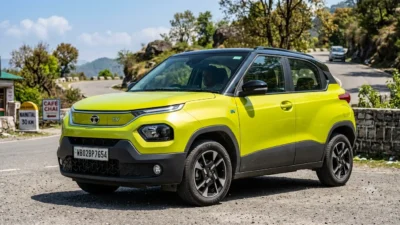
- If comparing this to other EVs you’re considering for similar long-distance use, it’s worth reading how a comparable segment vehicle performs under similar Indian conditions — this breakdown of Tata Punch EV real-world range problems in India covers many of the same claimed-vs-actual range dynamics from a different segment and price point.
Frequently Asked Questions
What is the real-world highway range of the MG Windsor EV Pro? Preliminary independent testing suggests a real-world range of approximately 377 km on the 52.9 kWh battery, against a claimed ARAI figure of 449 km, with highway-specific driving generally coming in somewhat lower than mixed or city-heavy driving.
Why does highway driving reduce EV range more than city driving? Aerodynamic drag increases sharply at higher, sustained speeds, and highway driving offers fewer opportunities for regenerative braking to recover energy compared to stop-start city traffic.
What are prismatic cells, and why does the Windsor Pro use them? Prismatic cells are rectangular battery cells that pack more tightly than cylindrical cells, offering higher energy density, better use of available space, and improved thermal management — which is part of how MG fit a significantly larger battery into the Windsor Pro.
Does cold weather or heavy AC use affect the Windsor Pro’s highway range? Yes. Independent service data has reported range drops of roughly 15–25% at sustained highway speeds in cold weather or with heavy AC use in earlier production batches, though MG has addressed this to some extent through OTA updates and manufacturing improvements in newer units.
How does the Windsor Pro’s Level 2 ADAS perform on Indian highways? It performs well on well-marked, divided highways, but Indian road conditions — inconsistent lane markings, mixed-speed traffic, and unexpected construction zones — mean the system may require more frequent manual intervention than it would on the more uniform road conditions these systems are typically calibrated for globally.
Is the Windsor Pro worth the price premium over the standard 38 kWh Windsor for highway use? If your usage includes frequent, sustained highway trips, the larger real-world range buffer (roughly 377 km versus 308 km) offers meaningfully more confidence for longer journeys, along with the added benefit of standard Level 2 ADAS.
What drive mode gives the best highway range on the Windsor Pro? Eco or Eco+ mode consistently delivers better efficiency than Normal or Sport mode in testing, though Eco+ does cap top speed lower, which may not suit all highway driving preferences.
How many fast-charging stops would a 400 km highway trip need? Based on current real-world range figures of roughly 350–380 km, most drivers would need at least one fast-charging stop to comfortably complete a 400 km highway trip with a reasonable safety margin.
Does the Windsor Pro’s battery chemistry affect long-term highway performance? LFP chemistry is generally considered stable and heat-tolerant over repeated charge cycles, which should support consistent performance over the vehicle’s lifespan, though this is based on the chemistry’s known general characteristics rather than long-term Windsor Pro-specific data, since the model is still relatively new to the Indian market.
Is the ARAI-claimed 449 km range achievable in any real-world scenario? It’s most achievable in low-speed, low-load, favourable-temperature conditions similar to lab testing — steady moderate speeds, minimal AC use, and light passenger load — which most everyday and highway driving scenarios won’t fully replicate.
Conclusion
The MG Windsor EV Pro’s 52.9 kWh battery genuinely delivers more usable range than the standard variant, and the prismatic cell architecture behind it is a meaningful part of why. But the claimed 449 km figure and the roughly 375–380 km that independent testing suggests in practice are two different numbers, and the difference shows up most clearly on sustained highway runs, where aerodynamic drag and reduced regen opportunities both work against efficiency. If you’re planning genuine long-distance highway use, plan your charging stops around the tested real-world range rather than the brochure number, and treat the Level 2 ADAS suite as a strong but imperfect assistant on Indian roads rather than a fully hands-off system.